Churlaud Guillaume, Pitoiset Fabien, Jebbawi Fadi, Lorenzon Roberta, Bellier Bertrand, Rosenzwajg Michelle, Klatzmann David
Department of Inflammation-Immunopathology-Biotherapy (I2B), Clinical Investigation Center for Biotherapies (CIC-BTi), Hôpital Pitié-Salpêtrière, Assistance Publique Hôpitaux de Paris (AP-HP) , Paris , France ; UMRS 959, Immunology-Immunopathology-Immunotherapy (I3), Sorbonne Université, Université Pierre-et-Marie-Curie, Institut national de la santé et de la recherche médicale (INSERM) , Paris , France ; FRE 3632, Immunology-Immunopathology-Immunotherapy (I3), Centre national de la recherche scientifique (CNRS) , Paris , France.
UMRS 959, Immunology-Immunopathology-Immunotherapy (I3), Sorbonne Université, Université Pierre-et-Marie-Curie, Institut national de la santé et de la recherche médicale (INSERM) , Paris , France ; FRE 3632, Immunology-Immunopathology-Immunotherapy (I3), Centre national de la recherche scientifique (CNRS) , Paris , France.
Front Immunol. 2015 Apr 15;6:171. doi: 10.3389/fimmu.2015.00171. eCollection 2015.
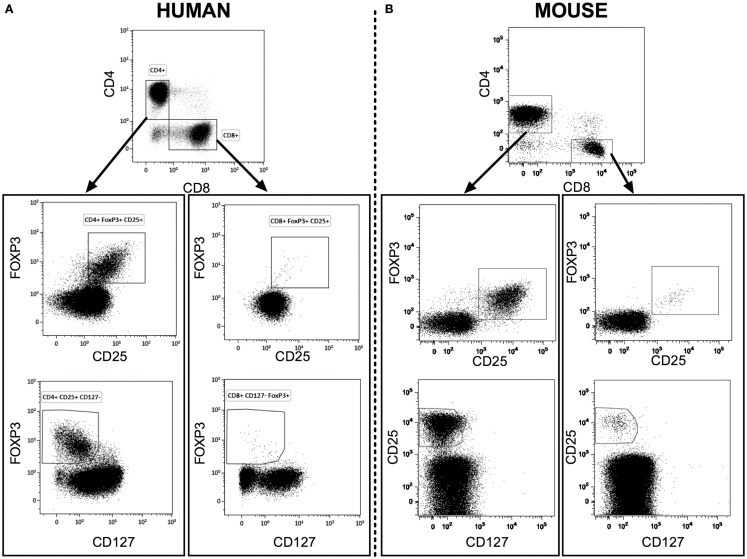
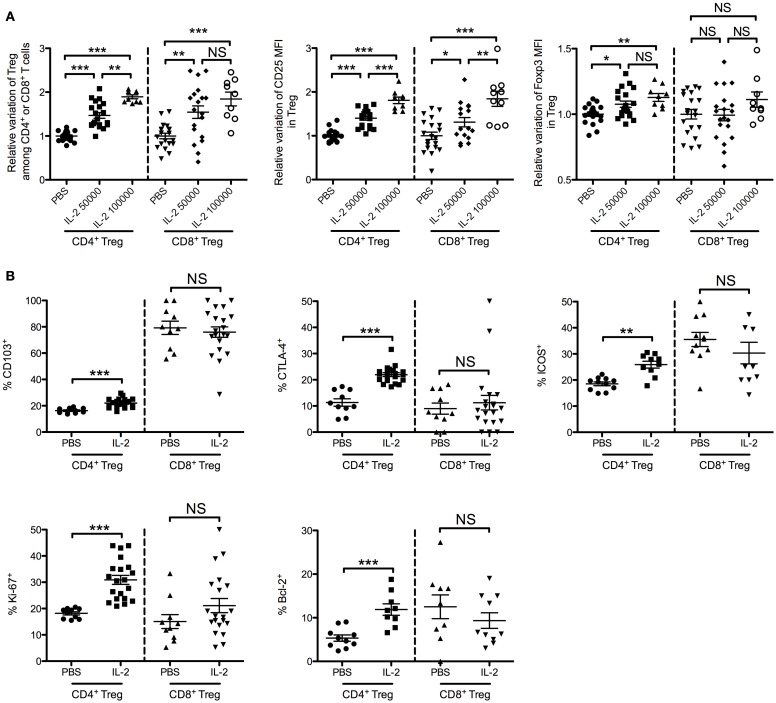
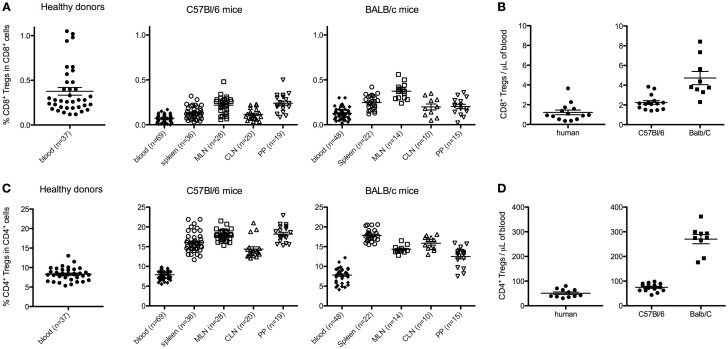
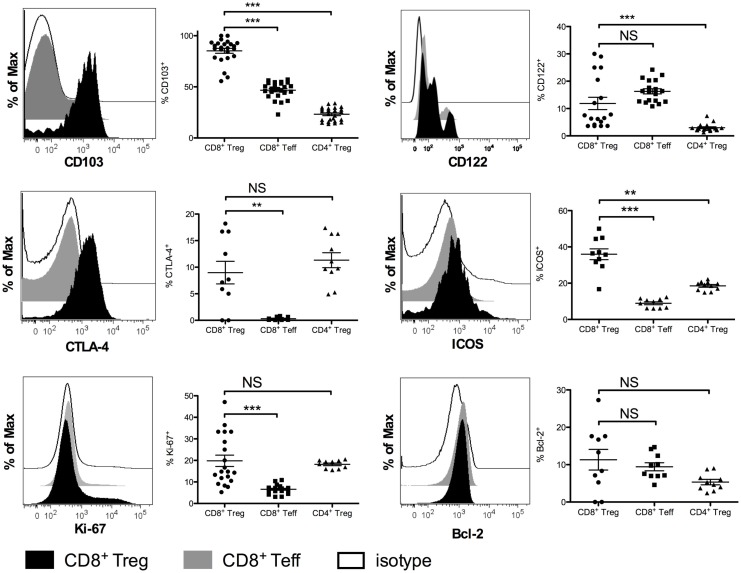
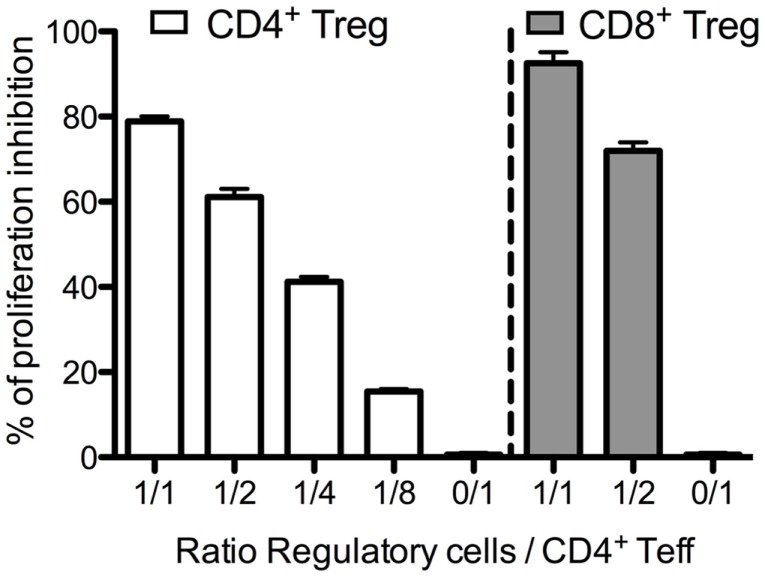
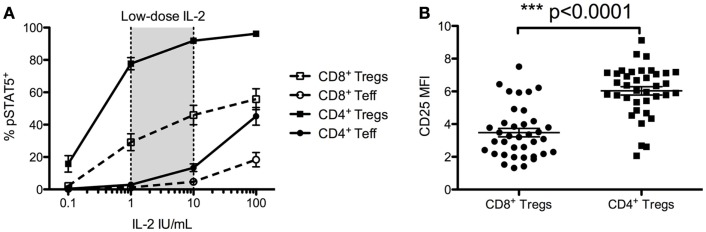
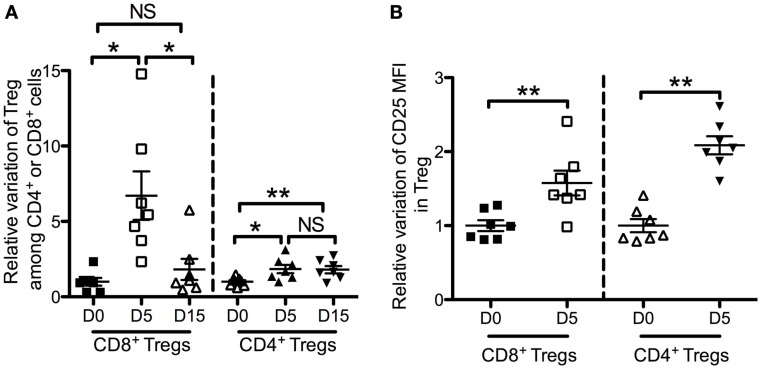
In addition to CD4(+) regulatory T cells (Tregs), CD8(+) suppressor T cells are emerging as an important subset of regulatory T cells. Diverse populations of CD8(+) T cells with suppressive activities have been described. Among them, a small population of CD8(+)CD25(+)FOXP3(+) T cells is found both in mice and humans. In contrast to thymic-derived CD4(+)CD25(+)FOXP3(+) Tregs, their origin and their role in the pathophysiology of autoimmune diseases (AIDs) are less understood. We report here the number, phenotype, and function of CD8(+) Tregs cells in mice and humans, at the steady state and in response to low-dose interleukin-2 (IL-2). CD8(+) Tregs represent approximately 0.4 and 0.1% of peripheral blood T cells in healthy humans and mice, respectively. In mice, their frequencies are quite similar in lymph nodes (LNs) and the spleen, but two to threefold higher in Peyer patches and mesenteric LNs. CD8(+) Tregs express low levels of CD127. CD8(+) Tregs express more activation or proliferation markers such as CTLA-4, ICOS, and Ki-67 than other CD8(+) T cells. In vitro, they suppress effector T cell proliferation as well as or even better than CD4(+) Tregs. Owing to constitutive expression of CD25, CD8(+) Tregs are 20- to 40-fold more sensitive to in vitro IL-2 stimulation than CD8(+) effector T cells, but 2-4 times less than CD4(+) Tregs. Nevertheless, low-dose IL-2 dramatically expands and activates CD8(+) Tregs even more than CD4(+) Tregs, in mice and humans. Further studies are warranted to fully appreciate the clinical relevance of CD8(+) Tregs in AIDs and the efficacy of IL-2 treatment.
除了CD4(+)调节性T细胞(Tregs)外,CD8(+)抑制性T细胞正逐渐成为调节性T细胞的一个重要亚群。已描述了具有抑制活性的多种CD8(+)T细胞群体。其中,在小鼠和人类中均发现了一小部分CD8(+)CD25(+)FOXP3(+)T细胞。与胸腺来源的CD4(+)CD25(+)FOXP3(+)Tregs不同,它们的起源及其在自身免疫性疾病(AIDs)病理生理学中的作用尚不太清楚。我们在此报告了小鼠和人类在稳态及对低剂量白细胞介素-2(IL-2)反应时CD8(+)Tregs细胞的数量、表型和功能。CD8(+)Tregs分别约占健康人类和小鼠外周血T细胞的0.4%和0.1%。在小鼠中,它们在淋巴结(LNs)和脾脏中的频率相当相似,但在派尔集合淋巴结和肠系膜淋巴结中高出两到三倍。CD8(+)Tregs表达低水平的CD127。与其他CD8(+)T细胞相比,CD8(+)Tregs表达更多的活化或增殖标志物,如CTLA-4、ICOS和Ki-67。在体外,它们抑制效应T细胞增殖的能力与CD4(+)Tregs相当甚至更好。由于CD25的组成性表达,CD8(+)Tregs对体外IL-2刺激的敏感性比CD8(+)效应T细胞高20至40倍,但比CD4(+)Tregs低2至4倍。然而,低剂量IL-2在小鼠和人类中能比CD4(+)Tregs更显著地扩增和激活CD8(+)Tregs。有必要进行进一步研究以充分了解CD8(+)Tregs在AIDs中的临床相关性以及IL-2治疗的疗效。