Lee Ji Hwan, Lee Taekjune, Lee Sung Chul, Lee Christopher Seungkyu
Department of Ophthalmology, Institute of Vision Research, Yonsei University College of Medicine, 134 Shinchondong, Seodaemungu, Seoul, Republic of Korea.
BMC Ophthalmol. 2015 Apr 28;15:43. doi: 10.1186/s12886-015-0029-8.
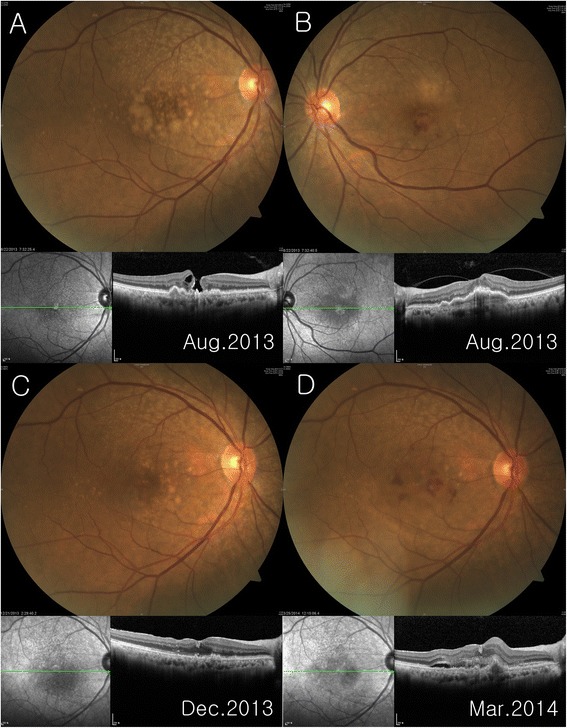
Drusen are important risk factor for neovascular age-related macular degeneration (AMD) and have a dynamic nature as they can enlarge, newly form, or disappear over time. There have been few reports on drusen regression or choroidal neovascularization (CNV) development after macular hole surgery. We report, to our knowledge, the first case of both drusen regression and subsequent CNV development within 7 months of successful macular hole surgery.
A 73-year-old woman presented with a stage 3 full-thickness macular hole and large, confluent soft macular drusen in the right eye and a neovascular age-related macular degeneration (AMD) in the fellow eye. Four months after the successful macular hole surgery, significant regression of drusen was seen, especially in the temporal area to the fovea. Three months later, the patient developed CNV and her best-corrected visual acuity decreased to 20/100, despite further regression of macular drusen.
Macular hole patients with macular soft drusen need to be carefully followed up after surgery for possible drusen regression and CNV development.
玻璃膜疣是新生血管性年龄相关性黄斑变性(AMD)的重要危险因素,并且具有动态变化的特性,因为它们可随时间增大、新形成或消失。关于黄斑裂孔手术后玻璃膜疣消退或脉络膜新生血管(CNV)形成的报道很少。据我们所知,我们报告了首例在成功进行黄斑裂孔手术后7个月内出现玻璃膜疣消退及随后发生CNV的病例。
一名73岁女性,右眼有3期全层黄斑裂孔和大的、融合性软性黄斑玻璃膜疣,对侧眼患有新生血管性年龄相关性黄斑变性(AMD)。成功进行黄斑裂孔手术后4个月,可见玻璃膜疣明显消退,尤其是在黄斑中心凹颞侧区域。3个月后,尽管黄斑玻璃膜疣进一步消退,但患者仍发生了CNV,其最佳矫正视力降至20/100。
患有黄斑软性玻璃膜疣的黄斑裂孔患者术后需要密切随访,以观察是否可能出现玻璃膜疣消退及CNV形成。