Mickiewicz Beata, Tam Patrick, Jenne Craig N, Leger Caroline, Wong Josee, Winston Brent W, Doig Christopher, Kubes Paul, Vogel Hans J
Bio-NMR-Centre, Department of Biological Sciences, University of Calgary, 2500 University Drive Northwest, Calgary, AB, T2N 1N4, Canada.
Snyder Translational Laboratory, Department of Critical Care Medicine, University of Calgary, 3280 Hospital Drive Northwest, Calgary, AB, T2N 4N1, Canada.
Crit Care. 2015 Jan 15;19(1):11. doi: 10.1186/s13054-014-0729-0.
Septic shock is a major life-threatening condition in critically ill patients and it is well known that early recognition of septic shock and expedient initiation of appropriate treatment improves patient outcome. Unfortunately, to date no single compound has shown sufficient sensitivity and specificity to be used as a routine biomarker for early diagnosis and prognosis of septic shock in the intensive care unit (ICU). Therefore, the identification of new diagnostic tools remains a priority for increasing the survival rate of ICU patients. In this study, we have evaluated whether a combined nuclear magnetic resonance spectroscopy-based metabolomics and a multiplex cytokine/chemokine profiling approach could be used for diagnosis and prognostic evaluation of septic shock patients in the ICU.
Serum and plasma samples were collected from septic shock patients and ICU controls (ICU patients with the systemic inflammatory response syndrome but not suspected of having an infection). (1)H Nuclear magnetic resonance spectra were analyzed and quantified using the targeted profiling methodology. The analysis of the inflammatory mediators was performed using human cytokine and chemokine assay kits.
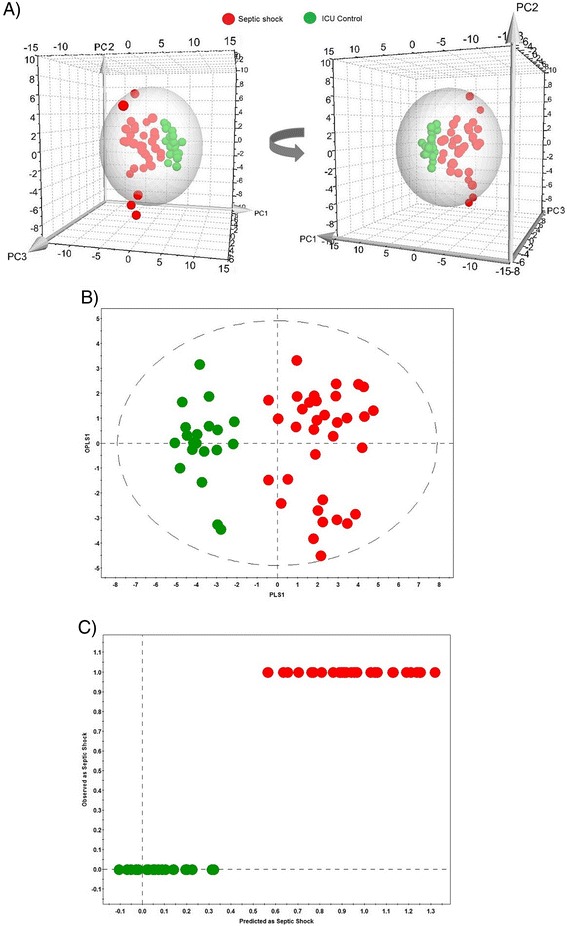
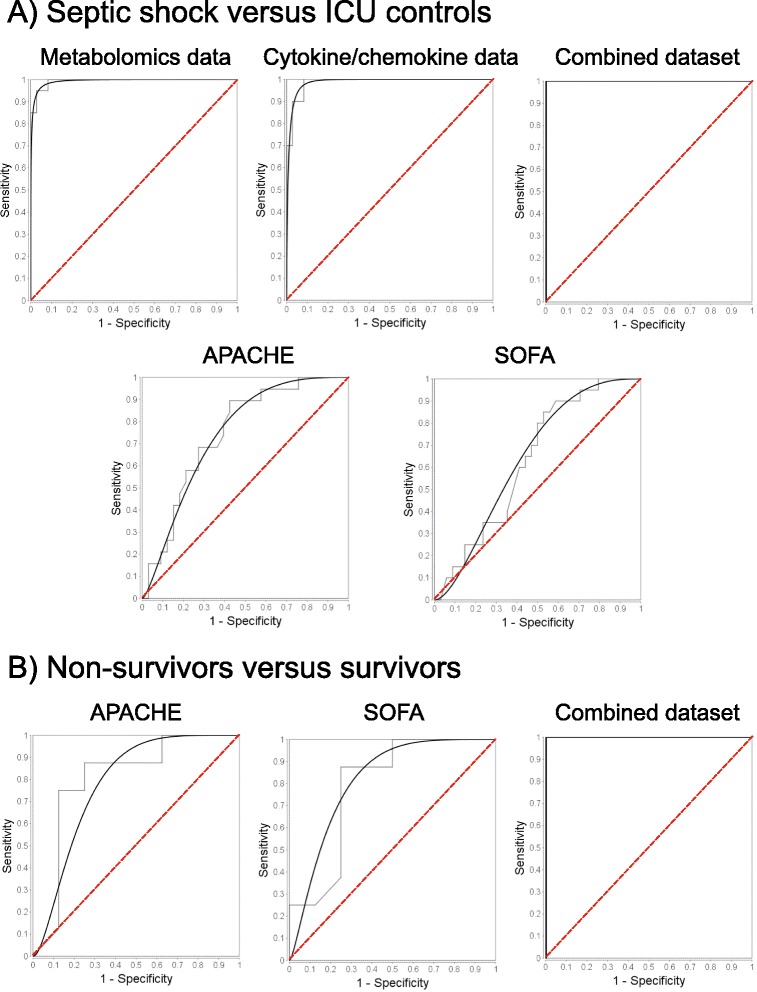
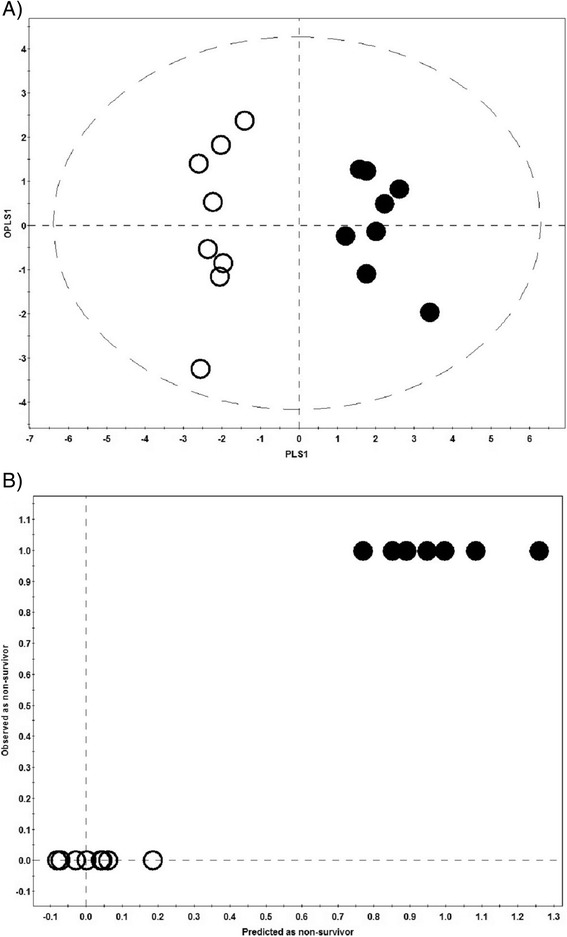
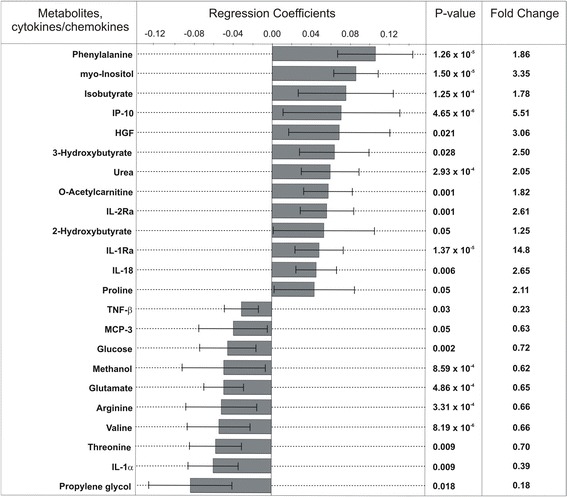
By using multivariate statistical analysis we were able to distinguish patient groups and detect specific metabolic and cytokine/chemokine patterns associated with septic shock and its mortality. These metabolites and cytokines/chemokines represent candidate biomarkers of the human response to septic shock and have the potential to improve early diagnosis and prognosis of septic shock.
Our findings show that integration of quantitative metabolic and inflammatory mediator data can be utilized for the diagnosis and prognosis of septic shock in the ICU.
脓毒性休克是危重症患者面临的一种主要的危及生命的病症,众所周知,早期识别脓毒性休克并迅速启动适当治疗可改善患者预后。不幸的是,迄今为止,尚无单一化合物表现出足够的敏感性和特异性,可作为重症监护病房(ICU)中脓毒性休克早期诊断和预后的常规生物标志物。因此,识别新的诊断工具仍然是提高ICU患者生存率的首要任务。在本研究中,我们评估了基于核磁共振波谱的代谢组学与多重细胞因子/趋化因子分析方法相结合是否可用于ICU中脓毒性休克患者的诊断和预后评估。
从脓毒性休克患者和ICU对照(患有全身炎症反应综合征但未怀疑有感染的ICU患者)中采集血清和血浆样本。使用靶向分析方法对氢核磁共振波谱进行分析和定量。使用人细胞因子和趋化因子检测试剂盒对炎症介质进行分析。
通过多变量统计分析,我们能够区分患者组,并检测与脓毒性休克及其死亡率相关的特定代谢和细胞因子/趋化因子模式。这些代谢物和细胞因子/趋化因子代表了人类对脓毒性休克反应的候选生物标志物,并且有可能改善脓毒性休克的早期诊断和预后。
我们的研究结果表明,定量代谢和炎症介质数据的整合可用于ICU中脓毒性休克的诊断和预后评估。