Chang Kuang-Hsi, Chang Mei-Yin, Muo Chih-Hsin, Wu Trong-Neng, Hwang Bing-Fang, Chen Chiu-Ying, Lin Tsung-Hsing, Kao Chia-Hung
From the Department of Public Health, China Medical University (K-HC, C-YC); Department of Medical Research, Taichung Veterans General Hospital, Taichung (K-HC); Department of Medical Laboratory Science and Biotechnology, School of Medical and Health Sciences, Fooyin University, Kaohsiung (M-YC); Management Office for Health Data, China Medical University Hospital (C-HM); Chair Professor and President, Department of Nursing, HungKuang University (T-NW); Department of Occupational Safety and Health, College of Public Health, China Medical University (B-FH); Department of Emergency, Kuang Tien General Hospital (T-HL); Graduate Institute of Clinical Medical Science, College of Medicine, China Medical University (C-HK); and Department of Nuclear Medicine and PET Center, China Medical University Hospital, Taichung, Taiwan (C-HK).
Medicine (Baltimore). 2015 May;94(17):e733. doi: 10.1097/MD.0000000000000733.
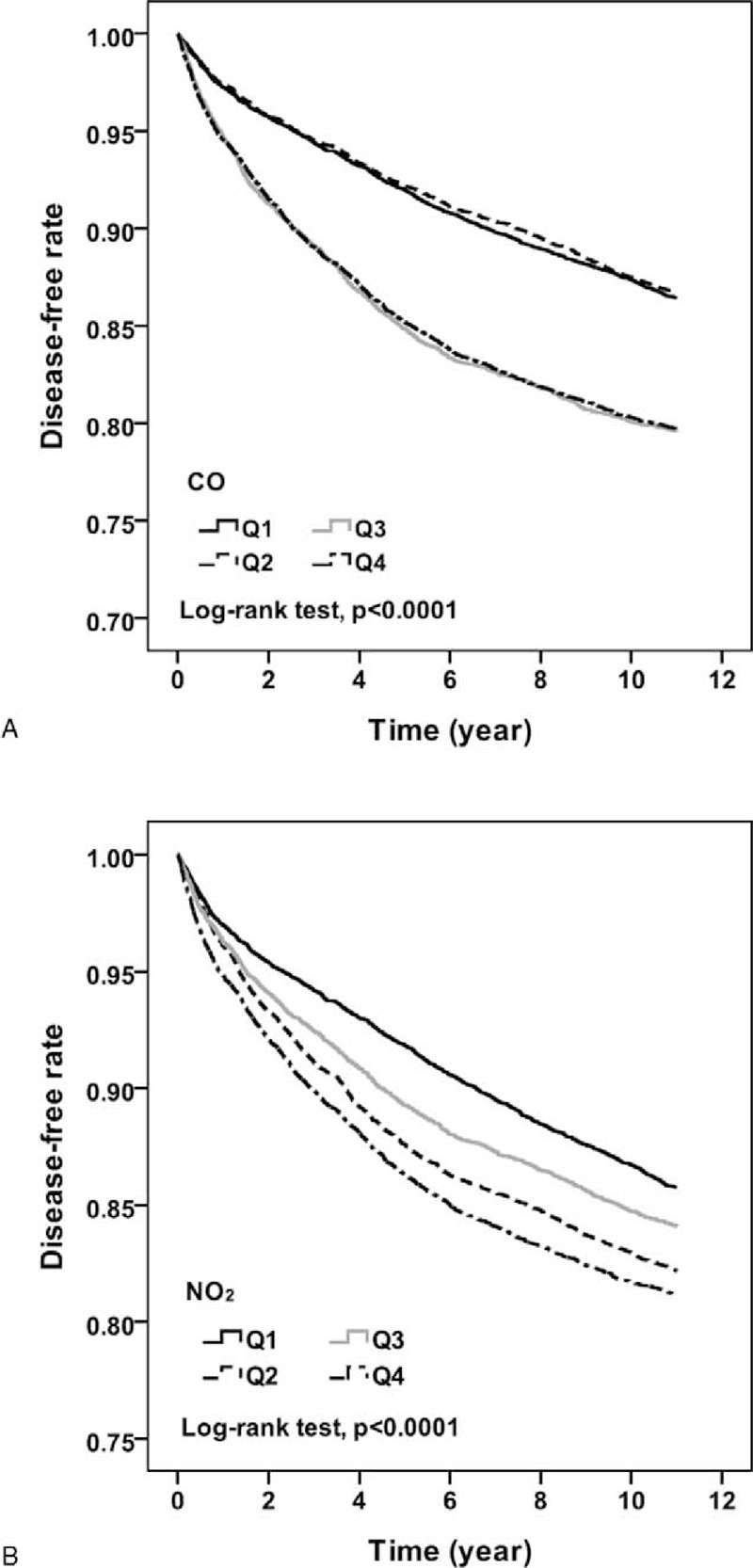
Several studies have indicated that air pollution induces systemic as well as tissue-specific inflammation. Chronic inflammatory diseases such as rheumatoid arthritis and chronic obstructive pulmonary disease reduce bone mineral density (BMD), leading to increased release of immune cells from the bone marrow. However, the association between air pollution and osteoporosis remains poorly defined. Therefore, we conducted this population-based retrospective cohort study to evaluate the risk of osteoporosis in Taiwanese residents exposed to air pollution.We combined 2 nationwide databases in this study. The National Health Insurance Research Database of Taiwan was available from 2000 to 2010. Detailed daily data on air pollution were collected by Taiwan Environmental Protection Agency (EPA) from 1998 to 2010. We calculated the yearly average concentrations of air pollutants from the study start to the date of osteoporosis occurrence, or withdrawal from the NHI program, or December 31, 2010. The yearly average concentrations of air pollutants were categorized into quartiles, and the risks of osteoporosis were evaluated among 4 stages of air pollutants.Among Q1, Q2, Q3, and Q4 of pollutants in all subjects, the adjusted hazard ratios (HRs) of osteoporosis in Q2, Q3, and Q4 were compared with Q1. For carbon monoxide (CO), the adjusted HRs were 1.05 (95% confidence interval [CI], 0.97-1.14), 1.78 (95% CI, 1.65-1.92), and 1.84 (95% CI, 1.71-1.98), respectively. For nitrogen dioxide (NO2), the adjusted HRs were 1.35 (95% CI, 1.25-1.45), 1.24 (95% CI, 1.15-1.35), and 1.60 (95% CI, 1.48-1.73), respectively, in all subjects.The findings of the present study show that CO and NO2 exposure is associated with an increased risk of osteoporosis in the Taiwanese population.
多项研究表明,空气污染会引发全身炎症以及特定组织的炎症。类风湿性关节炎和慢性阻塞性肺疾病等慢性炎症性疾病会降低骨矿物质密度(BMD),导致骨髓中免疫细胞的释放增加。然而,空气污染与骨质疏松症之间的关联仍不明确。因此,我们开展了这项基于人群的回顾性队列研究,以评估台湾地区暴露于空气污染中的居民患骨质疏松症的风险。
在本研究中,我们合并了两个全国性数据库。台湾地区国民健康保险研究数据库涵盖2000年至2010年的数据。台湾环境保护局(EPA)在1998年至2010年期间收集了详细的每日空气污染数据。我们计算了从研究开始到骨质疏松症发生之日、退出国民健康保险计划之日或2010年12月31日期间空气污染物的年平均浓度。空气污染物的年平均浓度被分为四分位数,并在空气污染物的四个阶段评估骨质疏松症的风险。
在所有受试者污染物的第一四分位数(Q1)、第二四分位数(Q2)、第三四分位数(Q3)和第四四分位数(Q4)中,将Q2、Q3和Q4中骨质疏松症的校正风险比(HRs)与Q1进行比较。对于一氧化碳(CO),校正后的HRs分别为1.05(95%置信区间[CI],0.97 - 1.14)、1.78(95%CI,1.65 - 1.92)和1.84(95%CI,1.71 - 1.98)。对于二氧化氮(NO2),在所有受试者中,校正后的HRs分别为1.35(95%CI,1.25 - 1.45)、1.24(95%CI,1.15 - 1.35)和1.60(95%CI,1.48 - 1.73)。
本研究结果表明,台湾人群中暴露于CO和NO2与患骨质疏松症的风险增加有关。