Department of Family Medicine, Konkuk University Medical Center, Konkuk University School of Medicine, Seoul, South Korea.
Department of Family Medicine, Konkuk University Medical Center, Chungju Hospital, Konkuk University School of Medicine, Chungju, South Korea.
BMC Public Health. 2021 Oct 6;21(1):1794. doi: 10.1186/s12889-021-11866-7.
This study investigated the associations between exposure to ambient air pollutants and the incidence of osteoporosis using the Korean National Insurance Service-National Sample Cohort.
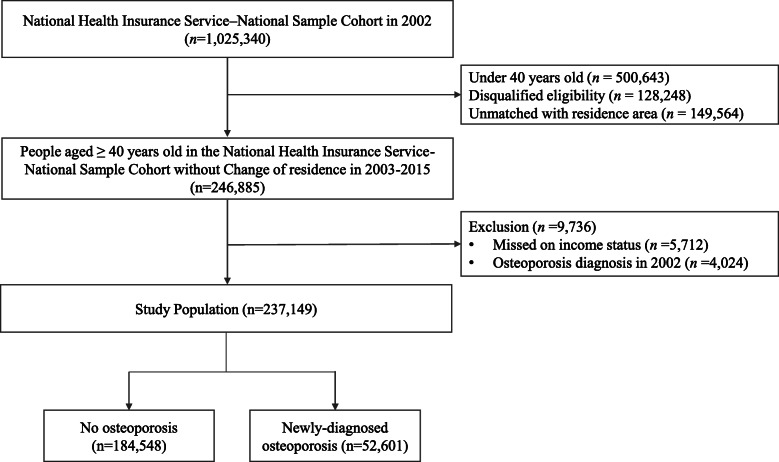
This nationwide, population-based, retrospective cohort study included 237,149 adults aged ≥40 years that did not have a diagnosis of osteoporosis at baseline between January 1, 2003, and December 31, 2015. Osteoporosis was defined as claim codes and prescriptions of bisphosphonates or selective estrogen receptor modulators at least twice annually. After matching values for PM, NO, CO, and SO during the 2002-2015 time period and PM in 2015 with residential areas, the incidence of osteoporosis was analyzed using a Cox proportional hazards regression model according to the quartile of average yearly concentrations of pollutants.
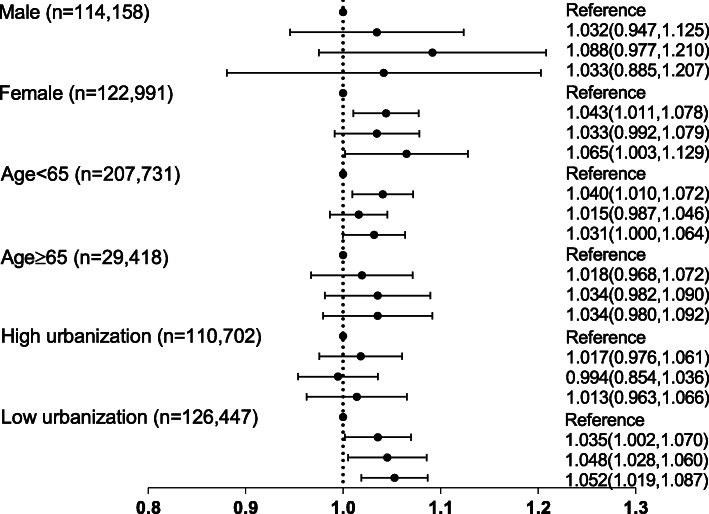
Overall 22.2% of the study subjects, 52,601 (male: 5.6%, female: 37.6%) adults in total, were newly diagnosed with osteoporosis and treated. Exposure to PM was positively associated with incidence of osteoporosis (Q4: 1798 per 100,000 person-years vs. Q1: 1655 per 100,000 person-years). The adjusted hazard ratio (HR) with 95% confidence interval (CI) of Q4 in PM was 1.034 (1.009-1.062). The effect of PM on osteoporosis incidence was distinct in females (adjusted sub-HR: 1.065, 95% CI: 1.003-1.129), subjects aged < 65 years (adjusted sub-HR: 1.040, 95% CI: 1.010-1.072), and for residents in areas with low urbanization (adjusted sub-HR: 1.052, 95% CI: 1.019-1.087). However, there was no increase in osteoporosis based on exposure to NO, CO, SO, or PM.
Long-term exposure to PM was associated with newly diagnosed osteoporosis in Korean adults aged ≥40 years. This finding can aid in policy-making that is directed to control air pollution as a risk factor for bone health.
本研究利用韩国国民健康保险服务-国家抽样队列调查了环境空气污染物暴露与骨质疏松症发病之间的关联。
本研究为全国性、基于人群的回顾性队列研究,纳入了 2003 年 1 月 1 日至 2015 年 12 月 31 日期间基线时无骨质疏松症诊断的 237149 名年龄≥40 岁的成年人。骨质疏松症的定义是每年至少两次服用双膦酸盐或选择性雌激素受体调节剂的处方代码和药物。根据污染物平均年浓度的四分位距和 2015 年 PM 的四分位距,将 2002-2015 年期间的 PM、NO、CO 和 SO 的居住区域进行匹配后,采用 Cox 比例风险回归模型分析骨质疏松症的发病率。
总体而言,22.2%的研究对象(男性:5.6%,女性:37.6%)共 52601 名成年人被新诊断为骨质疏松症并接受治疗。PM 暴露与骨质疏松症发病呈正相关(Q4:每 10 万人年 1798 例 vs. Q1:每 10 万人年 1655 例)。PM 四分位 Q4 的调整后危害比(HR)及其 95%置信区间(CI)为 1.034(1.009-1.062)。PM 对骨质疏松症发病率的影响在女性中更为显著(调整后的亚 HR:1.065,95%CI:1.003-1.129),年龄<65 岁的受试者(调整后的亚 HR:1.040,95%CI:1.010-1.072)和城市化程度较低地区的居民(调整后的亚 HR:1.052,95%CI:1.019-1.087)。然而,NO、CO、SO 和 PM 暴露均未导致骨质疏松症发病增加。
长期暴露于 PM 与韩国≥40 岁成年人新诊断的骨质疏松症有关。这一发现有助于制定政策,将空气污染作为骨骼健康的危险因素进行控制。