Salari Reza, Murlidaran Sruthi, Brannigan Grace
Center for Computational and Integrative Biology, Rutgers University, Camden, NJ ; Department of Physics, Rutgers University, Camden, NJ.
Center for Computational and Integrative Biology, Rutgers University, Camden, NJ.
Mol Simul. 2014 Apr 17;40(10-11):821-829. doi: 10.1080/08927022.2014.896462.
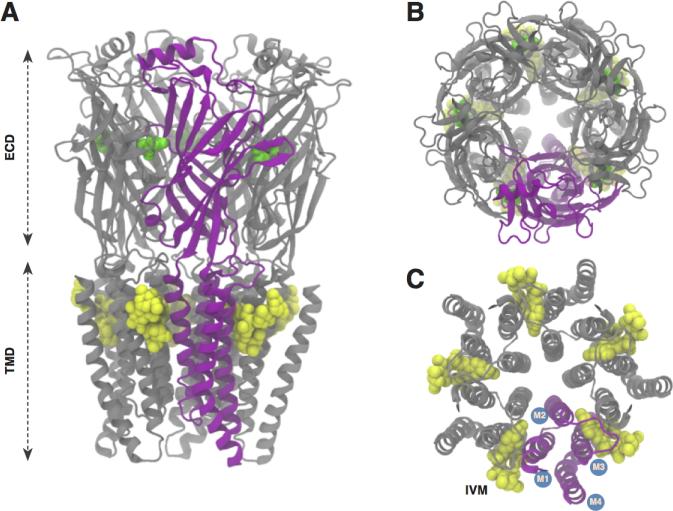
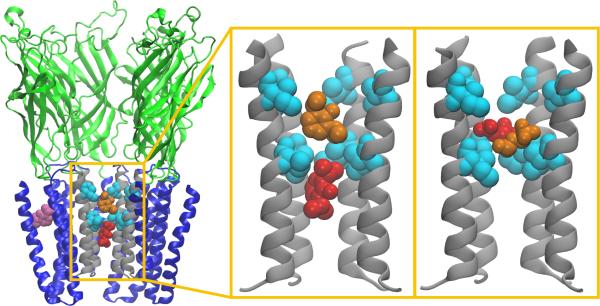
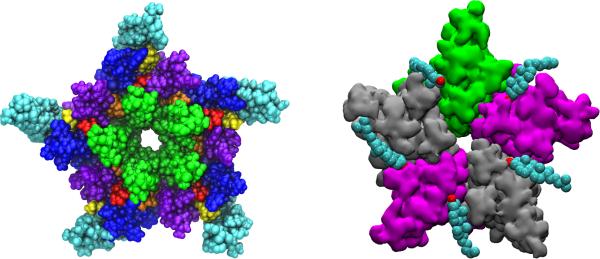
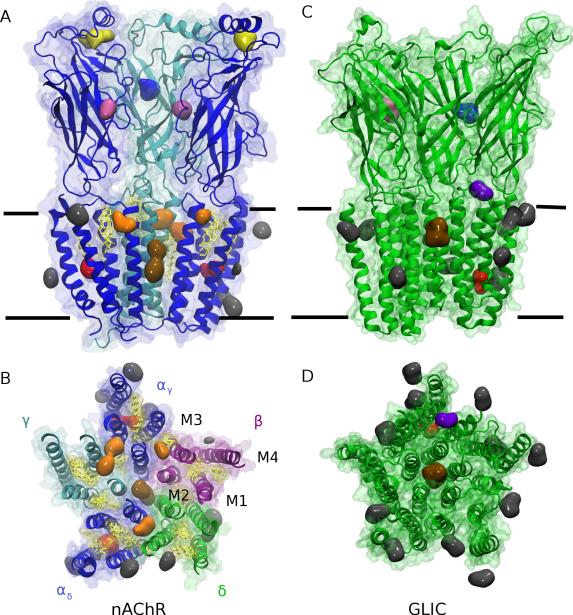
Pentameric ligand-gated ion channels (pLGICs) conduct upon the binding of an agonist and are fundamental to neurotransmission. New insights into the complex mechanisms underlying pLGIC gating, ion selectivity, and modulation have recently been gained via a series of crystal structures in prokaryotes and , as well as computational studies relying on these structures. Here we review contributions from a variety of computational approaches, including normal mode analysis, automated docking, and fully atomistic molecular dynamics simulation. Examples from our own research, particularly concerning interactions with general anesthetics and lipids, are used to illustrate predictive results complementary to crystallographic studies.
五聚体配体门控离子通道(pLGICs)在激动剂结合时传导离子,是神经传递的基础。最近,通过一系列原核生物的晶体结构以及基于这些结构的计算研究,人们对pLGIC门控、离子选择性和调节的复杂机制有了新的认识。在这里,我们回顾了各种计算方法的贡献,包括正常模式分析、自动对接和全原子分子动力学模拟。我们自己研究中的例子,特别是关于与全身麻醉剂和脂质相互作用的例子,用于说明与晶体学研究互补的预测结果。