Jia YanXiao, Yuan Yang, Zhang Yanchun, Yang Sihai, Zhang Xiaohui
State Key Laboratory of Pharmaceutical Biotechnology, School of Life Sciences, Nanjing University, 210023, Nanjing, China.
BMC Genet. 2015 May 3;16:48. doi: 10.1186/s12863-015-0208-x.
Nucleotide binding site leucine-rich repeats (NBS-LRR) genes encode a large class of disease resistance (R) proteins in plants. Extensive studies have been carried out to identify and investigate NBS-encoding gene families in many important plant species. However, no comprehensive research into NBS-encoding genes in the Rosaceae has been performed.
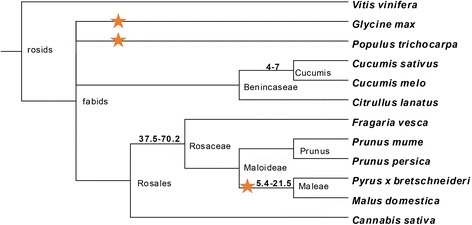
In this study, five whole-genome sequenced Rosaceae species, including apple, pear, peach, mei, and strawberry, were analyzed to investigate the evolutionary pattern of NBS-encoding genes and to compare them to those of three Cucurbitaceae species, cucumber, melon, and watermelon. Considerable differences in the copy number of NBS-encoding genes were observed between Cucurbitaceae and Rosaceae species. In Rosaceae species, a large number and a high proportion of NBS-encoding genes were observed in peach (437, 1.52%), mei (475, 1.51%), strawberry (346, 1.05%) and pear (617, 1.44%), and apple contained a whopping 1303 (2.05%) NBS-encoding genes, which might be the highest number of R-genes in all of these reported diploid plant. However, no more than 100 NBS-encoding genes were identified in Cucurbitaceae. Many more species-specific gene families were classified and detected with the signature of positive selection in Rosaceae species, especially in the apple genome.
Taken together, our findings indicate that NBS-encoding genes in Rosaceae, especially in apple, have undergone extreme expansion and rapid adaptive evolution. Useful information was provided for further research on the evolutionary mode of disease resistance genes in Rosaceae crops.
核苷酸结合位点富含亮氨酸重复序列(NBS-LRR)基因在植物中编码一大类抗病(R)蛋白。人们已经开展了大量研究来鉴定和研究许多重要植物物种中编码NBS的基因家族。然而,尚未对蔷薇科中编码NBS的基因进行全面研究。
在本研究中,分析了包括苹果、梨、桃、梅和草莓在内的5个全基因组测序的蔷薇科物种,以研究编码NBS的基因的进化模式,并将它们与3个葫芦科物种(黄瓜、甜瓜和西瓜)的进行比较。在葫芦科和蔷薇科物种之间观察到编码NBS的基因拷贝数存在显著差异。在蔷薇科物种中,桃(437个,占1.52%)、梅(475个,占1.51%)、草莓(346个,占1.05%)和梨(617个,占1.44%)中观察到大量且比例较高的编码NBS的基因,而苹果含有多达1303个(占2.05%)编码NBS的基因,这可能是所有这些已报道的二倍体植物中R基因数量最多的。然而,在葫芦科中鉴定出的编码NBS的基因不超过100个。在蔷薇科物种,特别是苹果基因组中,分类并检测到了更多的物种特异性基因家族,且具有正选择特征。
综上所述,我们的研究结果表明蔷薇科中编码NBS的基因,尤其是苹果中的,经历了极端扩张和快速适应性进化。为进一步研究蔷薇科作物抗病基因的进化模式提供了有用信息。