Centre of Pear Engineering Technology Research, State Key Laboratory of Crop Genetics and Germplasm Enhancement, Nanjing Agricultural University, Nanjing, 210095, China.
BMC Genomics. 2017 Oct 10;18(1):763. doi: 10.1186/s12864-017-4155-y.
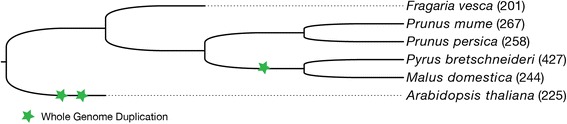
Leucine-rich repeat receptor-like protein kinase (LRR-RLK) is the largest gene family of receptor-like protein kinases (RLKs) and actively participates in regulating the growth, development, signal transduction, immunity, and stress responses of plants. However, the patterns of LRR-RLK gene family evolution in the five main Rosaceae species for which genome sequences are available have not yet been reported. In this study, we performed a comprehensive analysis of LRR-RLK genes for five Rosaceae species: Fragaria vesca (strawberry), Malus domestica (apple), Pyrus bretschneideri (Chinese white pear), Prunus mume (mei), and Prunus persica (peach), which contained 201, 244, 427, 267, and 258 LRR-RLK genes, respectively.
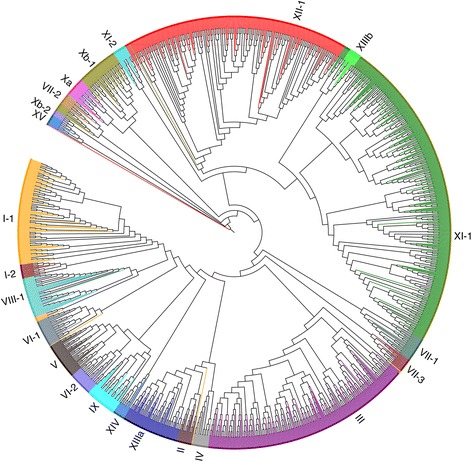
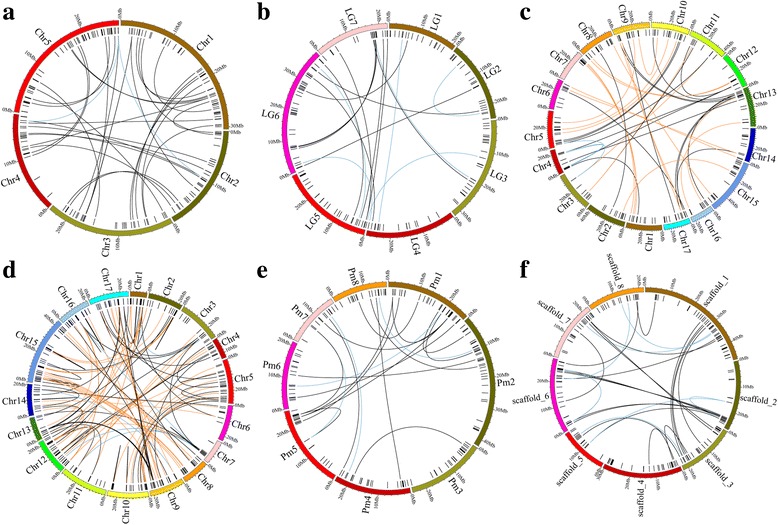
All LRR-RLK genes were further grouped into 23 subfamilies based on the hidden Markov models approach. RLK-Pelle_LRR-XII-1, RLK-Pelle_LRR-XI-1, and RLK-Pelle_LRR-III were the three largest subfamilies. Synteny analysis indicated that there were 236 tandem duplicated genes in the five Rosaceae species, among which subfamilies XII-1 (82 genes) and XI-1 (80 genes) comprised 68.6%.
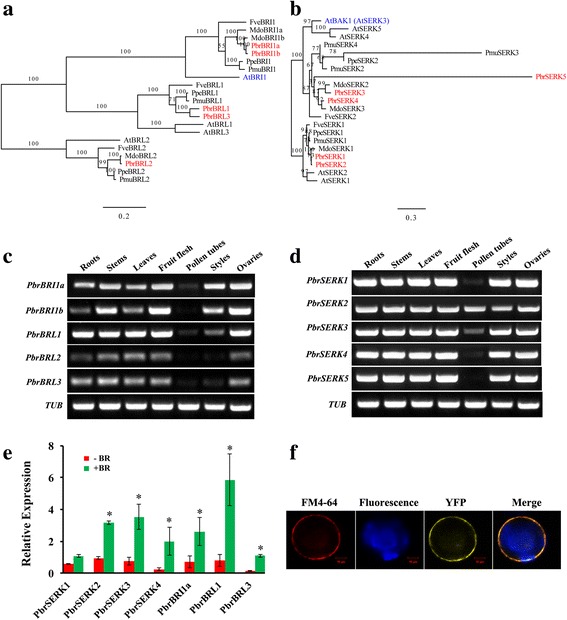
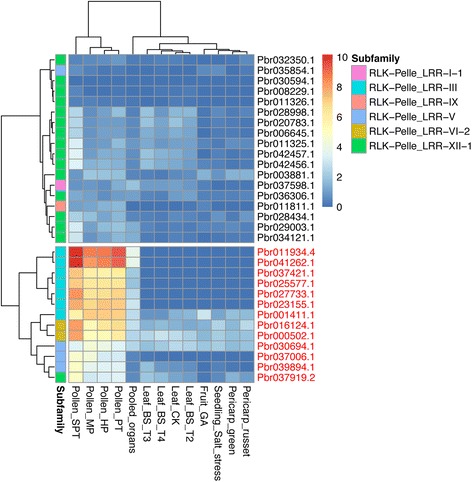
Our results indicate that tandem duplication made a large contribution to the expansion of the subfamilies. The gene expression, tissue-specific expression, and subcellular localization data revealed that LRR-RLK genes were differentially expressed in various organs and tissues, and the largest subfamily XI-1 was highly expressed in all five Rosaceae species, suggesting that LRR-RLKs play important roles in each stage of plant growth and development. Taken together, our results provide an overview of the LRR-RLK family in Rosaceae genomes and the basis for further functional studies.
富含亮氨酸重复受体样蛋白激酶(LRR-RLK)是受体样蛋白激酶(RLKs)中最大的基因家族,积极参与植物的生长、发育、信号转导、免疫和应激反应的调节。然而,对于五个具有基因组序列的主要蔷薇科物种的 LRR-RLK 基因家族进化模式尚未有报道。在这项研究中,我们对五个蔷薇科物种的 LRR-RLK 基因进行了全面分析:草莓( Fragaria vesca )、苹果( Malus domestica )、白梨( Pyrus bretschneideri )、梅花( Prunus mume )和桃( Prunus persica ),它们分别包含 201、244、427、267 和 258 个 LRR-RLK 基因。
所有的 LRR-RLK 基因进一步根据隐马尔可夫模型方法分为 23 个亚家族。RLK-Pelle_LRR-XII-1、RLK-Pelle_LRR-XI-1 和 RLK-Pelle_LRR-III 是三个最大的亚家族。共发现 236 个串联重复基因在五个蔷薇科物种中,其中亚家族 XII-1(82 个基因)和 XI-1(80 个基因)占 68.6%。
我们的结果表明,串联重复对亚家族的扩张做出了巨大贡献。基因表达、组织特异性表达和亚细胞定位数据表明,LRR-RLK 基因在不同的器官和组织中差异表达,最大的亚家族 XI-1 在五个蔷薇科物种中均高度表达,这表明 LRR-RLK 在植物生长发育的各个阶段都发挥着重要作用。总之,我们的研究结果提供了蔷薇科基因组中 LRR-RLK 家族的概述,并为进一步的功能研究奠定了基础。