Department of Medicine, Division of Cardiology, Emory University School of Medicine, Atlanta, GA USA ; Department of Epidemiology, Emory Rollins School of Public Health, Atlanta, GA USA.
Departments of Surgery and Public Health, University of Tennessee, 1914 Andy Holt Ave., HPER 390, Knoxville, TN 37996 USA.
Diabetol Metab Syndr. 2014 Nov 18;6:124. doi: 10.1186/1758-5996-6-124. eCollection 2014.
Supplemental melatonin may ameliorate metabolic syndrome (MetS) components, but data from placebo-controlled trials are lacking.
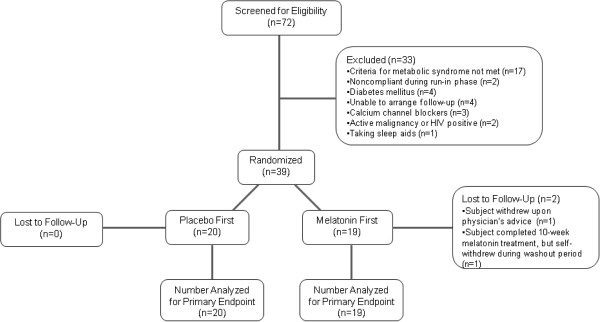
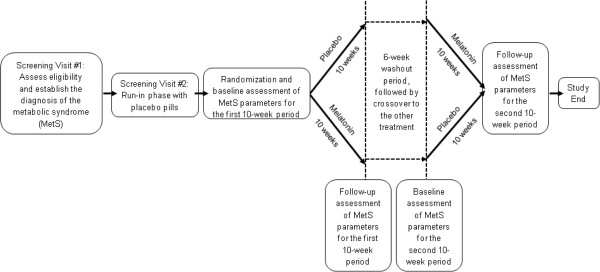
We conducted a double-blind, placebo-controlled, crossover, Phase II randomized pilot clinical trial to estimate the effects of melatonin supplementation on MetS components and the overall prevalence of MetS. We randomized 39 subjects with MetS to receive 8.0 mg oral melatonin or matching placebo nightly for 10 weeks. After a 6-week washout, subjects received the other treatment for 10 more weeks. We measured waist circumference, triglycerides, HDL cholesterol, fasting glucose, and blood pressure (BP) in each subject at the beginning and end of both 10-week treatment periods. The primary outcome was the mean 10-week change in each MetS component, and a secondary outcome was the proportion of subjects free from MetS, after melatonin versus placebo.
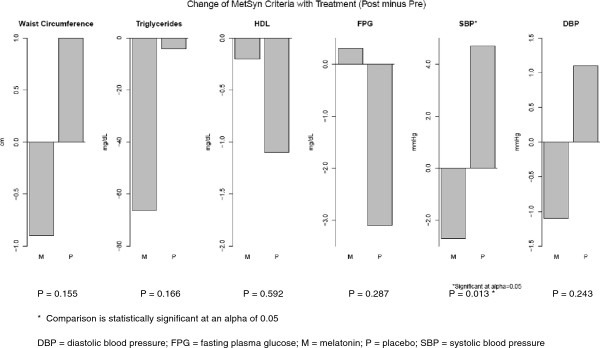
The mean 10-week change for most MetS components favored melatonin over placebo (except fasting glucose): waist circumference -0.9 vs. +1.0 cm (p = 0.15); triglycerides -66.3 vs. -4.2 mg/dL (p = 0.17); HDL cholesterol -0.2 vs. -1.1 mg/dL (p = 0.59); fasting glucose +0.3 vs. -3.1 mg/dL (p = 0.29); systolic BP -2.7 vs. +4.7 mmHg (p = 0.013); and diastolic BP -1.1 vs. +1.1 mmHg (p = 0.24). Freedom from MetS tended to be more common following melatonin versus placebo treatment (after the first 10 weeks, 35.3% vs. 15.0%, p = 0.25; after the second 10 weeks, 45.0% vs. 23.5%, p = 0.30). Melatonin was well-tolerated.
Melatonin supplementation modestly improved most individual MetS components compared with placebo, and tended to increase the proportion of subjects free from MetS after treatment.
NCT01038921, clinicaltrials.gov.
补充褪黑素可能改善代谢综合征 (MetS) 成分,但缺乏安慰剂对照试验的数据。
我们进行了一项双盲、安慰剂对照、交叉、二期随机临床试验,以评估褪黑素补充对 MetS 成分和 MetS 总体患病率的影响。我们将 39 名 MetS 患者随机分为每晚口服 8.0mg 褪黑素或匹配安慰剂,持续 10 周。6 周洗脱期后,受试者再接受另一种治疗 10 周。我们在每个受试者的两个 10 周治疗期的开始和结束时测量腰围、甘油三酯、高密度脂蛋白胆固醇、空腹血糖和血压 (BP)。主要结局是每个 MetS 成分的 10 周平均变化,次要结局是褪黑素与安慰剂相比,无 MetS 的受试者比例。
大多数 MetS 成分的 10 周平均变化有利于褪黑素治疗(除空腹血糖外):腰围-0.9 对 +1.0cm(p=0.15);甘油三酯-66.3 对 -4.2mg/dL(p=0.17);高密度脂蛋白胆固醇-0.2 对 -1.1mg/dL(p=0.59);空腹血糖+0.3 对 -3.1mg/dL(p=0.29);收缩压-2.7 对 +4.7mmHg(p=0.013);舒张压-1.1 对 +1.1mmHg(p=0.24)。与安慰剂相比,褪黑素治疗后无 MetS 的倾向更为常见(第一 10 周后,35.3%对 15.0%,p=0.25;第二 10 周后,45.0%对 23.5%,p=0.30)。褪黑素耐受性良好。
与安慰剂相比,褪黑素补充剂适度改善了大多数 MetS 成分,并且在治疗后增加了无 MetS 的受试者比例。
NCT01038921,clinicaltrials.gov。