Department of Health Promotion, School of Public Health, Sackler Faculty of Medicine, Tel Aviv University, Ramat Aviv, Israel.
International Center for Health, Law and Ethics and School of Public Health, University of Haifa, Haifa, Israel.
Isr J Health Policy Res. 2015 May 1;4:12. doi: 10.1186/s13584-015-0007-x. eCollection 2015.
Tobacco is the only consumer product known to kill half of its users, and is a significant cause of death and disability to exposed nonsmokers. This presents a unique conundrum for modern democracies, which emphasize personal liberty, yet are obligated to protect citizens. In Israel, the death toll in 2014 from smoking is expected to reach 8000 deaths; nearly a fifth of the population smokes, and over two-thirds of the population are exposed to tobacco smoke.
This paper provides an overview of tobacco policy in Israel since the inception of the State, presents the development of the National Tobacco Control Plan, and recommends future actions.
Sources for this article included the Knesset (Israeli Parliament) and Ministry of Health websites, Health Minister Reports to the Knesset on Smoking, and the scientific literature.
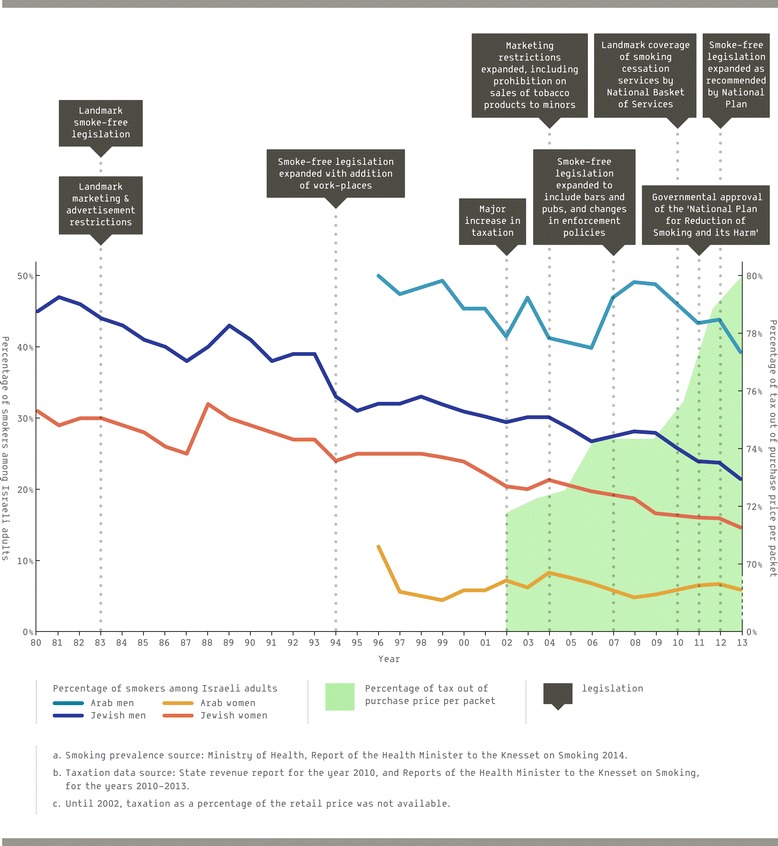
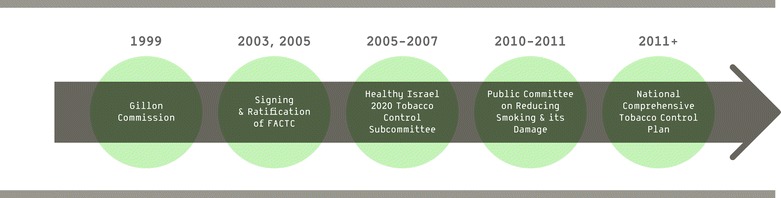
Israel has an impressive record on tobacco control policy, beginning with taxation in 1952, landmark smoke-free air and marketing legislation in the early 1980's, tax increases and expansions of smoke-free air and marketing legislation in the ensuing years, and the addition of subsidized smoking cessation technologies in 2010. Until 2011, actions were taken by various organizations without formal coordination; since the passage of the National Tobacco Control Plan in 2011, the Ministry of Health has held responsibility for coordinating tobacco control, with an action plan. The plan has been partially implemented. Smoke-free air laws were expanded, but enforcement is poor. Passage of critical marketing and advertising restrictions is stalled. Requested funds for tobacco control did not materialize.
In order to prevent hundreds of thousands of preventable premature deaths in the coming decades, Israel should considerably strengthen tobacco control policies to include: guaranteed funding for tobacco control; strong curbs on advertising, promotion and sponsorship of tobacco and smoking products; public education; law enforcement; protection of children from exposure to tobacco; regulation of electronic cigarettes and other alternative harm-reducing products; tobacco control research; and systematic monitoring of, and periodic updates to, the National Tobacco Control Plan. Israel should also begin discussions of Endgame scenarios, and consider abolition of tobacco, as it continues its progress towards making smoking history.
烟草是唯一已知的会导致半数使用者死亡的消费品,也是导致非吸烟者死亡和残疾的主要原因。这对现代民主国家构成了一个独特的难题,因为这些国家强调个人自由,但又有义务保护公民。在以色列,2014 年因吸烟导致的死亡人数预计将达到 8000 人;近五分之一的人口吸烟,超过三分之二的人口暴露于烟草烟雾中。
本文概述了以色列自建国以来的烟草政策,介绍了国家烟草控制计划的发展,并提出了未来的行动建议。
本文的资料来源包括以色列议会和卫生部的网站、卫生部长向议会提交的关于吸烟问题的报告,以及科学文献。
以色列在烟草控制政策方面有着令人印象深刻的记录,最早可追溯至 1952 年的税收政策,20 世纪 80 年代初的具有里程碑意义的无烟空气和市场营销立法,随后几年的税收增加和无烟空气及市场营销立法的扩大,以及 2010 年增加了补贴性戒烟技术。2011 年之前,各项行动都是由各个组织在没有正式协调的情况下进行的;自 2011 年通过国家烟草控制计划以来,卫生部一直负责协调烟草控制工作,并制定了行动计划。该计划已部分实施。无烟空气法得到了扩大,但执行情况不佳。关键的营销和广告限制的通过陷入僵局。用于烟草控制的请求资金没有实现。
为了防止未来几十年数十万例可预防的早逝,以色列应大力加强烟草控制政策,包括:为烟草控制提供有保障的资金;严格限制烟草和吸烟产品的广告、促销和赞助;开展公众教育;加强执法;保护儿童免受烟草的侵害;规范电子烟和其他减少危害的替代产品;开展烟草控制研究;以及对国家烟草控制计划进行系统监测和定期更新。以色列还应开始讨论终结场景,并考虑像其他国家一样彻底取缔烟草,以使其继续走向禁烟的历史进程。