Ng Sophia, Gordon Aubree
Department of Epidemiology, School of Public Health, University of Michigan, 1415 Washington Heights, Ann Arbor, MI 48109 USA.
Curr Epidemiol Rep. 2015;2(2):89-100. doi: 10.1007/s40471-015-0038-4.
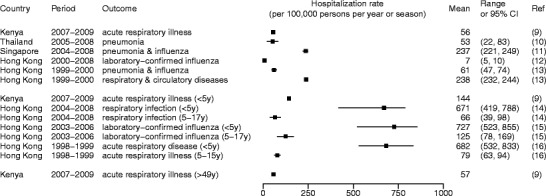
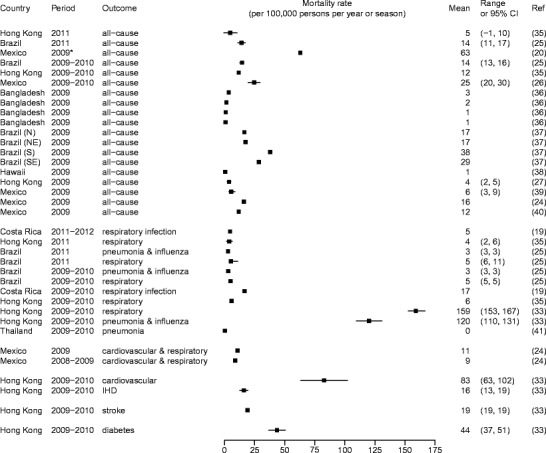
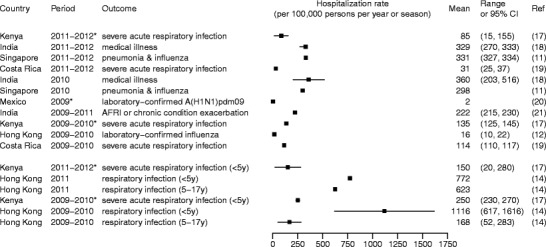
Each year, influenza causes substantial mortality and morbidity worldwide. It is important to understand influenza in the tropics because of the significant burden in the region and its relevance to global influenza circulation. In this review, influenza burden, transmission dynamics, and their determinants in the tropics are discussed. Environmental, cultural, and social conditions in the tropics are very diverse and often differ from those of temperate regions. Theories that account for and predict influenza dynamics in temperate regions do not fully explain influenza epidemic patterns observed in the tropics. Routine surveillance and household studies have been useful in understanding influenza dynamics in the tropics, but these studies have been limited to only some regions; there is still a lack of information regarding influenza burden and transmission dynamics in many tropical countries. Further studies in the tropics will provide useful insight on many questions that remain.
每年,流感在全球范围内导致大量死亡和发病。了解热带地区的流感情况很重要,因为该地区负担沉重且与全球流感传播相关。在这篇综述中,将讨论热带地区的流感负担、传播动态及其决定因素。热带地区的环境、文化和社会状况非常多样,且往往与温带地区不同。解释和预测温带地区流感动态的理论并不能完全解释在热带地区观察到的流感流行模式。常规监测和家庭研究有助于了解热带地区的流感动态,但这些研究仅局限于部分地区;许多热带国家仍缺乏有关流感负担和传播动态的信息。在热带地区开展进一步研究将为许多尚存的问题提供有益见解。