Knipstein Brittany, Huang Jiansheng, Barr Emily, Sossenheimer Philip, Dietzen Dennis, Egner Patricia A, Groopman John D, Rudnick David A
Department of Pediatrics, Washington University School of Medicine, St. Louis, Missouri.
Department of Environmental Health Sciences, Johns Hopkins Bloomberg School of Public Health, Baltimore, Maryland.
Pediatr Res. 2015 Aug;78(2):120-7. doi: 10.1038/pr.2015.84. Epub 2015 May 4.
Despite a strong statistical correlation between dietary aflatoxin B1 (AFB1)-exposure and childhood stunting, the causal mechanism remains speculative. This issue is important because of emerging interest in reduction of human aflatoxin exposure to diminish the prevalence and complications of stunting. Pediatric liver diseases cause growth impairment, and AFB1 is hepatotoxic. Thus, liver injury might mediate AFB1-associated growth impairment. We have developed a rat model of dietary AFB1-induced stunting to investigate these questions.
Newly-weaned rats were given AFB1-supplemented- or control-diets from age 3-9 wk, and then euthanized for serum- and tissue-collection. Food intake and weight were serially assessed, with tibial-length determined at the experimental endpoint. Serum AFB1-adducts, hepatic gene and protein expression, and liver injury markers were quantified using established methodologies.
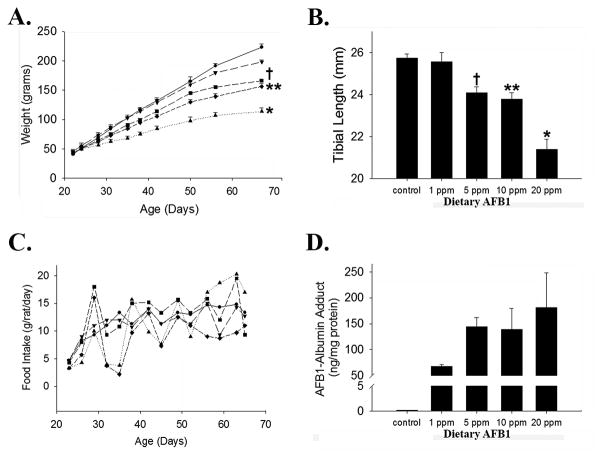
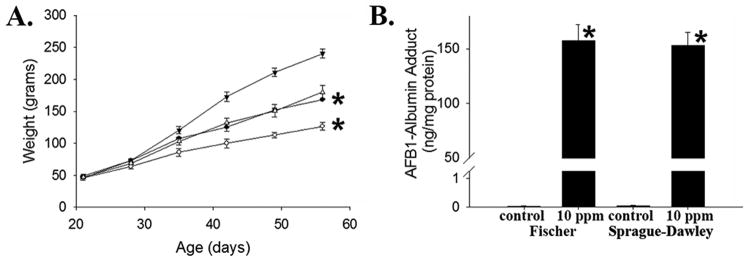
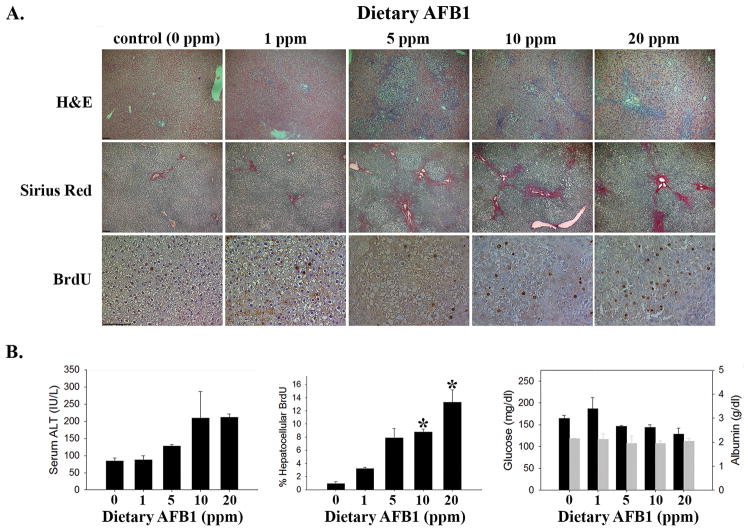
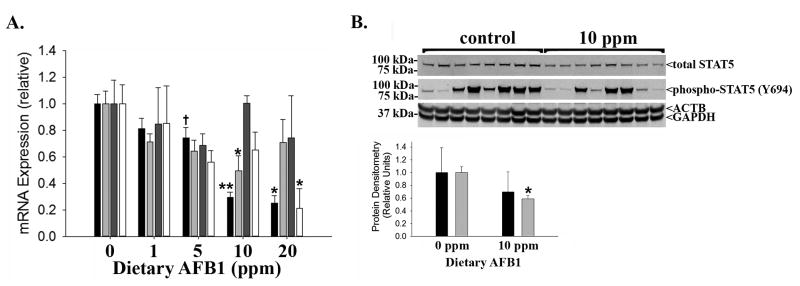
AFB1-albumin adducts correlated with dietary toxin contamination, but such contamination did not affect food consumption. AFB1-exposed animals exhibited dose-dependent wasting and stunting, liver pathology, and suppression of hepatic targets of growth hormone (GH) signaling, but did not display increased mortality.
These data establish toxin-dependent liver injury and hepatic GH-resistance as candidate mechanisms by which AFB1-exposure causes growth impairment in this mammalian model. Interrogation of modifiers of stunting using this model could guide interventions in at-risk and affected children.
尽管膳食黄曲霉毒素B1(AFB1)暴露与儿童发育迟缓之间存在很强的统计学相关性,但其因果机制仍具有推测性。由于人们越来越关注减少人类黄曲霉毒素暴露以降低发育迟缓的患病率和并发症,这个问题变得很重要。儿科肝脏疾病会导致生长发育受损,而AFB1具有肝毒性。因此,肝损伤可能介导了AFB1相关的生长发育受损。我们建立了一个膳食AFB1诱导发育迟缓的大鼠模型来研究这些问题。
将刚断奶的大鼠从3至9周龄开始给予补充AFB1的饲料或对照饲料,然后实施安乐死以收集血清和组织。连续评估食物摄入量和体重,并在实验终点测定胫骨长度。使用既定方法对血清AFB1加合物、肝脏基因和蛋白质表达以及肝损伤标志物进行定量分析。
AFB1-白蛋白加合物与膳食毒素污染相关,但这种污染不影响食物消耗。暴露于AFB1的动物表现出剂量依赖性的消瘦和发育迟缓、肝脏病理学变化以及生长激素(GH)信号传导的肝脏靶点受到抑制,但死亡率并未增加。
这些数据表明毒素依赖性肝损伤和肝脏GH抵抗是AFB1暴露在该哺乳动物模型中导致生长发育受损的候选机制。使用该模型对发育迟缓的调节因素进行研究可以指导对高危和受影响儿童的干预措施。