Werner Stefan, Ebert Helgard, Lechner Bob-Dan, Lange Frank, Achilles Anja, Bärenwald Ruth, Poppe Silvio, Blume Alfred, Saalwächter Kay, Tschierske Carsten, Bacia Kirsten
Institut für Chemie, Martin-Luther-Universität Halle-Wittenberg, 06120 Halle (Saale) (Germany).
ZIK HALOmem, Martin-Luther-Universität Halle-Wittenberg, 06120 Halle (Saale) (Germany).
Chemistry. 2015 Jun 8;21(24):8840-50. doi: 10.1002/chem.201405994. Epub 2015 May 4.
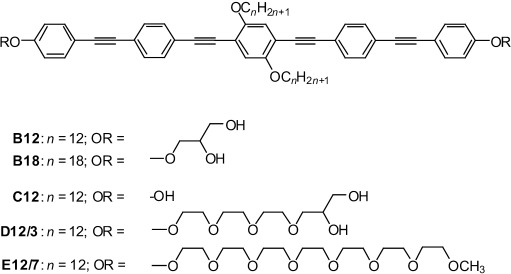
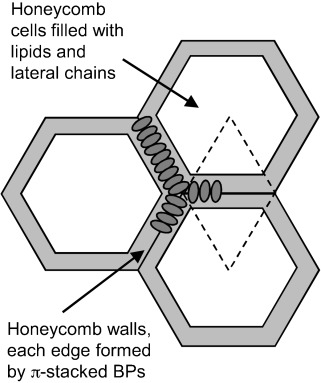
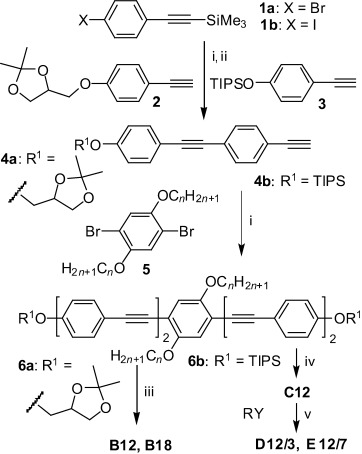
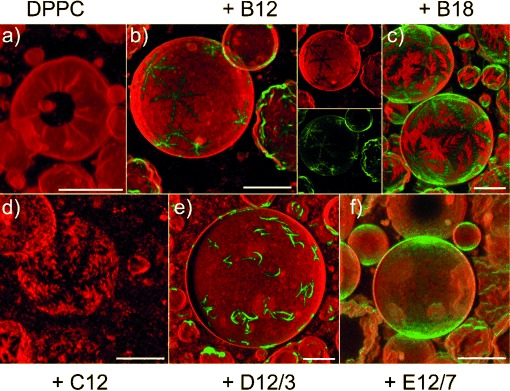
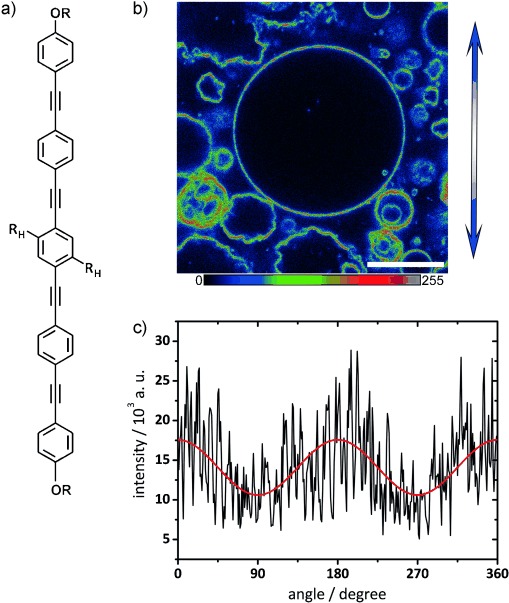
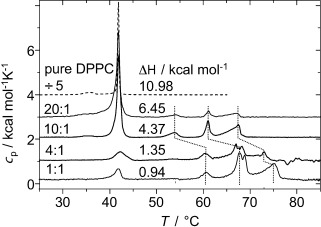
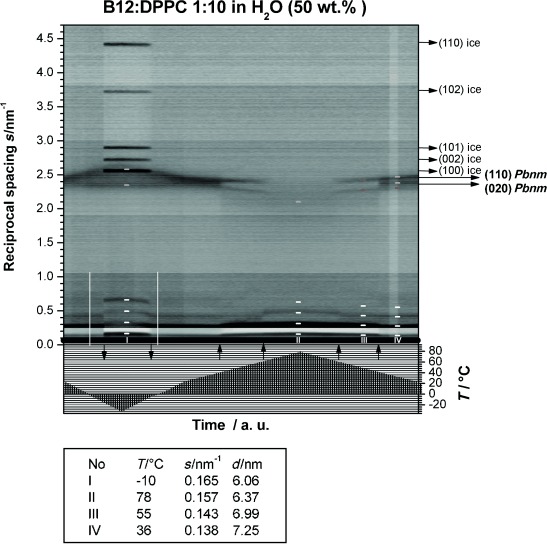
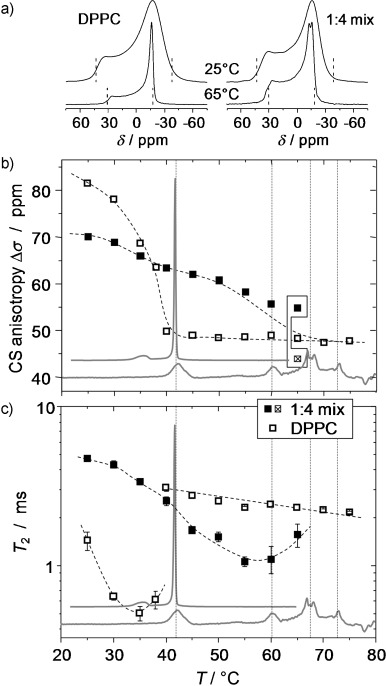
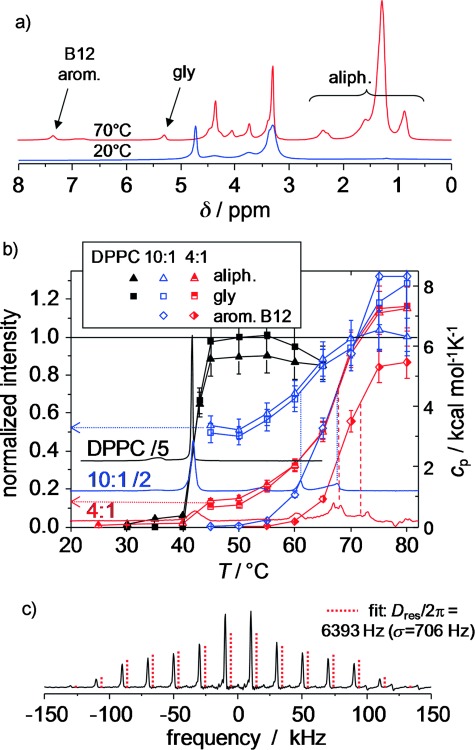
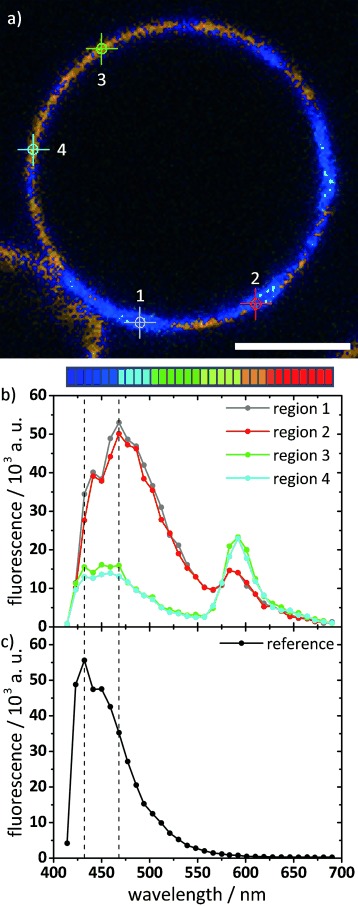
A novel class of bolapolyphile (BP) molecules are shown to integrate into phospholipid bilayers and self-assemble into unique sixfold symmetric domains of snowflake-like dendritic shapes. The BPs comprise three philicities: a lipophilic, rigid, π-π stacking core; two flexible lipophilic side chains; and two hydrophilic, hydrogen-bonding head groups. Confocal microscopy, differential scanning calorimetry, XRD, and solid-state NMR spectroscopy confirm BP-rich domains with transmembrane-oriented BPs and three to four lipid molecules per BP. Both species remain well organized even above the main 1,2-dipalmitoyl-sn-glycero-3-phosphocholine transition. The BP molecules only dissolve in the fluid membrane above 70 °C. Structural variations of the BP demonstrate that head-group hydrogen bonding is a prerequisite for domain formation. Independent of the head group, the BPs reduce membrane corrugation. In conclusion, the BPs form nanofilaments by π stacking of aromatic cores, which reduce membrane corrugation and possibly fuse into a hexagonal network in the dendritic domains.
一类新型的双亲性分子(BP)被证明能够整合到磷脂双层中,并自组装成独特的具有雪花状树枝状形状的六重对称结构域。BP包含三种亲性:一个亲脂性的、刚性的、π-π堆积核心;两条柔性亲脂性侧链;以及两个亲水性的氢键头基。共聚焦显微镜、差示扫描量热法、X射线衍射和固态核磁共振光谱证实了富含BP的结构域,其中BP呈跨膜取向,每个BP周围有三到四个脂质分子。即使在主要的1,2-二棕榈酰-sn-甘油-3-磷酸胆碱转变温度以上,这两种物质仍保持良好的有序性。BP分子仅在70°C以上溶解于流体膜中。BP的结构变化表明头基氢键是形成结构域的先决条件。与头基无关,BP减少了膜的波纹。总之,BP通过芳香核的π堆积形成纳米丝,这减少了膜的波纹,并可能在树枝状结构域中融合成六边形网络。