Gairí Margarida, Dyachenko Andrey, González M Teresa, Feliz Miguel, Pons Miquel, Giralt Ernest
NMR Facility, Scientific and Technological Centers, University of Barcelona (CCiTUB), Baldiri Reixac 10, 08028, Barcelona, Spain,
J Biomol NMR. 2015 Jun;62(2):209-20. doi: 10.1007/s10858-015-9937-4. Epub 2015 May 7.
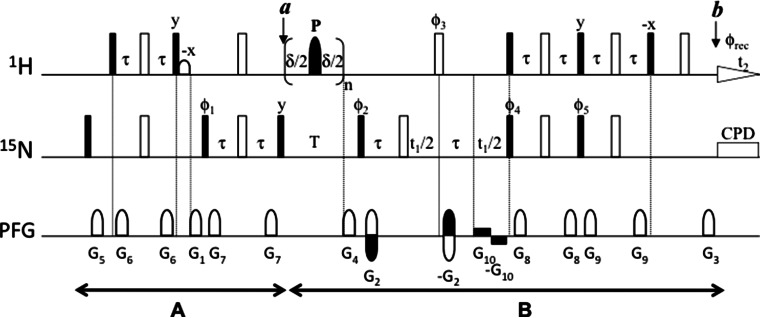
(15)N longitudinal relaxation rates are extensively used for the characterization of protein dynamics; however, their accurate measurement is hindered by systematic errors. (15)N CSA/(1)H-(15)N dipolar cross-correlated relaxation (CC) and amide proton exchange saturation transfer from water protons are the two main sources of systematic errors in the determination of (15)N R1 rates through (1)H-(15)N HSQC-based experiments. CC is usually suppressed through a train of 180° proton pulses applied during the variable (15)N relaxation period (T), which can perturb water magnetization. Thus CC cancellation is required in such a way as to minimize water saturation effects. Here we examined the level of water saturation during the T period caused by various types of inversion proton pulses to suppress CC: (I) amide-selective IBURP-2; (II) cosine-modulated IBURP-2; (III) Watergate-like blocks; and (IV) non-selective hard. We additionally demonstrate the effect of uncontrolled saturation of aliphatic protons on (15)N R1 rates. In this paper we present an optimized pulse sequence that takes into account the crucial effect of controlling also the saturation of the aliphatic protons during (15)N R1 measurements in non-deuterated proteins. We show that using cosine-modulated IBURP-2 pulses spaced 40 ms to cancel CC in this optimized pulse program is the method of choice to minimize systematic errors coming from water and aliphatic protons saturation effects.
15N纵向弛豫率被广泛用于表征蛋白质动力学;然而,其准确测量受到系统误差的阻碍。在基于1H-15N HSQC的实验中测定15N R1率时,15N化学位移各向异性(CSA)/1H-15N偶极交叉相关弛豫(CC)以及酰胺质子与水质子之间的交换饱和转移是系统误差的两个主要来源。CC通常通过在可变的15N弛豫期(T)施加一系列180°质子脉冲来抑制,这可能会扰乱水的磁化。因此,需要以最小化水饱和效应的方式消除CC。在这里,我们研究了由各种类型的反转质子脉冲抑制CC时在T期的水饱和水平:(I)酰胺选择性IBURP-2;(II)余弦调制的IBURP-2;(III)类似Watergate的模块;以及(IV)非选择性硬脉冲。我们还展示了脂肪族质子不受控制的饱和对15N R1率的影响。在本文中,我们提出了一种优化的脉冲序列,该序列考虑到在非氘代蛋白质的15N R1测量过程中控制脂肪族质子饱和的关键作用。我们表明,在这个优化的脉冲程序中使用间隔40毫秒的余弦调制IBURP-2脉冲来消除CC是最小化来自水和脂肪族质子饱和效应的系统误差的首选方法。