Kataja M, Hakala T K, Julku A, Huttunen M J, van Dijken S, Törmä P
NanoSpin, Department of Applied Physics, Aalto University School of Science, FI-00076 Aalto, Finland.
COMP Centre of Excellence, Department of Applied Physics, Aalto University, FI-00076 Aalto, Finland.
Nat Commun. 2015 May 7;6:7072. doi: 10.1038/ncomms8072.
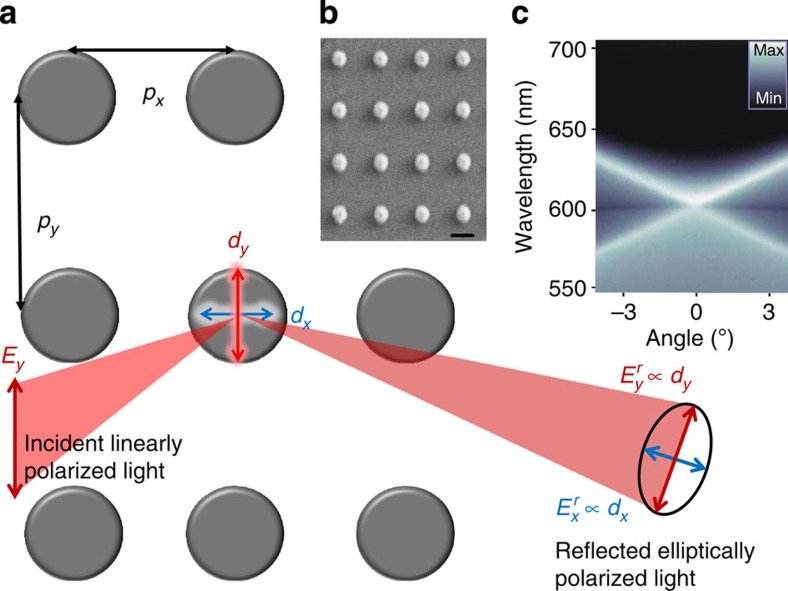
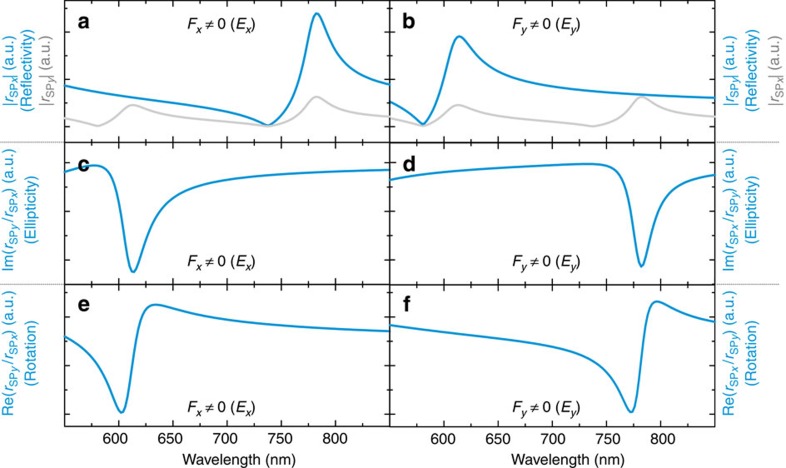
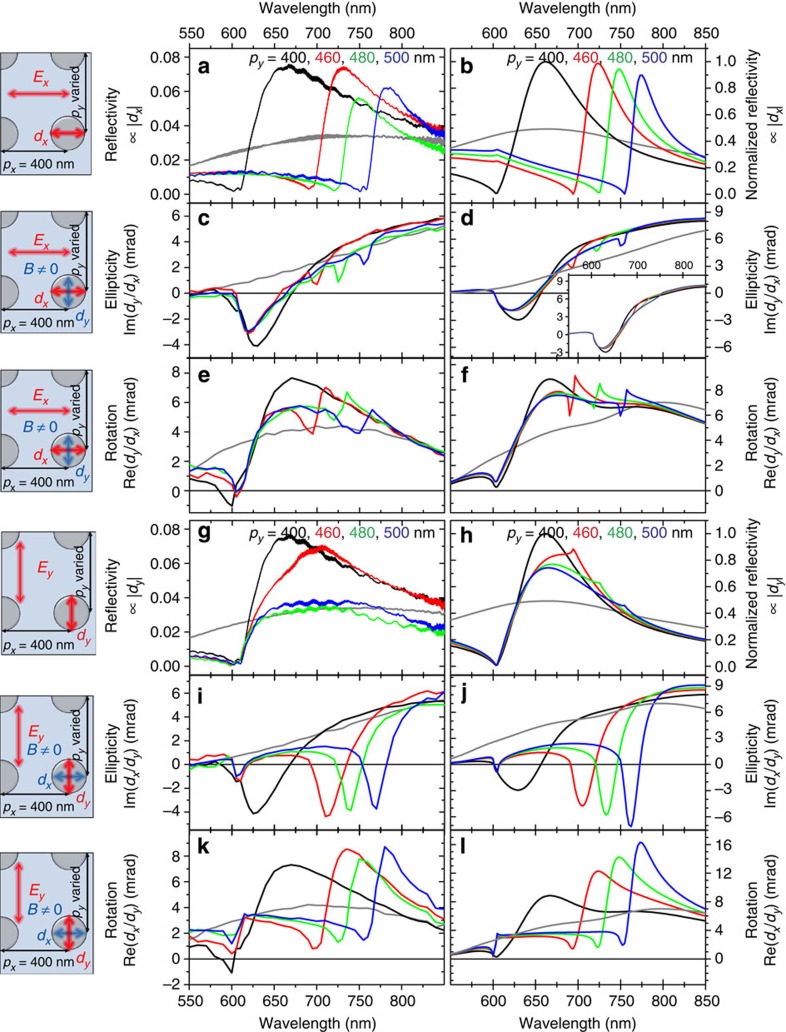
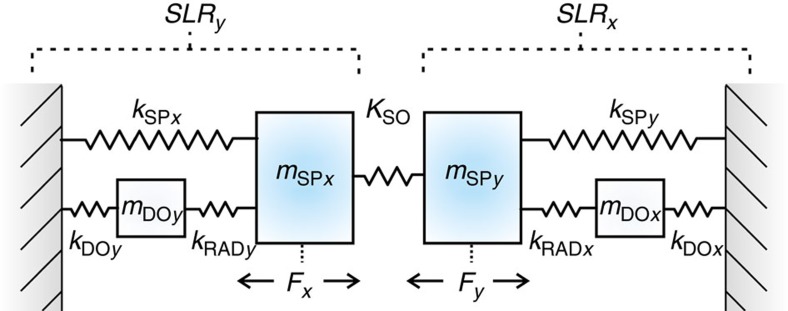
Structuring metallic and magnetic materials on subwavelength scales allows for extreme confinement and a versatile design of electromagnetic field modes. This may be used, for example, to enhance magneto-optical responses, to control plasmonic systems using a magnetic field, or to tailor magneto-optical properties of individual nanostructures. Here we show that periodic rectangular arrays of magnetic nanoparticles display surface plasmon modes in which the two directions of the lattice are coupled by the magnetic field-controllable spin-orbit coupling in the nanoparticles. When breaking the symmetry of the lattice, we find that the optical response shows Fano-type surface lattice resonances whose frequency is determined by the periodicity orthogonal to the polarization of the incident field. In striking contrast, the magneto-optical Kerr response is controlled by the period in the parallel direction. The spectral separation of the response for longitudinal and orthogonal excitations provides versatile tuning of narrow and intense magneto-optical resonances.
在亚波长尺度上构建金属和磁性材料能够实现电磁场模式的极端限制和多样化设计。例如,这可用于增强磁光响应、利用磁场控制等离子体系统或定制单个纳米结构的磁光特性。在此我们表明,磁性纳米颗粒的周期性矩形阵列展现出表面等离子体模式,其中晶格的两个方向通过纳米颗粒中磁场可控的自旋轨道耦合相互耦合。当打破晶格对称性时,我们发现光学响应呈现出法诺型表面晶格共振,其频率由与入射场偏振正交的周期性决定。与之形成鲜明对比的是,磁光克尔响应由平行方向的周期控制。纵向和正交激发响应的光谱分离提供了对窄而强的磁光共振的多样化调谐。