Gascon-Bayarri Jordi, Campdelacreu Jaume, Estela Jordi, Reñé Ramon
Unitat de Diagnòstic i Tractament de les Demències, Neurology Service, Hospital Universitari de Bellvitge, Feixa Llarga s/n, 08907 L'Hospitalet de Llobregat, Spain.
Neurology Service, Hospital Universitari Parc Taulí, Parc del Taulí 1, 08208 Sabadell, Spain.
Case Rep Neurol Med. 2015;2015:453752. doi: 10.1155/2015/453752. Epub 2015 Apr 9.
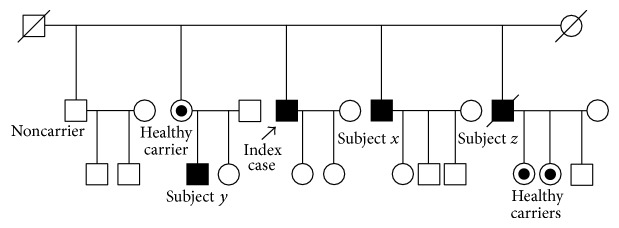
Ornithine transcarbamylase deficiency (OTCD) is a rare X-linked disorder of urea synthesis leading to hyperammonemia. Several late-onset cases have been reported. Undiagnosed and untreated patients are at the risk of death or suffering from irreversible sequelae. We describe a 56-year-old patient who presented with acute encephalopathy after steroid treatment. Hyperammonemia due to OTCD was diagnosed and a mutation was found. This allowed us to diagnose two other family members with unexplained encephalopathy who are now asymptomatic on a low-protein diet. OTCD should be considered in any patient with hyperammonemic encephalopathy and immediate treatment should be given to avoid a fatal outcome. We emphasize the need to examine other family members if the diagnosis is confirmed, in order to prevent further life-threatening episodes of encephalopathy or neonatal coma of newborn.
鸟氨酸转氨甲酰酶缺乏症(OTCD)是一种罕见的X连锁尿素合成障碍疾病,可导致高氨血症。已有数例迟发性病例报道。未确诊和未治疗的患者有死亡风险或遭受不可逆后遗症。我们描述了一名56岁的患者,他在接受类固醇治疗后出现急性脑病。诊断为OTCD所致高氨血症,并发现了一个突变。这使我们能够诊断出另外两名患有不明原因脑病的家庭成员,他们现在通过低蛋白饮食无症状。对于任何患有高氨血症性脑病的患者都应考虑OTCD,并应立即给予治疗以避免致命后果。我们强调,如果确诊,有必要检查其他家庭成员,以防止进一步发生危及生命的脑病发作或新生儿昏迷。