Gentzbittel Laurent, Andersen Stig U, Ben Cécile, Rickauer Martina, Stougaard Jens, Young Nevin D
EcoLab Laboratoire Écologie Fonctionnelle et Environnement, Institut National Polytechnique de Toulouse, Ecole Nationale Supérieure Agronomique de Toulouse, Université Fédérale de Toulouse Castanet Tolosan, France ; EcoLab Laboratoire Écologie Fonctionnelle et Environnement, Centre National de la Recherche Scientifique Castanet Tolosan, France.
Department of Molecular Biology and Genetics, Centre for Carbohydrate Recognition and Signalling, Aarhus University Aarhus, Denmark.
Front Plant Sci. 2015 Apr 21;6:269. doi: 10.3389/fpls.2015.00269. eCollection 2015.
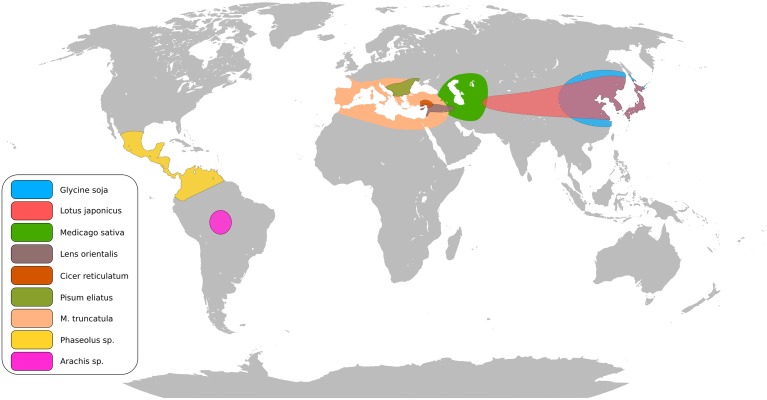
Environmental changes challenge plants and drive adaptation to new conditions, suggesting that natural biodiversity may be a source of adaptive alleles acting through phenotypic plasticity and/or micro-evolution. Crosses between accessions differing for a given trait have been the most common way to disentangle genetic and environmental components. Interestingly, such man-made crosses may combine alleles that never meet in nature. Another way to discover adaptive alleles, inspired by evolution, is to survey large ecotype collections and to use association genetics to identify loci of interest. Both of these two genetic approaches are based on the use of biodiversity and may eventually help us in identifying the genes that plants use to respond to challenges such as short-term stresses or those due to global climate change. In legumes, two wild species, Medicago truncatula and Lotus japonicus, plus the cultivated soybean (Glycine max) have been adopted as models for genomic studies. In this review, we will discuss the resources, limitations and future plans for a systematic use of biodiversity resources in model legumes to pinpoint genes of adaptive importance in legumes, and their application in breeding.
环境变化对植物构成挑战,并促使其适应新环境,这表明自然生物多样性可能是通过表型可塑性和/或微进化发挥作用的适应性等位基因的来源。针对某一特定性状存在差异的种质间杂交,一直是区分遗传和环境成分的最常用方法。有趣的是,这种人为杂交可能会组合在自然界中从未相遇的等位基因。另一种受进化启发发现适应性等位基因的方法,是对大量生态型群体进行调查,并利用关联遗传学来确定感兴趣的基因座。这两种遗传方法都基于生物多样性的利用,最终可能有助于我们识别植物用于应对短期胁迫或全球气候变化等挑战的基因。在豆科植物中,两种野生植物——蒺藜苜蓿和百脉根,以及栽培大豆已被用作基因组研究的模式植物。在本综述中,我们将讨论在模式豆科植物中系统利用生物多样性资源以确定豆科植物中具有适应性重要性的基因及其在育种中的应用的资源、局限性和未来计划。