Rodriguez Yesenia, Hinz John M, Smerdon Michael J
School of Molecular Biosciences, Washington State University, Pullman, WA 99164-7520, United States.
School of Molecular Biosciences, Washington State University, Pullman, WA 99164-7520, United States.
DNA Repair (Amst). 2015 Aug;32:113-119. doi: 10.1016/j.dnarep.2015.04.021. Epub 2015 May 2.
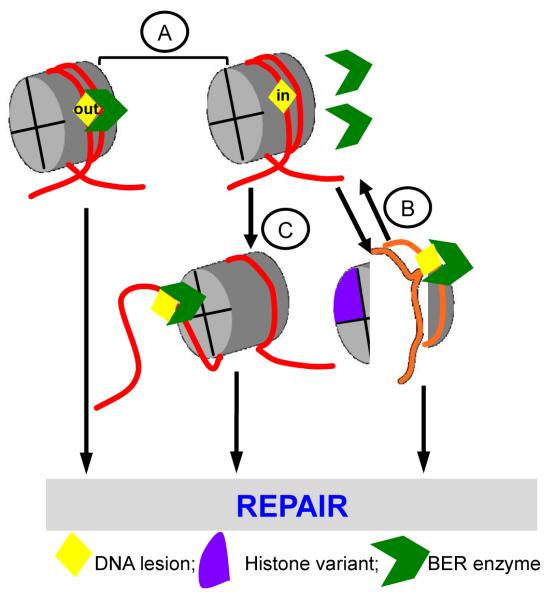
DNA damage in chromatin comes in many forms, including single base lesions that induce base excision repair (BER). We and others have shown that the structural location of DNA lesions within nucleosomes greatly influences their accessibility to repair enzymes. Indeed, a difference in the location of uracil as small as one-half turn of the DNA backbone on the histone surface can result in a 10-fold difference in the time course of its removal in vitro. In addition, the cell has evolved several interdependent processes capable of enhancing the accessibility of excision repair enzymes to DNA lesions in nucleosomes, including post-translational modification of histones, ATP-dependent chromatin remodeling and interchange of histone variants in nucleosomes. In this review, we focus on different factors that affect accessibility of BER enzymes to nucleosomal DNA.
染色质中的DNA损伤有多种形式,包括诱导碱基切除修复(BER)的单碱基损伤。我们和其他人已经表明,核小体内DNA损伤的结构位置极大地影响其对修复酶的可及性。事实上,尿嘧啶在组蛋白表面的位置差异小至DNA主链半圈,就可能导致其在体外去除时间进程上10倍的差异。此外,细胞已经进化出几种相互依赖的过程,能够增强切除修复酶对核小体中DNA损伤的可及性,包括组蛋白的翻译后修饰、ATP依赖的染色质重塑以及核小体中组蛋白变体的交换。在这篇综述中,我们关注影响BER酶对核小体DNA可及性的不同因素。