Bertoli Simona, Leone Alessandro, Ponissi Veronica, Bedogni Giorgio, Beggio Valentina, Strepparava Maria Grazia, Battezzati Alberto
1International Center for the Assessment of Nutritional Status (ICANS),Department of Food,Environmental and Nutritional Sciences (DEFENS),University of Milan,Via Botticelli 21,20133 Milan,Italy.
3Department of Health Sciences,School of Medicine,University of Milan-Bicocca,Milan,Italy.
Public Health Nutr. 2016 Jan;19(1):71-7. doi: 10.1017/S1368980015001068. Epub 2015 May 11.
Conflicting data are available on the prevalence of binge eating behaviour (BE) in individuals seeking to lose or maintain weight. The present study aimed to estimate the prevalence of and the risk factors for BE in a large sample of men and women starting a weight loss or maintenance programme.
Cross-sectional study. BE was defined as a Binge Eating Scale (BES) score ≥18. The State-Trait Anxiety Inventory and the Italian Depression Questionnaire were used to assess anxiety and depression. Besides sex, age and BMI, marital status, educational level, smoking and physical activity were evaluated as potential risk factors for BE. Uni- and multivariable Poisson working regression models were used to estimate prevalence ratios (PR) and marginal probabilities.
Nutritional research centre.
Adults (n 6930; 72 % women) with a median age of 46 years (range 18-81 years) were consecutively studied.
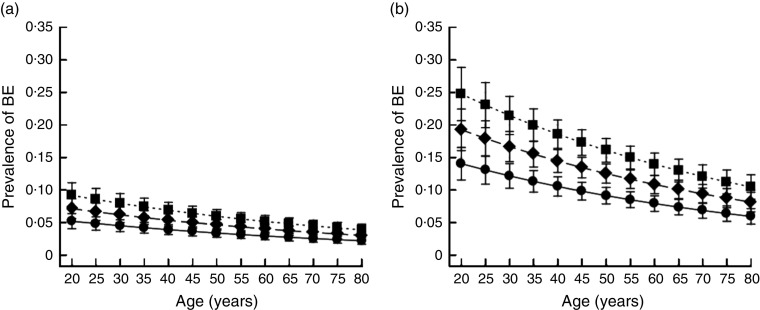
BE prevalence in the pooled sample was 17 %. At multivariable analysis, being a woman (PR=2·70), smoking (PR=1·15) and increasing BMI (PR=1·05 for 1 kg/m(2) increase) were risk factors for BE. On the contrary, being older (PR=0·99 for 1-year increase), performing physical activity (PR=0·89) and being married (PR=0·88) were protective factors for BE. Anxiety and depression were more common in subjects with BE.
BE is common in individuals seeking to lose or maintain weight. The prevalence of BE is higher in young obese women. However, BE is present also in men, elders and normal-weight subjects.
关于寻求减重或维持体重的个体中暴饮暴食行为(BE)的患病率,现有数据相互矛盾。本研究旨在估计开始减重或维持体重计划的大量男性和女性样本中BE的患病率及危险因素。
横断面研究。BE定义为暴饮暴食量表(BES)得分≥18。使用状态-特质焦虑量表和意大利抑郁问卷评估焦虑和抑郁。除了性别、年龄和体重指数外,婚姻状况、教育水平、吸烟和身体活动被评估为BE的潜在危险因素。使用单变量和多变量泊松工作回归模型估计患病率比(PR)和边际概率。
营养研究中心。
连续研究了6930名成年人(72%为女性),中位年龄为46岁(范围18 - 81岁)。
汇总样本中BE的患病率为17%。多变量分析显示,女性(PR = 2.70)、吸烟(PR = 1.15)和体重指数增加(每增加1 kg/m²,PR = 1.05)是BE的危险因素。相反,年龄较大(每增加1岁,PR = 0.99)、进行体育活动(PR = 0.89)和已婚(PR = 0.88)是BE的保护因素。焦虑和抑郁在BE患者中更为常见。
BE在寻求减重或维持体重的个体中很常见。年轻肥胖女性中BE的患病率更高。然而,男性、老年人和体重正常的个体中也存在BE。