Jamal Omar, Aneni Ehimen C, Shaharyar Sameer, Ali Shozab S, Parris Don, McEvoy John W, Veledar Emir, Blaha Michael J, Blumenthal Roger S, Agatston Arthur S, Conceição Raquel D, Feldman Theodore, Carvalho Jose A, Santos Raul D, Nasir Khurram
Center for Prevention and Wellness Research, Baptist Health South Florida, Miami, Florida, USA.
Center for Research and Grants, Baptist Health South Florida, Miami, Florida, USA.
Diabetol Metab Syndr. 2014 Jul 16;6:79. doi: 10.1186/1758-5996-6-79. eCollection 2014.
Emerging data suggests that the combination of smoking and metabolic syndrome (MetS) markedly increases cardiovascular disease risk well beyond that of either condition. In this study we assess if this interaction can be explained by an additive increase in the risk of systemic inflammation by MetS and cigarette smoking.
We evaluated 5,503 healthy non-diabetic Brazilian subjects (mean age of 43 ± 10 years, 79% males). Participants were divided into sub-groups of smokers and non-smokers with or without MetS. High-sensitivity C reactive protein (hs-CRP) was measured to assess degree of underlying inflammation.
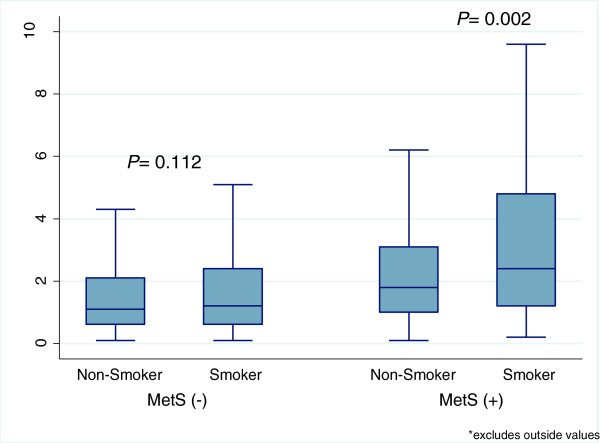
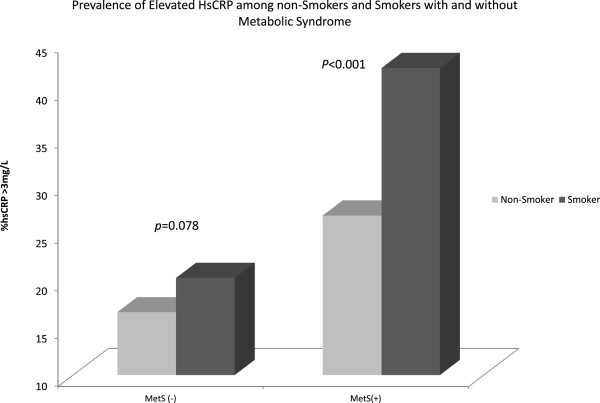
Overall (19%) had hs-CRP > 3 mg/L. In adjusted regression analyses, compared to non-smokers, there was a 0.19 mg/L (95% CI: 0.05, 0.32) increase in hs-CRP among smokers in the entire population and 0.63 mg/L (95% CI: 0.26, 1.01) increase among smokers with MetS while there was no significant increase among smokers without MetS (β = 0.09 95% CI: -0.05, 0.24). In a fully adjusted logistic regression model, smokers compared to non-smokers were 55% more likely to have elevated hs-CRP in the entire population (OR 1.55, 95% CI: 1.25, 1.92) and more than twice as likely to have elevated hs-CRP if they had MetS ( OR 2.05, 95% CI: 1.40, 3.01) while the risk was non-significant among those without MetS (OR = 1.29, 95% CI: 0.98, 1.69).
The study demonstrates an additive effect of cigarette smoking on the risk of systemic inflammation in MetS thus highlighting the need for determining smoking status among those with MetS and aggressively targeting smoking cessation in this population.
新出现的数据表明,吸烟与代谢综合征(MetS)相结合会显著增加心血管疾病风险,且远超这两种情况单独存在时的风险。在本研究中,我们评估这种相互作用是否可以通过MetS和吸烟导致的全身炎症风险的累加增加来解释。
我们评估了5503名健康的非糖尿病巴西受试者(平均年龄43±10岁,79%为男性)。参与者被分为有或无MetS的吸烟者和非吸烟者亚组。测量高敏C反应蛋白(hs-CRP)以评估潜在炎症程度。
总体上(19%)的hs-CRP>3mg/L。在调整后的回归分析中,与非吸烟者相比,整个人群中吸烟者的hs-CRP升高了0.19mg/L(95%CI:0.05,0.32),患有MetS的吸烟者中升高了0.63mg/L(95%CI:0.26,1.01),而没有MetS的吸烟者中没有显著升高(β = 0.09,95%CI:-0.05,0.24)。在完全调整的逻辑回归模型中,与非吸烟者相比,整个人群中吸烟者hs-CRP升高的可能性高55%(OR 1.55,95%CI:1.25,1.92),如果患有MetS,hs-CRP升高的可能性则是其两倍多(OR 2.05,95%CI:1.40,3.01),而在没有MetS的人群中风险不显著(OR = 1.29,95%CI:0.98,1.69)。
该研究证明了吸烟对MetS患者全身炎症风险的累加效应,从而突出了确定MetS患者吸烟状况并积极针对该人群进行戒烟的必要性。