de Barros Camila Risso, Cezaretto Adriana, Curti Maíra Ladeia Rodrigues, Pires Milena Monfort, Folchetti Luciana Dias, Siqueira-Catania Antonela, Ferreira Sandra Roberta Gouvea
Department of Epidemiology, School of Public Health, University of São Paulo, São Paulo, Brazil.
Diabetol Metab Syndr. 2014 Dec 7;6:136. doi: 10.1186/1758-5996-6-136. eCollection 2014.
BACKGROUND/OBJECTIVES: Cardioprotective effects of Mediterranean-style diet have been shown. Instead of excluding foods, replacement or addition may facilitate compliance with impact on glucose metabolism of individuals at cardiometabolic risk. This study investigated the effect of changing selected nutrients intake on glucose metabolism during a lifestyle intervention tailored to living conditions of prediabetic Brazilians.
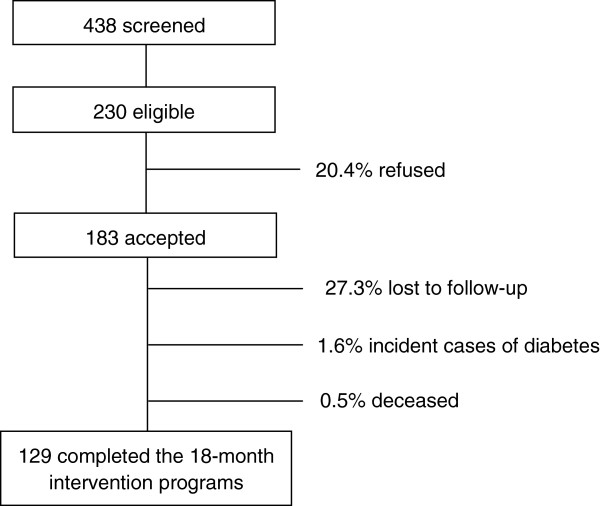
SUBJECTS/METHODS: 183 prediabetic adults treated under the Brazilian public health system underwent an 18-month intervention on diet and physical activity. Dietary counseling focused on reducing saturated fat replaced by unsaturated fatty acids. Data were collected at baseline and after follow-up. ANOVA and multiple linear regression were used to test association of changes in nutrients intake with changes in plasma glucose.
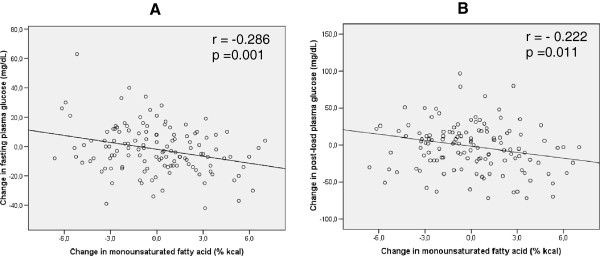
Changes in fasting and 2-h plasma glucose but not in weight, HOMA-IR or C-reactive protein decreased after intervention across tertiles of MUFA changes (p-trend 0.017 and 0.024, respectively). Regression models showed that increase in MUFA intake was independently associated with reduction in fasting (β -1.475, p = 0.008) and 2-h plasma glucose (β -3.321, p = 0.007). Moreover, increase in soluble fibers intake was associated with decrease in fasting plasma glucose (β -1.579, p = 0.038). Adjustment for anthropometric measurements did not change the results but did after including change in insulin in the models.
Increases of MUFA and soluble fibers intakes promote benefits on glucose metabolism, independently of adiposity, during a realistic lifestyle intervention in at-risk individuals. Mechanisms mediating these processes may include mainly insulin sensitivity improvement.
背景/目的:地中海式饮食的心脏保护作用已得到证实。与其排除某些食物,替换或添加食物可能更有助于处于心脏代谢风险的个体遵循饮食建议,同时对其葡萄糖代谢产生影响。本研究针对处于糖尿病前期的巴西人的生活条件,进行了一项生活方式干预,调查了改变特定营养素摄入量对葡萄糖代谢的影响。
受试者/方法:183名在巴西公共卫生系统接受治疗的糖尿病前期成年人接受了为期18个月的饮食和体育活动干预。饮食咨询重点是减少饱和脂肪,用不饱和脂肪酸替代。在基线和随访后收集数据。采用方差分析和多元线性回归来测试营养素摄入量变化与血浆葡萄糖变化之间的关联。
在干预后,空腹和2小时血浆葡萄糖水平发生变化,但体重、稳态模型评估的胰岛素抵抗(HOMA-IR)或C反应蛋白未发生变化,变化趋势在单不饱和脂肪酸(MUFA)变化的三个三分位数中呈下降趋势(p趋势分别为0.017和0.024)。回归模型显示,MUFA摄入量的增加与空腹血糖降低(β -1.475,p = 0.008)和2小时血浆葡萄糖降低(β -3.321,p = 0.007)独立相关。此外,可溶性纤维摄入量的增加与空腹血浆葡萄糖降低相关(β -1.579,p = 0.038)。调整人体测量指标后结果未改变,但在模型中纳入胰岛素变化后结果发生了改变。
在对有风险个体进行的现实生活方式干预中,增加MUFA和可溶性纤维的摄入量可独立于肥胖对葡萄糖代谢产生有益影响。介导这些过程的机制可能主要包括胰岛素敏感性的改善。