Nouri Saeed, Sharif Mohammad Reza, Panahi Yunes, Ghanei Mostafa, Jamali Bardia
Chemical Injuries Research Center, Baqiyatallah University of Medical Sciences, Tehran, IR Iran.
Trauma Research Center, Kashan University of Medical Sciences, Kashan, IR Iran.
Iran Red Crescent Med J. 2015 Mar 20;17(3):e19714. doi: 10.5812/ircmj.19714. eCollection 2015 Mar.
Despite all the progress in surgical science, bleeding caused by traffic accidents is still one of the challenges surgeons face in saving patients' lives. Therefore, introducing an effective method to control external bleeding is an important research priority.
This study aimed to compare the hemostatic effect of aluminum chloride versus simple suturing in controlling external bleeding.
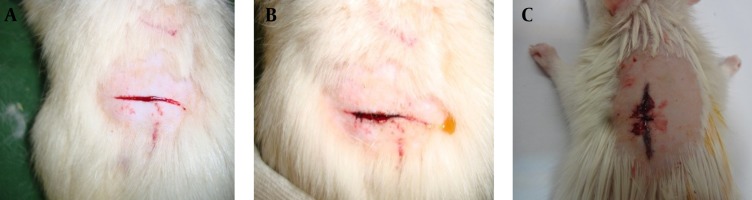
This experimental study was conducted in Kashan, Iran. In this study, 60 male Wistar rats were randomly allocated into six groups. An incision, two centimeters (cm) long and half a cm deep, was made on each rat's shaved back skin and the hemostatic time was measured once using aluminum chloride with different concentrations (5%, 10%, 15%, 25%, and 50%) and then using the control method (controlling hemorrhage by simple suturing). The skin tissue was assessed for pathological changes.
The hemostatic time of aluminum chloride 50%, 25%, 15%, 10% and 5% were 8.20 ± 0.919, 14.10 ± 1.37, 21.20 ± 1.31, 30.80 ± 1.68 and 42.00 ± 4.19 seconds, respectively. Also, the mean hemostasis time in the control group (suture) was 84.00 ± 4.05 seconds. The hemostatic times of different concentrations of aluminum chloride were significantly less than that of the control group. There was a statistically significant difference between every two hemostatic time. The pathologic examination showed the highest frequency of low-grade inflammation based on the defined pathological grading.
The aluminum chloride method needs less time to control external hemorrhage compared to the control method (controlling external hemorrhage by simple suturing). Aluminum chloride is an effective agent in controlling external hemorrhage in an animal model.
尽管外科学取得了诸多进展,但交通事故导致的出血仍是外科医生在挽救患者生命时面临的挑战之一。因此,引入一种有效的控制外出血的方法是一项重要的研究重点。
本研究旨在比较氯化铝与单纯缝合在控制外出血方面的止血效果。
本实验研究在伊朗卡尚进行。在本研究中,60只雄性Wistar大鼠被随机分为六组。在每只大鼠剃毛后的背部皮肤上做一个2厘米长、0.5厘米深的切口,分别使用不同浓度(5%、10%、15%、25%和50%)的氯化铝,然后使用对照方法(单纯缝合控制出血)测量一次止血时间。对皮肤组织进行病理变化评估。
50%、25%、15%、10%和5%氯化铝的止血时间分别为8.20±0.919、14.10±1.37、21.20±1.31、30.80±1.68和42.00±4.19秒。此外,对照组(缝合)的平均止血时间为84.00±4.05秒。不同浓度氯化铝的止血时间明显短于对照组。每两个止血时间之间存在统计学显著差异。病理检查显示,根据定义的病理分级,低度炎症的发生率最高。
与对照方法(单纯缝合控制外出血)相比,氯化铝方法控制外出血所需时间更短。氯化铝是动物模型中控制外出血的有效药物。