Malmivaara Antti
Centre for Health and Social Economics, National Institute for Health and Welfare , Helsinki , Finland.
Ann Med. 2015 Jun;47(4):332-40. doi: 10.3109/07853890.2015.1027255. Epub 2015 May 12.
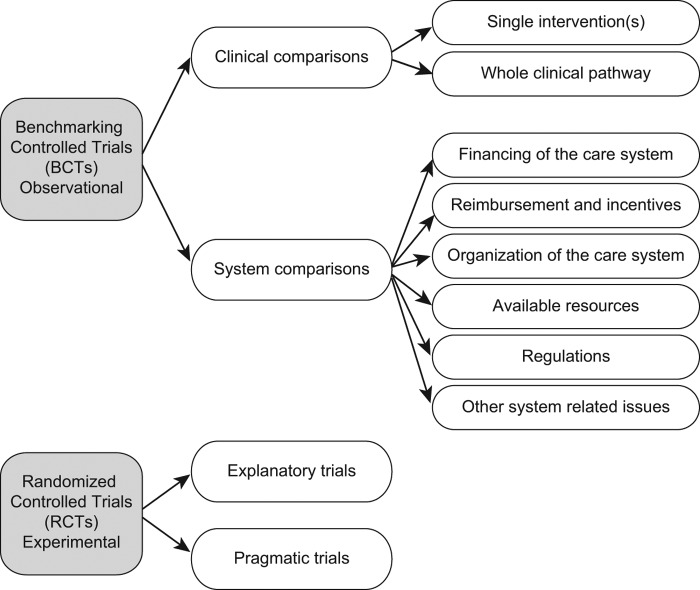
The Benchmarking Controlled Trial (BCT) is a novel concept which covers all observational studies aiming to assess effectiveness. BCTs provide evidence of the comparative effectiveness between health service providers, and of effectiveness due to particular features of the health and social care systems. BCTs complement randomized controlled trials (RCTs) as the sources of evidence on effectiveness. This paper presents a definition of the BCT; compares the position of BCTs in assessing effectiveness with that of RCTs; presents a checklist for assessing methodological validity of a BCT; and pilot-tests the checklist with BCTs published recently in the leading medical journals.
基准对照试验(BCT)是一个新颖的概念,涵盖了所有旨在评估有效性的观察性研究。BCT提供了医疗服务提供者之间比较有效性的证据,以及由于卫生和社会护理系统的特定特征而产生的有效性证据。BCT作为有效性证据的来源,对随机对照试验(RCT)起到了补充作用。本文给出了BCT的定义;比较了BCT在评估有效性方面与RCT的地位;给出了一份评估BCT方法学有效性的清单;并用最近发表在主要医学期刊上的BCT对该清单进行了预测试。