Zisko Nina, Stensvold Dorthe, Hordnes-Slagsvold Katrine, Rognmo Øivind, Nauman Javaid, Wisløff Ulrik, Karlsen Trine
K.G. Jebsen - Center for Exercise in Medicine at the Department of Circulation and Medical Imaging, Norwegian University of Science and Technology, Trondheim, Norway.
K.G. Jebsen - Center for Exercise in Medicine at the Department of Circulation and Medical Imaging, Norwegian University of Science and Technology, Trondheim, Norway. ; Central Norway Regional Health Authority P.o.box 464, N-7501 Stjørdal.
Open Cardiovasc Med J. 2015 Apr 30;9:50-7. doi: 10.2174/1874192401509010050. eCollection 2015.
To investigate how a change in VO2max induced through 6 weeks of high intensity aerobic interval training affects daily total energy expenditure (TEE), active energy expenditure (AEE) and mitochondrial function in people not previously exposed to structured high intensity aerobic interval training (AIT).
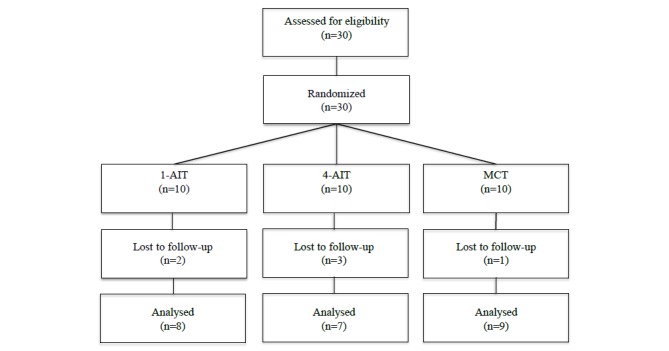
Thirty healthy males (39±6 yrs) not exposed to structured exercise training were randomized to either 1x4 min AIT (1-AIT), 4x4 min AIT (4-AIT), both at 90-95% maximum heart rate (HRmax) or 47 min of MCT at 70% HRmax. TEE, AEE, number of steps, active time, sedentary time, VO2max and mitochondrial function in m. vastus lateralis were measured before and after intervention.
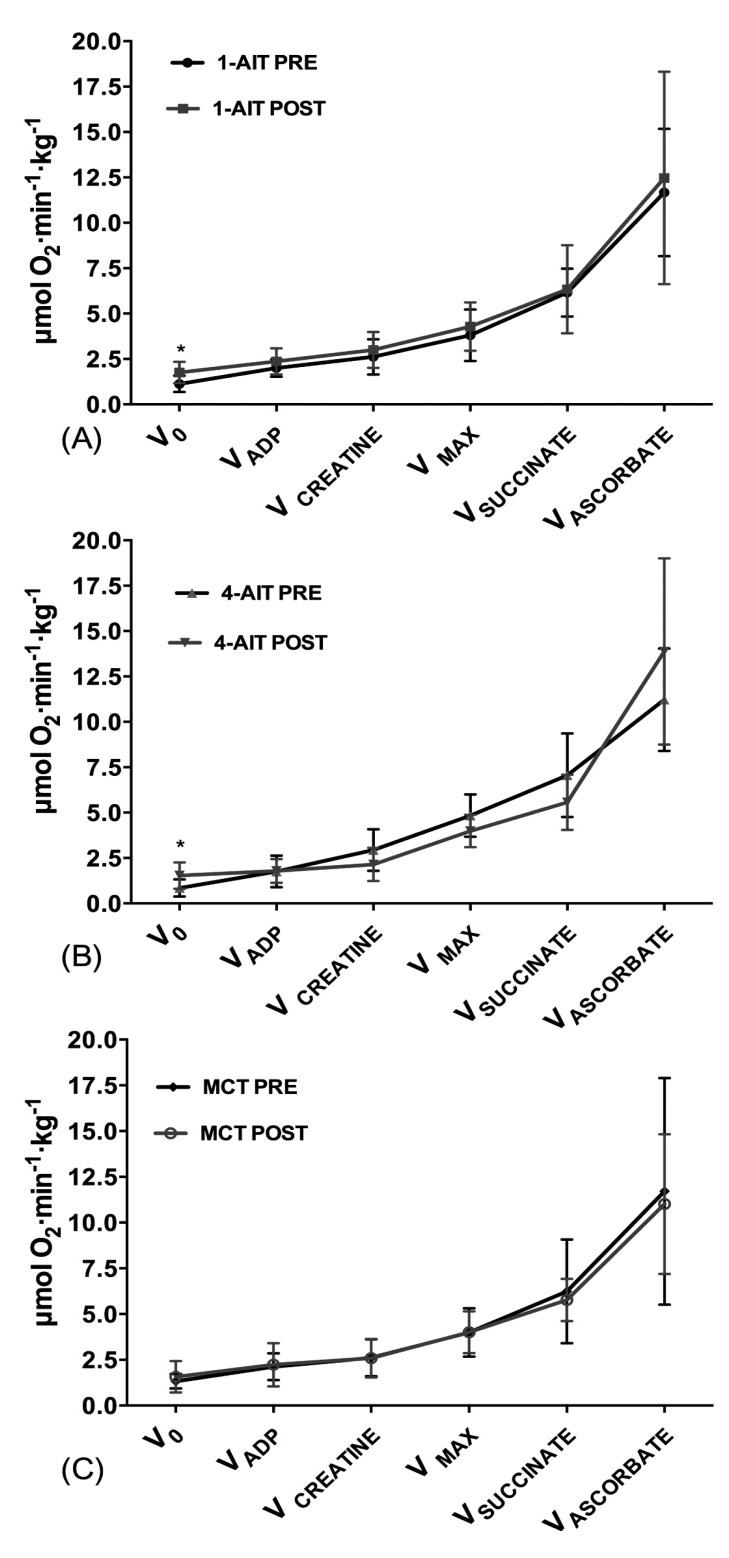
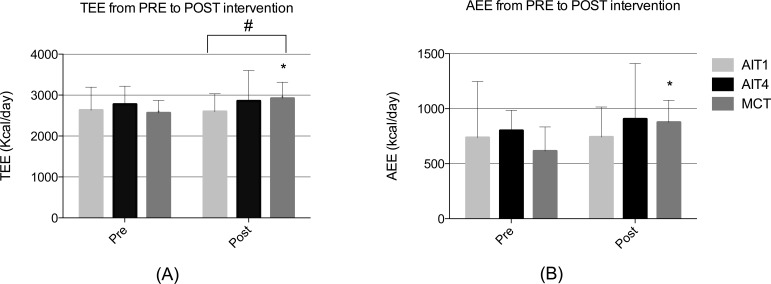
TEE increased 14% (p=0.014) and AEE increased 43% (p= 0.004) after MCT. There was no change in TEE or AEE after 1-AIT or 4-AIT, but 1-AIT had significantly lower TEE (p=0.033) and step-count (p=0.011) compared to MCT post intervention. VO2max increased 7% after 1-AIT (p= 0.004) and 9% after 4-AIT (p=0.004), with no change after MCT. No change was observed in maximal mitochondrial respiration (VMAX) or Citrate Synthase (CS) activity within or between interventions. Basal respiration (V0) increased after 1-AIT (p=0.029) and 4-AIT (p=0.022), with no significant change after MCT.
AIT interventions that increase VO2max, do not stimulate subjects to increase TEE or AEE. The intensity of exercise seems to play apart, as MCT increased TEE and AEE and AIT did not. Emphasis should be placed on the importance of maintaining everyday activities when introducing structured exercise training to untrained individuals.
研究在未曾接受过结构化高强度有氧间歇训练(AIT)的人群中,通过6周高强度有氧间歇训练引起的最大摄氧量(VO2max)变化如何影响每日总能量消耗(TEE)、活动能量消耗(AEE)和线粒体功能。
30名未接受过结构化运动训练的健康男性(39±6岁)被随机分为三组,分别进行1次4分钟的AIT(1-AIT组)、4次4分钟的AIT(4-AIT组),运动强度均为最大心率(HRmax)的90-95%,或进行47分钟、运动强度为HRmax的70%的中等强度持续训练(MCT)。在干预前后测量TEE、AEE、步数、活动时间、久坐时间、VO2max以及股外侧肌的线粒体功能。
MCT后TEE增加了14%(p=0.014),AEE增加了43%(p=0.004)。1-AIT组或4-AIT组后TEE和AEE无变化,但与干预后的MCT相比,1-AIT组的TEE(p=0.033)和步数(p=0.011)显著更低。1-AIT组后VO2max增加了7%(p=0.004),4-AIT组后增加了9%(p=0.004),MCT后无变化。在干预内或干预间,最大线粒体呼吸(VMAX)或柠檬酸合酶(CS)活性均未观察到变化。1-AIT组(p=0.029)和4-AIT组(p=0.022)后基础呼吸(V0)增加,MCT后无显著变化。
增加VO2max的AIT干预不会刺激受试者增加TEE或AEE。运动强度似乎起了作用,因为MCT增加了TEE和AEE,而AIT没有。在向未受过训练的个体引入结构化运动训练时,应强调维持日常活动的重要性。