Serban Corina, Sahebkar Amirhossein, Ursoniu Sorin, Mikhailidis Dimitri P, Rizzo Manfredi, Lip Gregory Y H, Kees Hovingh G, Kastelein John J P, Kalinowski Leszek, Rysz Jacek, Banach Maciej
Department of Functional Sciences, Discipline of Pathophysiology, "Victor Babes" University of Medicine and Pharmacy, Timisoara, Romania.
1] Biotechnology Research Center, Mashhad University of Medical Sciences, Mashhad, Iran [2] Metabolic Research Centre, Royal Perth Hospital, School of Medicine and Pharmacology, University of Western Australia, Perth, Australia.
Sci Rep. 2015 May 13;5:9902. doi: 10.1038/srep09902.
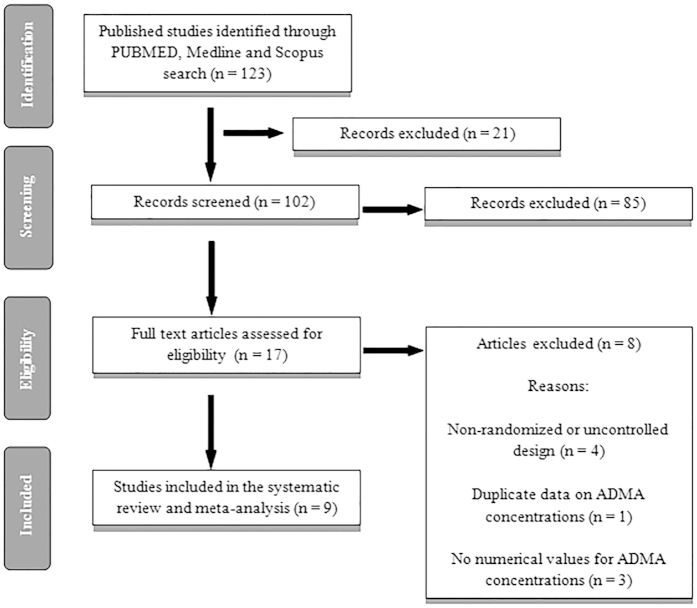
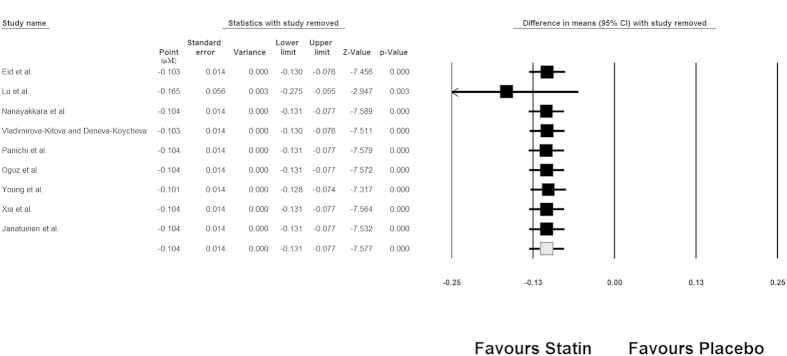
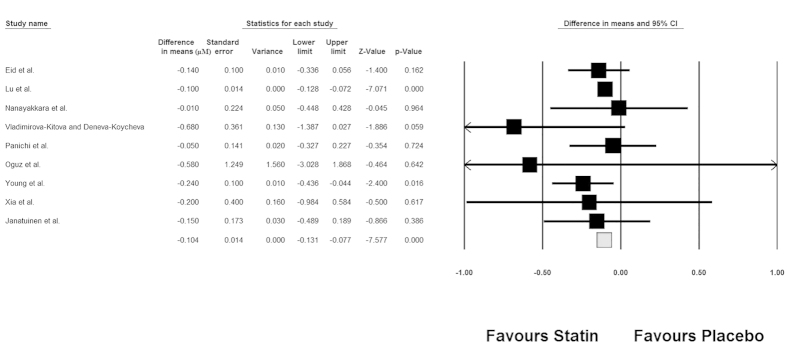
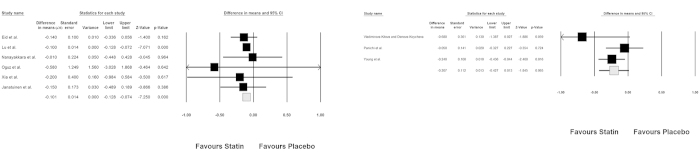
The impact of statin therapy on plasma asymmetric dimethylarginine (ADMA) levels has not been conclusively studied. Therefore the aim of the meta-analysis was to assess the effect of statins on circulating ADMA levels. We searched selected databases (up to August 2014) to identify randomized controlled trials (RCTs) that investigate the effect of statins on plasma ADMA concentrations. A weighted meta-regression (WMD) using unrestricted maximum likelihood model was performed to assess the impact of statin dose, duration of statin therapy and baseline ADMA concentrations as potential variables on the WMD between statin and placebo group. In total, 1134 participants in 9 selected RCTs were randomized; 568 were allocated to statin treatment and 566 were controls. There was a significant reduction in plasma ADMA concentrations following statin therapy compared with placebo (WMD: -0.104 μM, 95% confidence interval: -0.131 to -0.077, Z = -7.577, p < 0.0001). Subgroups analysis has shown a significant impact of hydrophilic statins (WMD: -0.207 μM, 95%CI: -0.427 to +0.013, Z = -7.250, p < .0001) and a non-significant effect of hydrophobic statins (WMD: -0.101 μM, 95%CI: -0.128 to -0.074, Z = -1.845, p = 0.065). In conclusion, this meta-analysis of available RCTs showed a significant reduction in plasma ADMA concentrations following therapy with hydrophilic statins.
他汀类药物治疗对血浆不对称二甲基精氨酸(ADMA)水平的影响尚未得到最终定论。因此,本荟萃分析的目的是评估他汀类药物对循环ADMA水平的影响。我们检索了选定的数据库(截至2014年8月),以确定研究他汀类药物对血浆ADMA浓度影响的随机对照试验(RCT)。采用无限制最大似然模型进行加权荟萃回归(WMD),以评估他汀类药物剂量、他汀类药物治疗持续时间和基线ADMA浓度作为潜在变量对他汀类药物组与安慰剂组之间WMD的影响。总共9项选定的RCT中有1134名参与者被随机分组;568名被分配接受他汀类药物治疗,566名作为对照。与安慰剂相比,他汀类药物治疗后血浆ADMA浓度显著降低(WMD:-0.104μM,95%置信区间:-0.131至-0.077,Z = -7.577,p < 0.0001)。亚组分析显示亲水性他汀类药物有显著影响(WMD:-0.207μM,95%CI:-0.427至+0.013,Z = -7.250,p <.0001),而疏水性他汀类药物无显著影响(WMD:-0.101μM,95%CI:-0.128至-0.074,Z = -1.845,p = 0.065)。总之,这项对现有RCT的荟萃分析表明,亲水性他汀类药物治疗后血浆ADMA浓度显著降低。