Abbas Tariq, Younus Muhammad, Muhammad Sayyad Aun
Section of Veterinary Preventive Medicine and Public Health, University College of Veterinary and Animal Sciences, The Islamia University of Bahawalpur, Bahawalpur, Pakistan.
Department of Pathobiology, College of Veterinary and Animal Sciences, Jhang, Pakistan.
Infect Dis Poverty. 2015 Mar 2;4:9. doi: 10.1186/2049-9957-4-9. eCollection 2015.
Crimean Congo hemorrhagic fever (CCHF) is a tick-borne viral zoonotic disease that has been reported in almost all geographic regions in Pakistan. The aim of this study was to identify spatial clusters of human cases of CCHF reported in country.
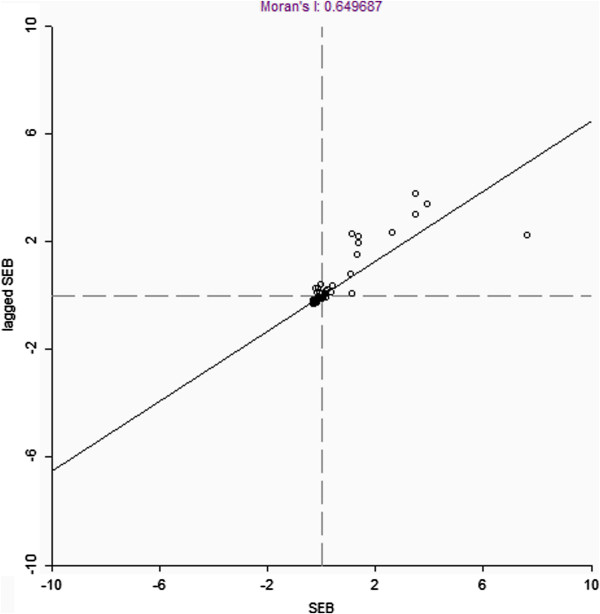
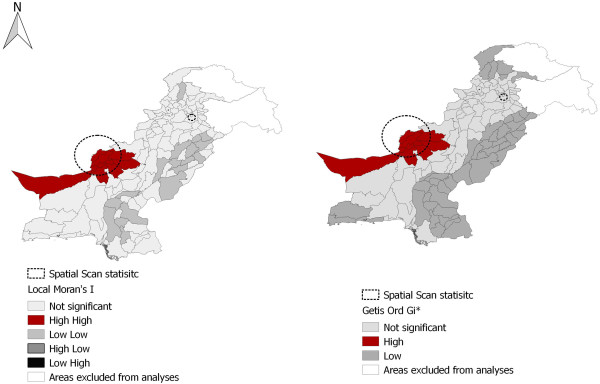
Kulldorff's spatial scan statisitc, Anselin's Local Moran's I and Getis Ord Gi* tests were applied on data (i.e. number of laboratory confirmed cases reported from each district during year 2013).
The analyses revealed a large multi-district cluster of high CCHF incidence in the uplands of Balochistan province near it border with Afghanistan. The cluster comprised the following districts: Qilla Abdullah; Qilla Saifullah; Loralai, Quetta, Sibi, Chagai, and Mastung. Another cluster was detected in Punjab and included Rawalpindi district and a part of Islamabad.
We provide empirical evidence of spatial clustering of human CCHF cases in the country. The districts in the clusters should be given priority in surveillance, control programs, and further research.
克里米亚刚果出血热(CCHF)是一种由蜱传播的病毒性人畜共患病,在巴基斯坦几乎所有地理区域均有报道。本研究的目的是确定该国报告的人类CCHF病例的空间聚集情况。
将Kulldorff空间扫描统计量、Anselin局部莫兰指数I和Getis Ord Gi*检验应用于数据(即2013年各地区报告的实验室确诊病例数)。
分析显示,在俾路支省与阿富汗接壤的高地附近存在一个多地区的高CCHF发病率大聚集区。该聚集区包括以下地区:基拉阿卜杜拉;基拉赛义夫拉;洛拉莱、奎达、锡比、查盖和马斯图格。在旁遮普邦检测到另一个聚集区,包括拉瓦尔品第区和伊斯兰堡的一部分。
我们提供了该国人类CCHF病例空间聚集的实证证据。应在监测、控制计划和进一步研究中优先考虑聚集区内的地区。