Cheema Birinder S, Davies Timothy B, Stewart Matthew, Papalia Shona, Atlantis Evan
School of Science and Health, University of Western Sydney, Locked Bag 1797, Penrith, 2751 Campbelltown, New South Wales Australia ; The National Institute of Complementary Medicine, University of Western Sydney, Campbelltown, NSW 2650 Australia.
School of Science and Health, University of Western Sydney, Locked Bag 1797, Penrith, 2751 Campbelltown, New South Wales Australia.
BMC Sports Sci Med Rehabil. 2015 Jan 16;7:3. doi: 10.1186/2052-1847-7-3. eCollection 2015.
High-intensity interval training (HIIT) performed on exercise cycle or treadmill is considered safe and often more beneficial for fat loss and cardiometabolic health than moderate-intensity continuous training (MICT). The aim of this pilot study was to assess the feasibility and effectiveness of a 12-week boxing training (HIIT) intervention compared with an equivalent dose of brisk walking (MICT) in obese adults.
Men and women with abdominal obesity and body mass index >25 kg/m(2) were randomized to either a boxing group or a brisk walking (control) group for 12 weeks. Each group engaged in 4 training sessions per week, equated for total physical activity. Feasibility outcomes included recruitment rates, assessment of training intensities, adherence and adverse events. Effectiveness was assessed pre and post intervention via pertinent obesity-, cardiovascular-, and health-related quality of life (HRQoL) outcomes.
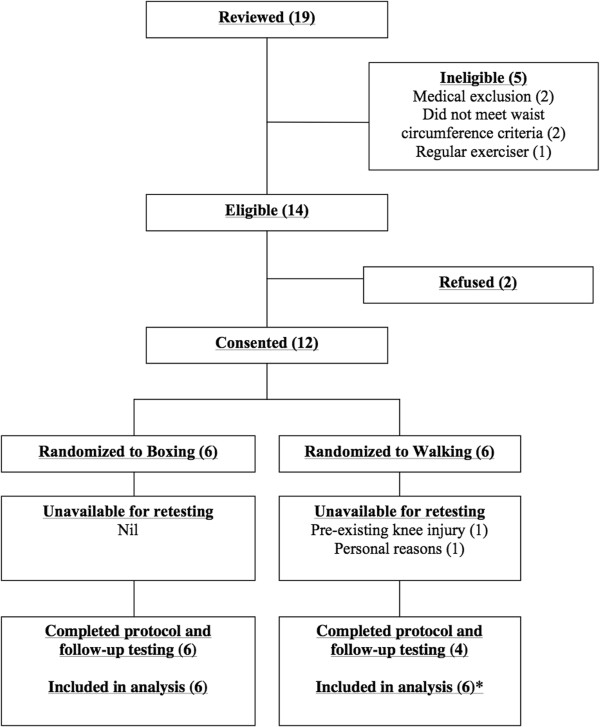
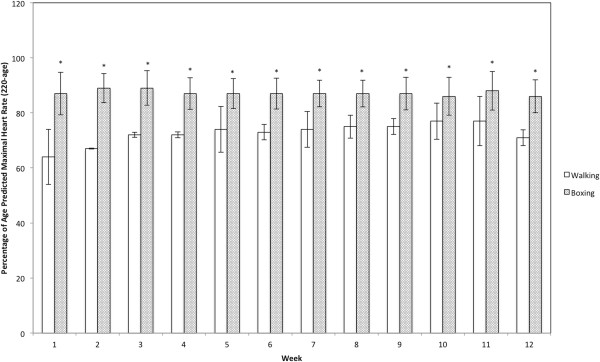
Nineteen individuals expressed an interest and 63% (n = 12) consented. Recruitment was slower than anticipated (1.3 participants/week). The boxing group trained at a significantly higher intensity each week versus the brisk walking group (p < 0.05). Two participants in the boxing group experienced an adverse event; both continued to exercise with modifications to the exercise program. No other adverse events were noted. The boxing group attended more sessions (79% vs. 55%) and had a lower attrition rate (n = 0 vs. n = 2) than the walking group. Analysis of covariance revealed that the boxing group significantly improved body fat percentage (p = 0.047), systolic blood pressure (p = 0.026), augmentation index (AIx; p < 0.001), absolute VO2max (p = 0.015), and Physical Functioning (p = 0.042) and Vitality (p = 0.024) domains of HRQoL over time. The walking group did not improve any clinical outcomes, and experienced a worsening of Vitality (p = 0.043).
Boxing training (HIIT) in adults with abdominal obesity is feasible and may elicit a better therapeutic effect on obesity, cardiovascular, and HRQoL outcomes than an equivalent dose of brisk walking (MICT). Robustly designed randomized controlled trials are required to confirm these findings and inform clinical guidelines and practice for obesity treatment.
ACTRN12615000007538.
在健身自行车或跑步机上进行的高强度间歇训练(HIIT)被认为是安全的,并且与中等强度持续训练(MICT)相比,通常对减脂和心脏代谢健康更有益。这项初步研究的目的是评估在肥胖成年人中,与同等剂量的快走(MICT)相比,为期12周的拳击训练(HIIT)干预的可行性和有效性。
腹部肥胖且体重指数>25kg/m²的男性和女性被随机分为拳击组或快走(对照组)组,为期12周。每组每周进行4次训练,总运动量相当。可行性结果包括招募率、训练强度评估、依从性和不良事件。通过相关的肥胖、心血管和健康相关生活质量(HRQoL)结果在干预前后评估有效性。
19人表示有兴趣,63%(n = 12)同意参与。招募速度比预期慢(每周1.3名参与者)。拳击组每周的训练强度明显高于快走组(p < 0.05)。拳击组有两名参与者经历了不良事件;两人都在对训练计划进行调整后继续锻炼。未发现其他不良事件。拳击组的训练课程参与率更高(79%对55%),流失率更低(n = 0对n = 2)。协方差分析显示,随着时间的推移,拳击组显著改善了体脂百分比(p = 0.047)、收缩压(p = 0.026)、增强指数(AIx;p < 0.001)、绝对最大摄氧量(p = 0.015)以及HRQoL的身体功能(p = 0.042)和活力(p = 0.024)领域。快走组没有改善任何临床结果,并且活力有所下降(p = 0.043)。
对于腹部肥胖的成年人,拳击训练(HIIT)是可行的,并且与同等剂量的快走(MICT)相比,可能对肥胖、心血管和HRQoL结果产生更好的治疗效果。需要设计严谨的随机对照试验来证实这些发现,并为肥胖治疗的临床指南和实践提供依据。
ACTRN12615000007538。