Dinat Natalya, Marinda Edmore, Moch Shirra, Rice Andrew S C, Kamerman Peter R
Centre for Palliative Care, Faculty of Health Sciences, University of the Witwatersrand, Johannesburg, South Africa.
School of Public Health, Faculty of Health Sciences, University of the Witwatersrand, Johannesburg, South Africa.
PLoS One. 2015 May 14;10(5):e0126297. doi: 10.1371/journal.pone.0126297. eCollection 2015.
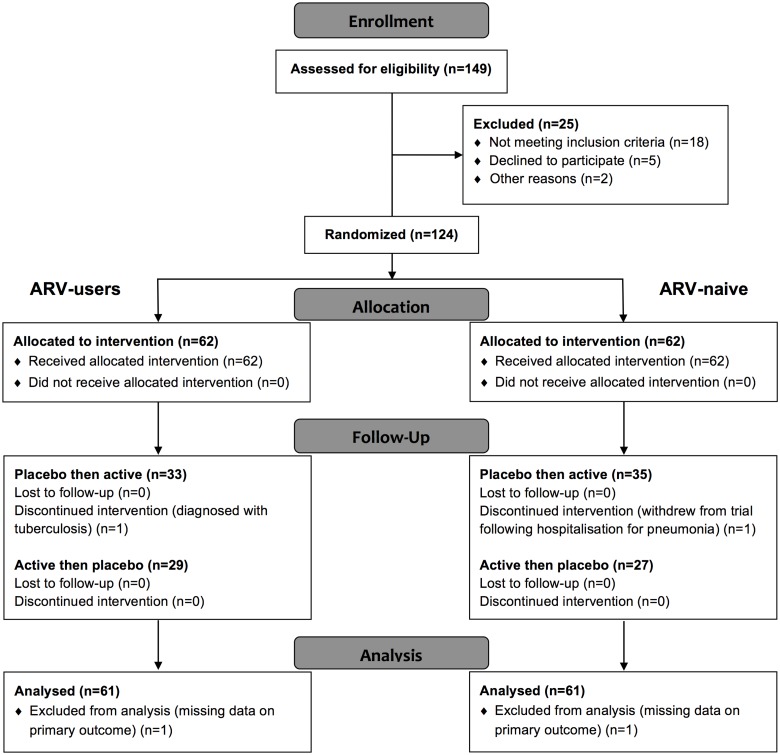
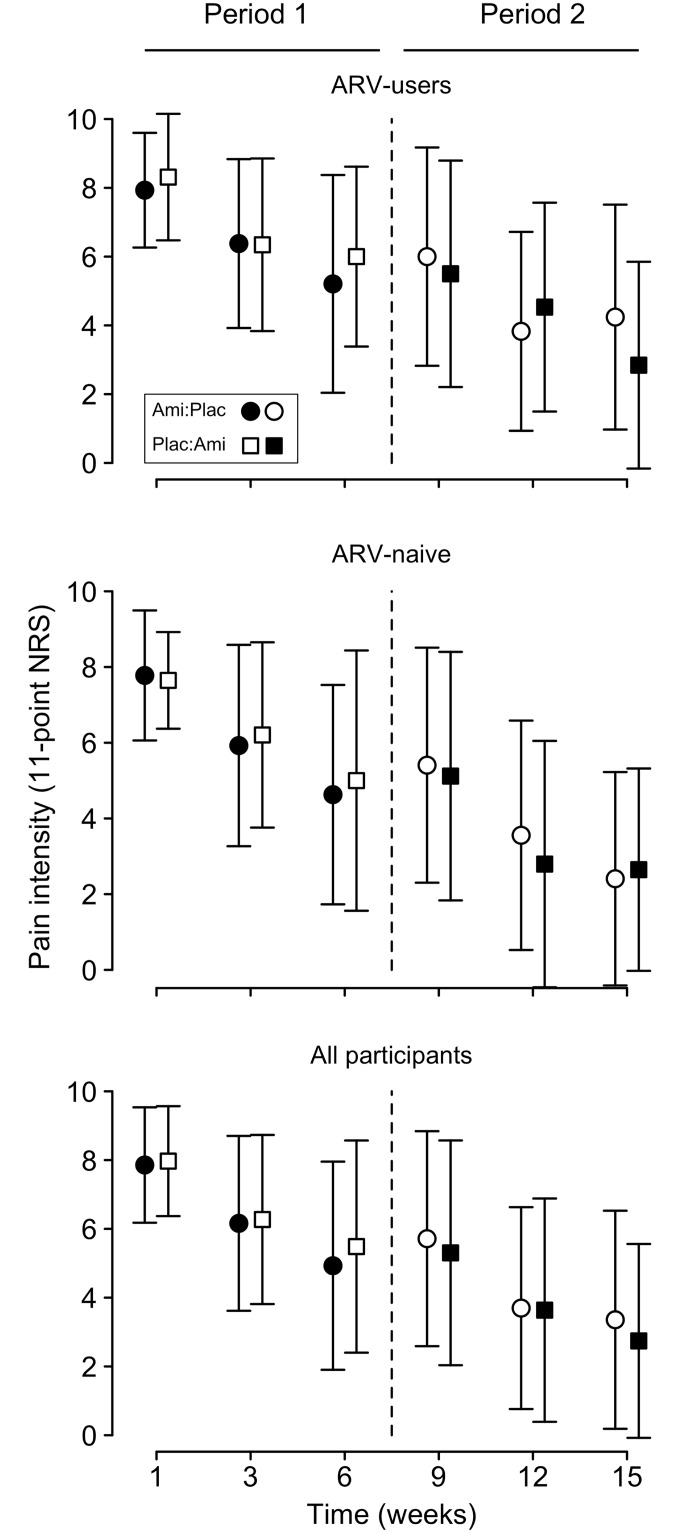
We conducted a randomized, double-blind, placebo-controlled, crossover study at a single center in South Africa, to ascertain whether amitriptyline is an effective analgesic for painful HIV-associated sensory neuropathy of moderate to severe intensity in: i) antiretroviral drug naive individuals, and ii) antiretroviral drug users. 124 HIV-infected participants (antiretroviral drug naive = 62, antiretroviral drug users = 62) who met the study criteria for painful HIV-associated sensory neuropathy were randomized to once-daily oral amitriptyline (titrated to a median: interquartile range of 50: 25-50 mg) or placebo for six weeks, followed by a three-week washout period and subsequent treatment crossover. The primary outcome measure was change from baseline in worst pain intensity of the feet (measured by participant self-report using an 11-point numerical pain rating scale) after six weeks of treatment. 122 of 124 participants completed all study visits and were included in the analysis of the primary outcome. In the antiretroviral drug-naive group (n = 61) there was no significant difference in the mean change in pain score from baseline after six weeks of treatment with placebo or amitriptyline [amitriptyline: 2.8 (SD 3.3) vs. placebo: 2.8 (3.4)]. Similarly, there was no significant difference in the change in pain score after six weeks of treatment with placebo or amitriptyline in the antiretroviral drug-user group (n = 61) [amitriptyline: 2.7 (3.3) vs. placebo: 2.1 (2.8)]. Controlling for period effects and treatment order effects did not alter the outcome of the analyses. Nor did analyzing the intention-to-treat cohort (missing data interpolated using baseline observation carried forward) alter the outcome of the analyses. In summary, amitriptyline, at the doses used here, was no more effective than an inactive placebo at reducing pain intensity in individuals with painful HIV-associated sensory neuropathy of moderate to severe intensity, irrespective of whether they were on antiretroviral therapy or not.
ISRCTN 54452526.
我们在南非的一个中心进行了一项随机、双盲、安慰剂对照的交叉研究,以确定阿米替林对于以下两类人群中中度至重度疼痛的HIV相关感觉神经病变是否为一种有效的镇痛药:i)未接受过抗逆转录病毒药物治疗的个体,以及ii)抗逆转录病毒药物使用者。124名符合疼痛性HIV相关感觉神经病变研究标准的HIV感染者(未接受过抗逆转录病毒药物治疗者 = 62人,抗逆转录病毒药物使用者 = 62人)被随机分为每日口服一次阿米替林(滴定至中位数:四分位间距为50: 25 - 50 mg)或安慰剂,为期六周,随后是为期三周的洗脱期以及后续的治疗交叉。主要结局指标是治疗六周后足部最严重疼痛强度相对于基线的变化(通过参与者使用11点数字疼痛评分量表进行自我报告测量)。124名参与者中有122人完成了所有研究访视并被纳入主要结局分析。在未接受过抗逆转录病毒药物治疗的组(n = 61)中,使用安慰剂或阿米替林治疗六周后,疼痛评分相对于基线的平均变化无显著差异[阿米替林组:2.8(标准差3.3)对安慰剂组:2.8(3.4)]。同样,在抗逆转录病毒药物使用者组(n = 61)中,使用安慰剂或阿米替林治疗六周后疼痛评分的变化也无显著差异[阿米替林组:2.7(3.3)对安慰剂组:2.1(2.8)]。控制周期效应和治疗顺序效应并未改变分析结果。分析意向性治疗队列(使用向前结转的基线观察值对缺失数据进行插补)也未改变分析结果。总之,在此处使用的剂量下,阿米替林在减轻中度至重度疼痛的HIV相关感觉神经病变个体的疼痛强度方面并不比无活性的安慰剂更有效,无论他们是否接受抗逆转录病毒治疗。
ISRCTN 54452526 。