Department of Preventive Medicine and Biometrics, Division of Occupational and Environmental Health Sciences, F. Edward Hebert School of Medicine, Uniformed Services University of the Health Sciences, Bethesda, MD USA.
Department of Sociology, University of Maryland, College Park, Maryland, USA.
Arch Public Health. 2015 Apr 27;73(1):22. doi: 10.1186/s13690-015-0070-3. eCollection 2015.
Research has demonstrated that children who participate in active play are more likely to be physically active, thereby improving long-term health outcomes. Many adult studies have also shown that neighborhood built environments can encourage or discourage routine physical activity. Limited evidence has demonstrated that children who reside in neighborhoods with a built environment that is more inviting to active play exhibit lower overweight and obesity rates as well as an overall better state of well-being. This Built Environment and Active Play (BEAP) Study aims to develop a neighborhood playability rating system in the Washington, DC (DMV) area. Similar to walkability scores, these playability scores will estimate how affable a neighborhood is to active play. The BEAP Study will attempt to provide a broad view of factors influencing the level and type of active play among children.
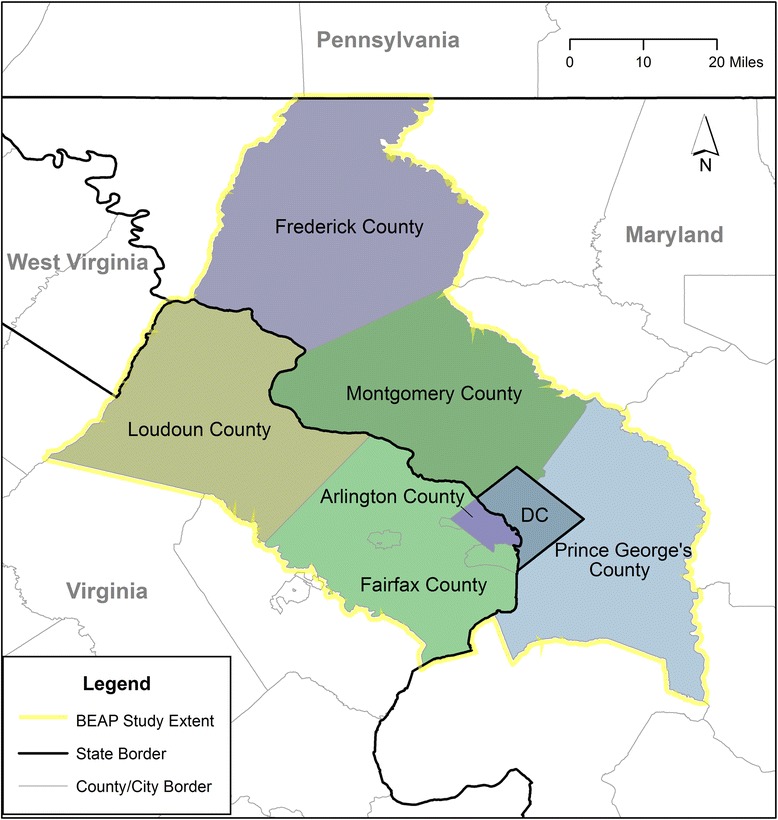
METHODS/DESIGN: Using a cross-sectional design, the BEAP Study will collect data using a mail questionnaire administered to the parents and/or guardians of 2000 children aged 7-12 years residing in select DMV areas in October of 2014. Questionnaire data, including information on active play, home and neighborhood characteristics, parental perceptions, and sociodemographic characteristics will be merged through a geographic information system (GIS) with objective built environment measures in the participants' neighborhoods. An ordered logit model will be used to regress an ordinal active play outcome on built environment exposure variables while adjusting for potential confounders. Upon the construction of the final model, predictor coefficients will be used as parameters in the scoring system to develop neighborhood playability scores.
The BEAP Study intends to generate a neighborhood playability index by characterizing and quantifying children's active play using parent-reported physical activity data in children, GIS data and built environment measures in participant neighborhoods. The BEAP Study will improve our understanding of the built environment and childhood playability relationship while also contributing to the body of evidence-based built environment and physical activity research.
研究表明,积极参与游戏的儿童更有可能进行身体活动,从而改善长期健康状况。许多成人研究还表明,邻里环境的构建可以鼓励或阻止日常身体活动。有限的证据表明,居住在邻里环境更有利于积极游戏的儿童,超重和肥胖率较低,整体健康状况也更好。这项邻里环境与积极游戏(BEAP)研究旨在开发华盛顿特区(DMV)地区的邻里游戏性评级系统。与可步行性评分类似,这些游戏性评分将估计邻里环境对积极游戏的友好程度。BEAP 研究将试图提供一个广泛的视角,了解影响儿童积极游戏水平和类型的因素。
方法/设计:使用横断面设计,BEAP 研究将在 2014 年 10 月通过邮寄问卷收集数据,问卷对象是居住在 DMV 地区的 2000 名 7-12 岁儿童的家长或监护人。问卷数据包括有关积极游戏、家庭和邻里特征、家长看法以及社会人口特征的信息,将通过地理信息系统(GIS)与参与者社区的客观构建环境测量数据进行合并。有序逻辑回归模型将用于在调整潜在混杂因素的情况下,将有序积极游戏结果回归到构建环境暴露变量。在构建最终模型后,将使用预测系数作为参数来开发邻里游戏性评分系统中的评分系统。
BEAP 研究旨在通过使用父母报告的儿童身体活动数据、GIS 数据和参与者社区的构建环境测量数据来描述和量化儿童的积极游戏,生成邻里游戏性指数。BEAP 研究将提高我们对构建环境与儿童游戏性关系的理解,同时为基于证据的构建环境和身体活动研究提供依据。