Jago Russell, Sebire Simon J, Wood Lesley, Pool Laura, Zahra Jesmond, Thompson Janice L, Lawlor Deborah A
Centre for Exercise, Nutrition & Health Sciences, School for Policy Studies, University of Bristol, 8 Priory Road, Bristol, BS8 1TZ, UK.
BMC Public Health. 2014 Jun 27;14:655. doi: 10.1186/1471-2458-14-655.
A number of studies have suggested that there is a need to increase the physical activity levels of children. Parents are important influences on children's behaviour. There is a lack of information about whether there are associations between the physical activity levels of young children and their parents. The current study examined the associations between the physical activity (PA) of parents and their children at age five to six years old, and determined whether any associations differed by child or parent gender or between week and weekend days.
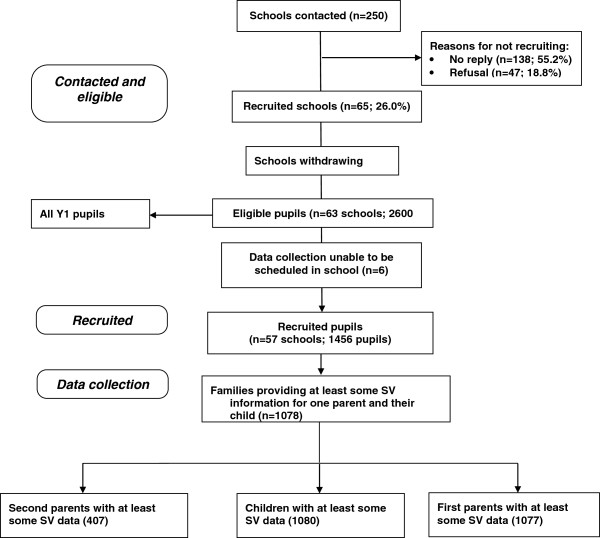
Cross-sectional study, with 1267 Year 1 pupils (five to six years of age) and at least one parent from 57 primary schools. Children and parents wore an accelerometer for five days and mean minutes of moderate-to-vigorous intensity physical activity (MVPA) per day were derived. We used multivariable linear regression to investigate whether parental and child time spent in MVPA was associated with each other. Each model was adjusted for age, child gender, parent BMI and neighbourhood deprivation with subgroup analysis by child gender.
80% of parents met PA guidelines, however 29% of boys and 47% of girls aged five to six years failed to meet them. Fully-adjusted analyses suggested weak positive associations of parent's and children's time spent in MVPA. Every 10 additional minutes of parental MVPA were associated with one additional minute of child MVPA. There was no evidence of a difference in associations for boys and girls or between mothers and fathers.
29% of boys and 47% of girls aged five to six years did not meet PA guidelines indicating that these children would benefit from new approaches that focus on increasing physical activity. There were weak associations between the MVPA of 5-6 year old children and their parents, demonstrating that the time that children are active with their parents is not a major source of physical activity. Clinicians and public health professionals should encourage parents to create opportunities for their children to be active.
多项研究表明,有必要提高儿童的身体活动水平。父母对孩子的行为有重要影响。关于幼儿的身体活动水平与其父母之间是否存在关联,目前缺乏相关信息。本研究调查了父母与5至6岁孩子的身体活动之间的关联,并确定这些关联是否因孩子或父母的性别,以及工作日和周末而有所不同。
横断面研究,纳入了来自57所小学的1267名一年级学生(5至6岁)及其至少一位家长。儿童和家长佩戴加速度计5天,并计算出每天中度至剧烈强度身体活动(MVPA)的平均分钟数。我们使用多变量线性回归来研究父母和孩子在MVPA上花费的时间是否相互关联。每个模型都根据年龄、儿童性别、父母体重指数和邻里贫困程度进行了调整,并按儿童性别进行了亚组分析。
80%的父母达到了身体活动指南的要求,然而,5至6岁的男孩中有29%、女孩中有47%未达到该要求。完全调整后的分析表明,父母和孩子在MVPA上花费的时间之间存在微弱的正相关。父母的MVPA每增加10分钟,孩子的MVPA就会增加1分钟。没有证据表明男孩和女孩之间或母亲和父亲之间的关联存在差异。
5至6岁的男孩中有29%、女孩中有47%未达到身体活动指南的要求,这表明这些孩子将从专注于增加身体活动的新方法中受益。5至6岁儿童的MVPA与他们父母的MVPA之间存在微弱的关联,这表明孩子与父母一起活动的时间不是身体活动的主要来源。临床医生和公共卫生专业人员应鼓励父母为孩子创造积极活动的机会。