Almagro-Moreno Salvador, Pruss Kali, Taylor Ronald K
Department of Microbiology and Immunology, Geisel School of Medicine at Dartmouth, Hanover, New Hampshire, United States of America.
PLoS Pathog. 2015 May 21;11(5):e1004787. doi: 10.1371/journal.ppat.1004787. eCollection 2015 May.
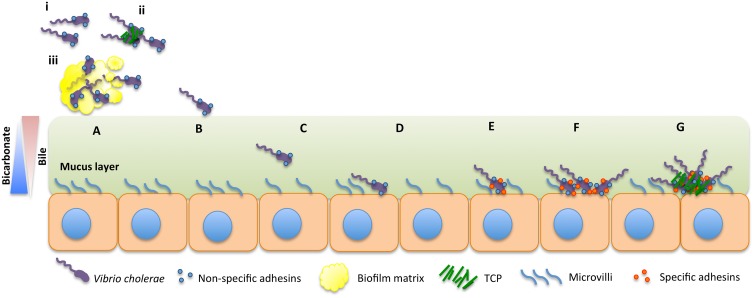
To cause the diarrheal disease cholera, Vibrio cholerae must effectively colonize the small intestine. In order to do so, the bacterium needs to successfully travel through the stomach and withstand the presence of agents such as bile and antimicrobial peptides in the intestinal lumen and mucus. The bacterial cells penetrate the viscous mucus layer covering the epithelium and attach and proliferate on its surface. In this review, we discuss recent developments and known aspects of the early stages of V. cholerae intestinal colonization and highlight areas that remain to be fully understood. We propose mechanisms and postulate a model that covers some of the steps that are required in order for the bacterium to efficiently colonize the human host. A deeper understanding of the colonization dynamics of V. cholerae and other intestinal pathogens will provide us with a variety of novel targets and strategies to avoid the diseases caused by these organisms.
为引发腹泻病霍乱,霍乱弧菌必须有效地在小肠中定殖。为此,该细菌需要成功穿过胃部,并抵御肠腔和黏液中诸如胆汁和抗菌肽等物质的存在。细菌细胞穿透覆盖上皮的黏性黏液层,并在其表面附着和增殖。在本综述中,我们讨论了霍乱弧菌肠道定殖早期阶段的最新进展和已知方面,并强调了仍有待充分了解的领域。我们提出了机制并假定了一个模型,该模型涵盖了细菌有效定殖人类宿主所需的一些步骤。对霍乱弧菌和其他肠道病原体定殖动态的更深入了解将为我们提供各种新的靶点和策略,以避免由这些病原体引起的疾病。