Scherzer Sönke, Böhm Jennifer, Krol Elzbieta, Shabala Lana, Kreuzer Ines, Larisch Christina, Bemm Felix, Al-Rasheid Khaled A S, Shabala Sergey, Rennenberg Heinz, Neher Erwin, Hedrich Rainer
Institute for Molecular Plant Physiology and Biophysics, University of Wuerzburg, D-97082 Würzburg, Germany;
School of Land and Food, University of Tasmania, Hobart TAS 7001, Australia;
Proc Natl Acad Sci U S A. 2015 Jun 9;112(23):7309-14. doi: 10.1073/pnas.1507810112. Epub 2015 May 21.
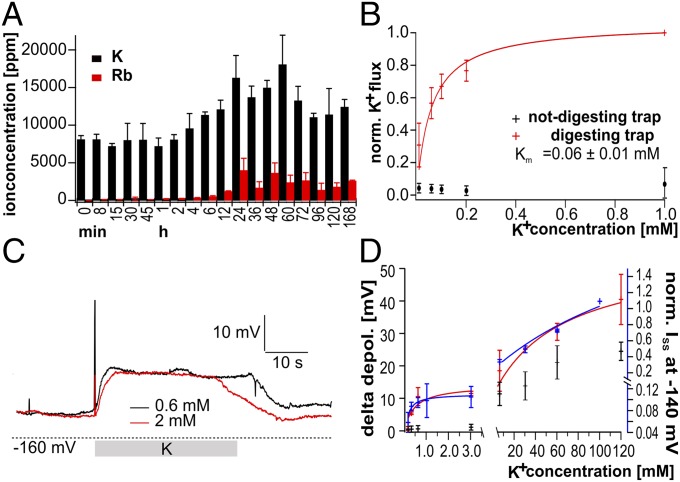
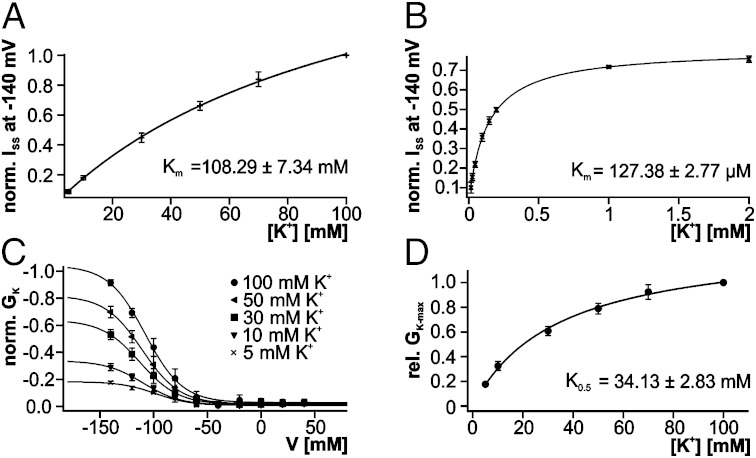
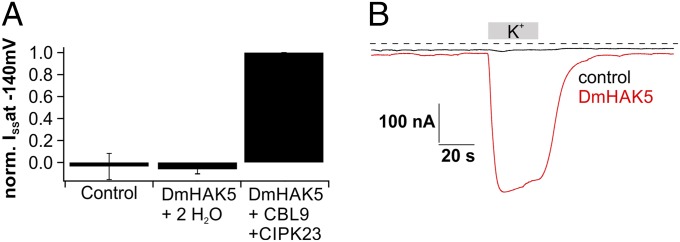
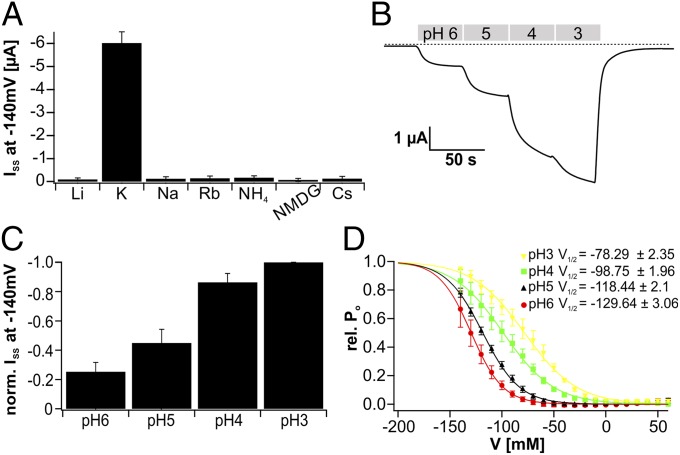
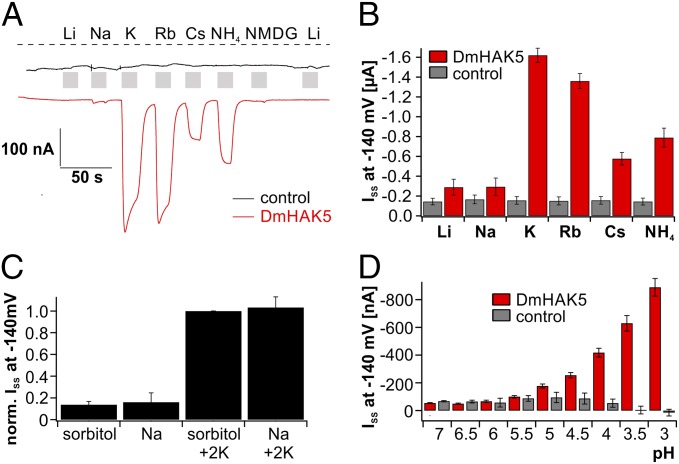
The Darwin plant Dionaea muscipula is able to grow on mineral-poor soil, because it gains essential nutrients from captured animal prey. Given that no nutrients remain in the trap when it opens after the consumption of an animal meal, we here asked the question of how Dionaea sequesters prey-derived potassium. We show that prey capture triggers expression of a K(+) uptake system in the Venus flytrap. In search of K(+) transporters endowed with adequate properties for this role, we screened a Dionaea expressed sequence tag (EST) database and identified DmKT1 and DmHAK5 as candidates. On insect and touch hormone stimulation, the number of transcripts of these transporters increased in flytraps. After cRNA injection of K(+)-transporter genes into Xenopus oocytes, however, both putative K(+) transporters remained silent. Assuming that calcium sensor kinases are regulating Arabidopsis K(+) transporter 1 (AKT1), we coexpressed the putative K(+) transporters with a large set of kinases and identified the CBL9-CIPK23 pair as the major activating complex for both transporters in Dionaea K(+) uptake. DmKT1 was found to be a K(+)-selective channel of voltage-dependent high capacity and low affinity, whereas DmHAK5 was identified as the first, to our knowledge, proton-driven, high-affinity potassium transporter with weak selectivity. When the Venus flytrap is processing its prey, the gland cell membrane potential is maintained around -120 mV, and the apoplast is acidified to pH 3. These conditions in the green stomach formed by the closed flytrap allow DmKT1 and DmHAK5 to acquire prey-derived K(+), reducing its concentration from millimolar levels down to trace levels.
达尔文植物捕蝇草能够在矿物质贫瘠的土壤中生长,因为它从捕获的动物猎物中获取必需的营养物质。鉴于动物被消化后陷阱打开时其中没有剩余营养物质,我们在此提出一个问题:捕蝇草如何隔离猎物来源的钾。我们发现猎物捕获会触发捕蝇草中钾离子吸收系统的表达。为了寻找具有适合此功能特性的钾离子转运蛋白,我们筛选了捕蝇草的表达序列标签(EST)数据库,并确定DmKT1和DmHAK5为候选蛋白。在昆虫和触碰激素刺激下,这些转运蛋白的转录本数量在捕蝇草中增加。然而,将钾离子转运蛋白基因的cRNA注射到非洲爪蟾卵母细胞后,这两种假定的钾离子转运蛋白均无活性。假设钙传感激酶调节拟南芥钾离子转运蛋白1(AKT1),我们将假定的钾离子转运蛋白与大量激酶共表达,并确定CBL9-CIPK23对是捕蝇草钾离子吸收中这两种转运蛋白的主要激活复合物。发现DmKT1是一种电压依赖性、高容量、低亲和力的钾离子选择性通道,而据我们所知,DmHAK5是首个质子驱动、高亲和力、选择性较弱的钾离子转运蛋白。当捕蝇草处理其猎物时,腺细胞膜电位维持在-120 mV左右,质外体酸化至pH 3。由关闭的捕蝇草形成的绿色“胃”中的这些条件使DmKT1和DmHAK5能够获取猎物来源的钾,将其浓度从毫摩尔水平降低到痕量水平。