Bluth Karen, Roberson Patricia N E, Gaylord Susan A
Program on Integrative Medicine, Department of Physical Medicine and Rehabilitation, University of North Carolina, CB 7200, Chapel Hill, NC 27599.
Department of Psychology, University of Tennessee, Knoxville, TN.
Explore (NY). 2015 Jul-Aug;11(4):292-5. doi: 10.1016/j.explore.2015.04.005. Epub 2015 Apr 28.
In this pilot study, we sought to investigate the effects of a mindfulness intervention for adolescents on a community sample of teens. Specifically, we explored the effects of mindfulness training on emotional well-being outcomes. Also, we examined the relationship between mindfulness and self-compassion at baseline-predicted outcome measures.
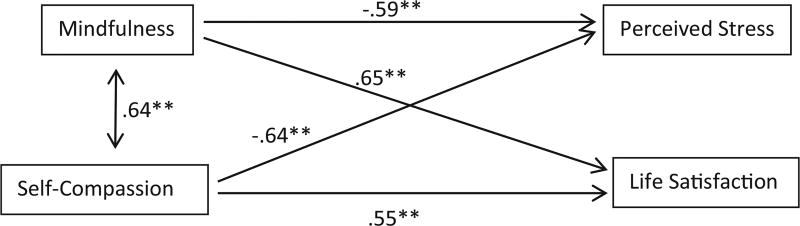
This design was a pre-/post-pilot intervention study. Paired t-tests were conducted to examine change in outcome measures before and after the mindfulness intervention. Multiple regression was also conducted to investigate the influence of baseline mindfulness and self-compassion on outcome measures.
The study took place after school in a classroom at a local university.
Overall 28 adolescents age 10-18 years from two different cohorts participated in this study.
Learning to BREATHE, a mindfulness curriculum designed specifically for adolescents and taught in six 1.5h sessions, was implemented.
The outcome measures, life satisfaction and perceived stress, were included in an online survey before and after the mindfulness intervention.
Results indicated that mindfulness, self-compassion, perceived stress, and life satisfaction improved from pre-intervention to post-intervention. Further, self-compassion (taught within the mindfulness intervention) was negatively related to perceived stress post-intervention while controlling for baseline stress. These findings suggest that mindfulness may be an effective intervention for improving indicators of emotional well-being among an adolescent population. Additionally, self-compassion may be a pathway through which youth can lower stress. Future research should examine self-compassion as a potential factor in promoting emotional well-being.
在这项试点研究中,我们试图调查针对青少年的正念干预对青少年社区样本的影响。具体而言,我们探讨了正念训练对情绪幸福感结果的影响。此外,我们在基线预测结果测量中检验了正念与自我同情之间的关系。
本设计为预试验/后试验干预研究。进行配对t检验以检查正念干预前后结果测量的变化。还进行了多元回归分析,以研究基线正念和自我同情对结果测量的影响。
该研究在当地一所大学的一间教室里放学后进行。
来自两个不同队列的28名10 - 18岁青少年参与了本研究。
实施了“学会呼吸”这一专门为青少年设计的正念课程,共六个课时,每个课时1.5小时。
在正念干预前后的在线调查中纳入了结果测量指标,即生活满意度和感知压力。
结果表明,从干预前到干预后,正念、自我同情、感知压力和生活满意度均有所改善。此外,在控制基线压力的情况下,干预后的自我同情(在正念干预中教授)与感知压力呈负相关。这些发现表明,正念可能是改善青少年群体情绪幸福感指标的有效干预措施。此外,自我同情可能是年轻人减轻压力的一条途径。未来的研究应将自我同情作为促进情绪幸福感的一个潜在因素进行研究。