Beciragic Amela, Resic Halima, Prohic Nejra, Karamehic Jasenko, Smajlovic Ajdin, Masnic Fahrudin, Ajanovic Selma, Coric Aida
Clinic of Hemodialysis, University Clinical Centre, Sarajevo, Bosnia and Herzegovina.
Clinic for Immunology, University Clinical Centre, Sarajevo, Bosnia and Herzegovina.
Mater Sociomed. 2015 Apr;27(2):87-90. doi: 10.5455/msm.2015.27.87-90. Epub 2015 Apr 5.
Increased levels of C-Reactive Protein are found in 30-60% on hemodialysis patients and it is closely associated with the progression of atherosclerosis, cardiovascular morbidity and mortality. Non enzymatic antioxidants are antioxidants which primarily retain potentially dangerous ions of iron and copper in their inactive form and thereby prevent its participation in the production of free radicals.
The aim of the study was to examine the relationship of CRP and non enzymatic antioxidants (albumin, ferritin, uric acid and bilirubin) i.e. examine the importance of CRP as a serum biomarker in assessing the condition of inflammation and its relationship to antioxidant protection in patients on hemodialysis.
The study was cross-sectional, clinical, comparative and descriptive. The study involved 100 patients (non diabetic) on chronic hemodialysis. The control group consisted of 50 subjects without subjective and objective indicators of chronic renal disease. In all patients, the concentration of CRP as well as concentrations of non enzymatic antioxidants were determined.
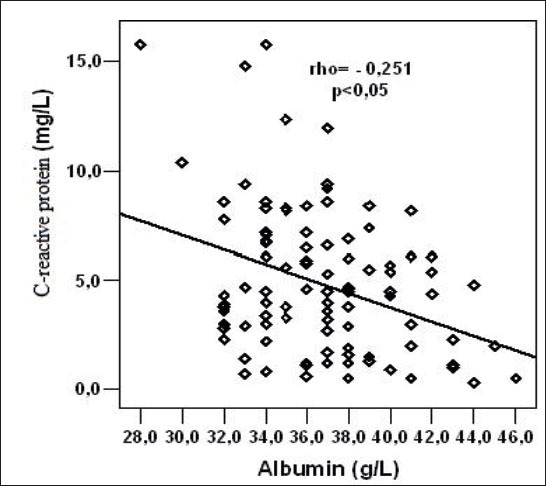
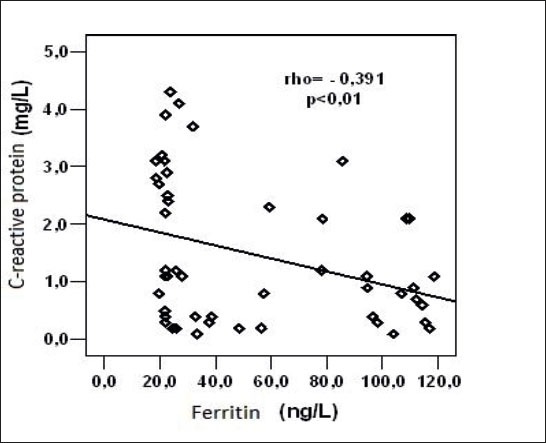
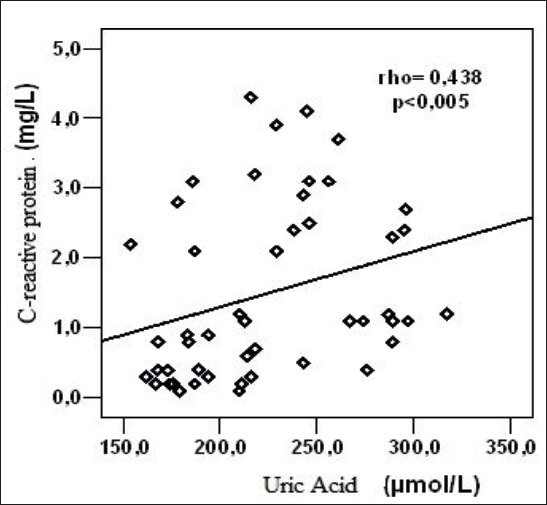
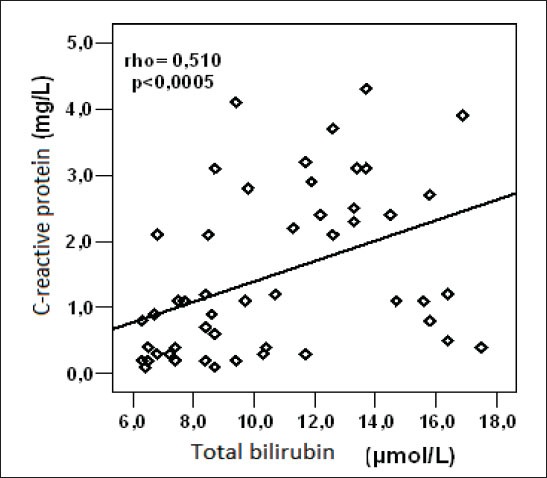
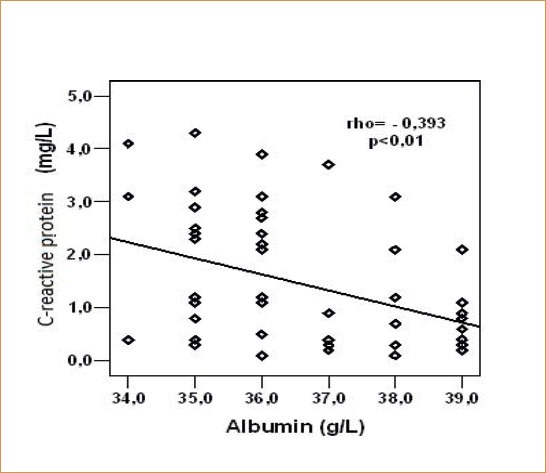
In the group of hemodialysis patients 60% were men and 40% women. The average age of hemodialysis patients was 54.13 ± 11.8 years and the average age of the control group 41.72 ± 9.8 years. The average duration of hemodialysis treatment was 91.42 ± 76.2 months. In the group of hemodialysis patients statistically significant, negative linear correlation was determined between the concentration of CRP in and albumin concentration (rho = -0.251, p = 0.012) as well as negative, statistics insignificant, linear correlation between serum CRP and the concentration of uric acid (r = -0.077, p = 0.448). Furthermore, the positive, linear correlation was determined between serum CRP and ferritin (r = 0.159, p = 0.114) and positive linear correlation between CRP and total serum bilirubin (r = 0.121, p = 0.230). In the control group was determined a statistically significant, positive, linear correlation between serum CRP and uric acid concentration (rho = 0.438, p = 0.001) and statistically significant, positive, linear correlation between serum CRP and total serum bilirubin (rho = 0.510, p = 0.0001) A statistically significant, negative linear correlation was determined between CRP and albumin concentration (rho= -0.393, p = 0.005) as well as statistically significant, negative linear correlation between serum CRP and ferritin control group (rho = -0.391, p = 0.005).
Elevated CRP level is a strong and independent predictor of low levels of serum albumin, which indicates that the hypoalbuminemia in hemodialysis patients could be more due to inflammation than malnutrition. There was no statistically significant correlation between CRP and other non enzymatic antioxidants (uric acid, ferritin, bilirubin), which shows that indicators of antioxidant defense in hemodialysis patients must be individually measured to determine their actual stocks and activity.
30%-60%的血液透析患者体内C反应蛋白水平升高,且其与动脉粥样硬化进展、心血管疾病发病率及死亡率密切相关。非酶抗氧化剂主要以非活性形式保留潜在危险的铁离子和铜离子,从而防止其参与自由基的产生。
本研究旨在探讨C反应蛋白与非酶抗氧化剂(白蛋白、铁蛋白、尿酸和胆红素)之间的关系,即研究C反应蛋白作为血清生物标志物在评估血液透析患者炎症状态及其与抗氧化保护关系中的重要性。
本研究为横断面、临床、对比及描述性研究。研究纳入100例慢性血液透析的非糖尿病患者。对照组由50名无慢性肾病主观及客观指标的受试者组成。测定所有患者的C反应蛋白浓度以及非酶抗氧化剂浓度。
血液透析患者组中男性占60%,女性占40%。血液透析患者的平均年龄为54.13±11.8岁,对照组的平均年龄为41.72±9.8岁。血液透析治疗的平均时长为91.42±76.2个月。在血液透析患者组中,C反应蛋白浓度与白蛋白浓度之间存在统计学显著的负线性相关性(rho = -0.251, p = 0.012),血清C反应蛋白与尿酸浓度之间存在负的、统计学不显著的线性相关性(r = -0.077, p = 0.448)。此外,血清C反应蛋白与铁蛋白之间存在正线性相关性(r = 0.159, p = 0.114),C反应蛋白与血清总胆红素之间存在正线性相关性(r = 0.121, p = 0.230)。在对照组中,血清C反应蛋白与尿酸浓度之间存在统计学显著且正的线性相关性(rho = 0.438, p = 0.001),血清C反应蛋白与血清总胆红素之间存在统计学显著且正的线性相关性(rho = 0.510, p = 0.0001)。C反应蛋白与白蛋白浓度之间存在统计学显著的负线性相关性(rho = -0.393, p = 0.005),血清C反应蛋白与对照组铁蛋白之间也存在统计学显著的负线性相关性(rho = -0.391, p = 0.005)。
C反应蛋白水平升高是血清白蛋白水平降低的一个强有力的独立预测指标,这表明血液透析患者的低白蛋白血症可能更多是由炎症而非营养不良导致。C反应蛋白与其他非酶抗氧化剂(尿酸、铁蛋白、胆红素)之间无统计学显著相关性,这表明必须单独测量血液透析患者的抗氧化防御指标,以确定其实际储备和活性。