de Pedro Miguel A, Cava Felipe
Centro de Biología Molecular "Severo Ochoa" - Consejo Superior de Investigaciones Científicas, Universidad Autónoma de Madrid Madrid, Spain ; Laboratory for Molecular Infection Medicine Sweden, Department of Molecular Biology, Umeå Center for Microbial Research, Umeå University, Umeå Sweden.
Laboratory for Molecular Infection Medicine Sweden, Department of Molecular Biology, Umeå Center for Microbial Research, Umeå University, Umeå Sweden.
Front Microbiol. 2015 May 8;6:449. doi: 10.3389/fmicb.2015.00449. eCollection 2015.
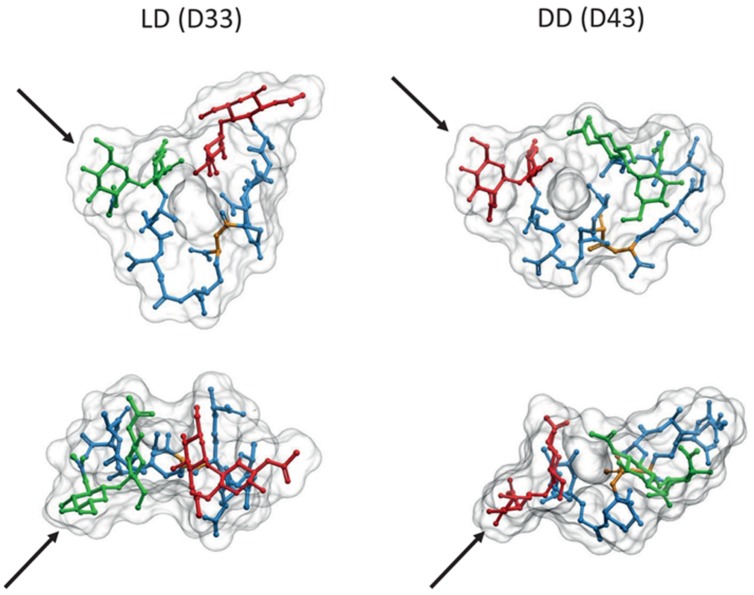
The peptidoglycan wall (PG) is a unique structure which confers physical strength and defined shape to bacteria. It consists of a net-like macromolecule of peptide interlinked glycan chains overlying the cell membrane. The structure and layout of the PG dictates that the wall has to be continuously modified as bacteria go through division, morphological differentiation, and adaptive responses. The PG is poorly known in structural terms. However, to understand morphogenesis a precise knowledge of glycan strand arrangement and of local effects of the different kinds of subunits is essential. The scarcity of data led to a conception of the PG as a regular, highly ordered structure which strongly influenced growth models. Here, we review the structure of the PG to define a more realistic conceptual framework. We discuss the consequences of the plasticity of murein architecture in morphogenesis and try to define a set of minimal structural constraints that must be fulfilled by any model to be compatible with present day information.
肽聚糖细胞壁(PG)是一种独特的结构,它赋予细菌物理强度并确定其形状。它由覆盖在细胞膜上的肽交联聚糖链的网状大分子组成。PG的结构和布局决定了随着细菌经历分裂、形态分化和适应性反应,细胞壁必须不断地进行修饰。PG在结构方面鲜为人知。然而,为了理解形态发生,聚糖链排列以及不同种类亚基的局部效应的精确知识是必不可少的。数据的稀缺导致了将PG视为一种规则、高度有序结构的概念,这对生长模型产生了强烈影响。在这里,我们回顾PG的结构以定义一个更现实的概念框架。我们讨论了胞壁质结构可塑性在形态发生中的后果,并试图定义一组任何模型为了与当今信息兼容而必须满足的最小结构约束条件。