Gonzalez-Anton Carolina, Rico Maria C, Sanchez-Rodriguez Estefania, Ruiz-Lopez Maria D, Gil Angel, Mesa Maria D
Department of Biochemistry and Molecular Biology II, Institute of Nutrition and Food Technology "Jose Mataix", University of Granada, Avenida del Conocimiento s/n, 18100 Armilla (Granada), Spain.
Department of Nutrition and Food Science, Institute of Nutrition and Food Technology "Jose Mataix", University of Granada, Campus Universitario de Cartuja C.P., 18071 Granada (Granada), Spain.
Nutrients. 2015 May 27;7(6):4033-53. doi: 10.3390/nu7064033.
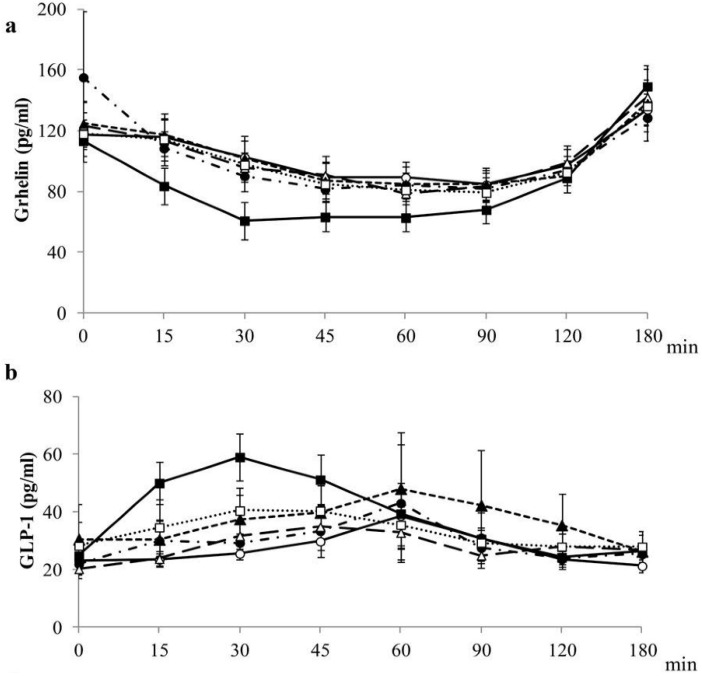
The present study was carried out to determine the glycemic index (GI), glycemic load (GL), insulinemic index (InI), appetite ratings and postprandial plasma concentrations of gastrointestinal hormones related to the control of food intake after the ingestion of the five most common breads consumed in Spain with different compositions and manufacturing processes. Twenty-two healthy adults participated in a randomized crossover study. The breads tested were Ordinary, Precooked-Frozen, Candeal-flour, Alfacar whites and Wholemeal. All breads portions were calculated to supply 50 g of available carbohydrates. In addition, 50 g of glucose was used as a reference. A linear mixed-effects model was used to compare data calculated for all breads with glucose load. The GI value varied from 61 for the Wholemeal, to Alfacar 68, Ordinary 76, and 78 and 86 for the Precooked-Frozen and Candeal-flour breads, respectively. Wholemeal and Alfacar had lower GI than glucose. All tested breads had a lower GL (ranged 9 to 18) compared with glucose. Wholemeal GL was similar to Alfacar, but lower than the other white breads. InI were significantly lower for all breads (ranged 68 to 73) compared with glucose, and similar among them. The intake of the Wholemeal bread led to a higher release of gastric inhibitory polypeptide compared with the Ordinary and Precooked breads and to a higher release of pancreatic polypeptide compared with the Precooked-Frozen bread. All breads affected appetite ratings similarly. In conclusion, based on GL, the Wholemeal bread would be expected to exert a favorable glycemic response.
本研究旨在测定西班牙消费的五种不同成分和制作工艺的常见面包摄入后,其血糖生成指数(GI)、血糖负荷(GL)、胰岛素生成指数(InI)、食欲评分以及与食物摄入控制相关的餐后血浆胃肠激素浓度。22名健康成年人参与了一项随机交叉研究。测试的面包有普通面包、预煮冷冻面包、坎代尔面粉面包、阿尔法卡尔白面包和全麦面包。所有面包的份量均按提供50克可利用碳水化合物计算。此外,使用50克葡萄糖作为对照。采用线性混合效应模型将所有面包与葡萄糖负荷计算的数据进行比较。GI值从全麦面包的61到阿尔法卡尔面包的68、普通面包的76、预煮冷冻面包的78以及坎代尔面粉面包的86不等。全麦面包和阿尔法卡尔面包的GI低于葡萄糖。与葡萄糖相比,所有测试面包的GL均较低(范围为9至18)。全麦面包的GL与阿尔法卡尔面包相似,但低于其他白面包。与葡萄糖相比,所有面包的InI均显著较低(范围为68至73),且它们之间相似。与普通面包和预煮面包相比,全麦面包的摄入导致胃抑制性多肽释放增加,与预煮冷冻面包相比,导致胰多肽释放增加。所有面包对食欲评分的影响相似。总之,基于GL,预计全麦面包会产生有利的血糖反应。