Midwest Biomedical Research, Addison, IL, USA.
Bell Institute of Nutrition, General Mills, Inc., Minneapolis, MN, USA.
Adv Nutr. 2021 Jul 30;12(4):1177-1195. doi: 10.1093/advances/nmaa178.
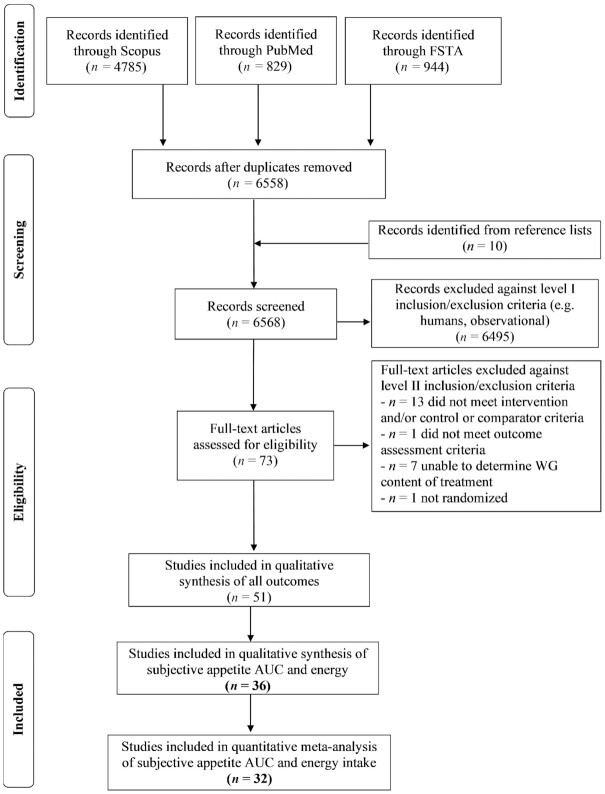
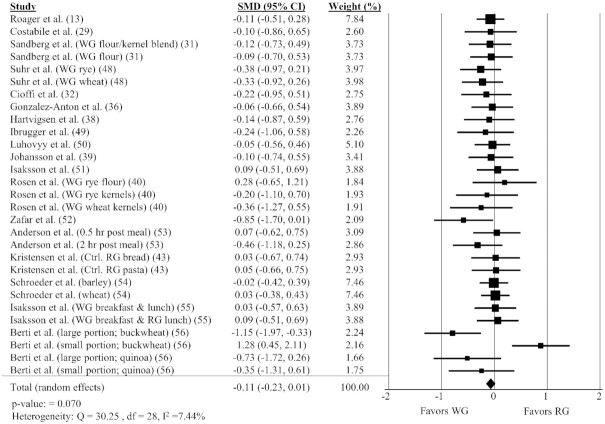
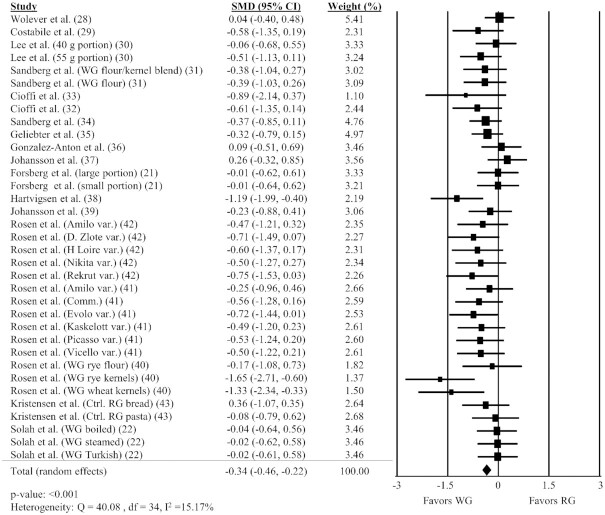
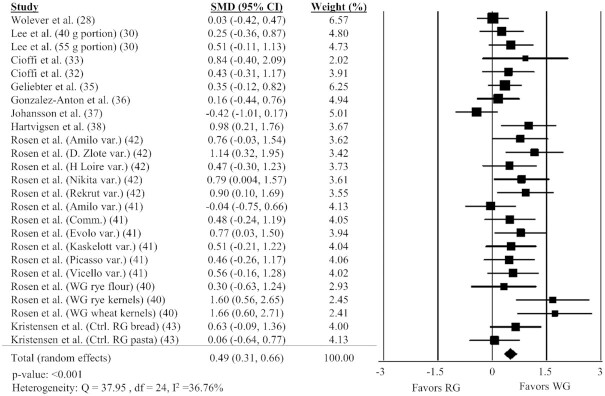
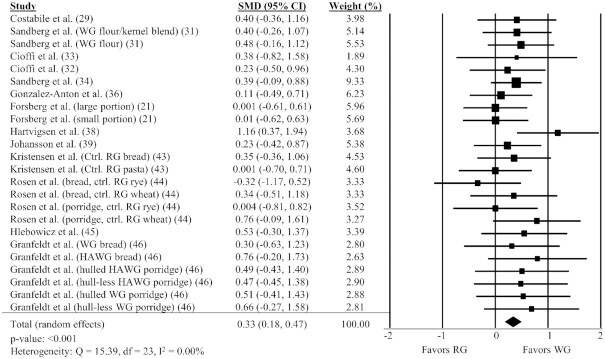
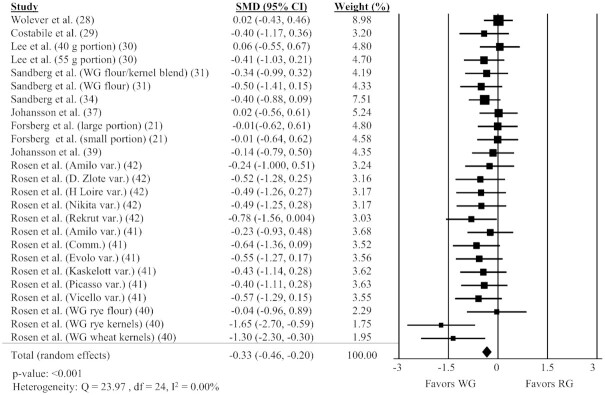
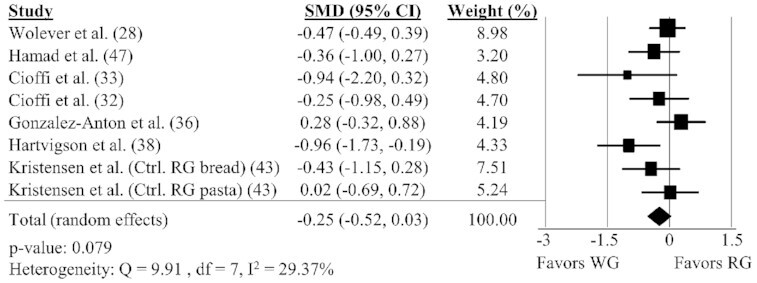
Results from observational studies indicate that whole grain (WG) intake is inversely associated with BMI and risk of weight gain. WG intake may influence energy balance and body composition through effects on appetite and energy intake. To evaluate the impact of WG food consumption on appetite and energy intake, a systematic review and meta-analysis was performed of results from randomized controlled trials (RCTs) assessing WG food consumption, appetite, and energy intake in adults. A search of PubMed, Scopus, and Food Science and Technology Abstracts yielded 36 RCTs measuring subjective appetite ratings after consuming WG foods compared with refined grain (RG) controls. Thirty-two of these studies reported AUCs for subjective appetite (hunger, fullness, satiety, desire to eat, or prospective consumption) and/or energy intake and were included in the meta-analysis. Pooled estimates from meta-analyses are expressed as standardized mean differences (SMDs). Compared with RG foods, intake of WG foods resulted in significant differences in AUCs for subjective hunger (SMD: -0.34; 95% CI: -0.46, -0.22; P < 0.001), fullness (SMD: 0.49; 95% CI: 0.31, 0.66; P < 0.001), satiety (SMD: 0.33; 95% CI: 0.18, 0.47; P < 0.001), and desire to eat (SMD: -0.33; 95% CI: -0.46, -0.20; P < 0.001). There were small, nonsignificant reductions in prospective consumption ratings (P = 0.08) and energy intake (P = 0.07) with WG intake compared with RG. These results support the view that consumption of WG foods, compared with RG foods, significantly impacts subjective appetite, and might partly explain the inverse associations between WG food intake and risk of overweight, obesity, and weight gain over time. PROSPERO registration: CRD42020148217.
观察性研究的结果表明,全谷物(WG)的摄入量与 BMI 和体重增加的风险呈负相关。WG 的摄入量可能通过对食欲和能量摄入的影响来影响能量平衡和身体成分。为了评估 WG 食物消费对食欲和能量摄入的影响,对评估 WG 食物消费、食欲和成年人能量摄入的随机对照试验(RCT)的结果进行了系统评价和荟萃分析。对 PubMed、Scopus 和食品科学与技术摘要进行了搜索,得出了 36 项 RCT,比较了 WG 食物与精制谷物(RG)对照后主观食欲评分的结果。其中 32 项研究报告了主观食欲(饥饿感、饱腹感、满足感、食欲或预期摄入量)和/或能量摄入的 AUC,并纳入了荟萃分析。荟萃分析的汇总估计值表示为标准化均数差(SMD)。与 RG 食物相比,WG 食物的摄入量在 AUC 方面存在显著差异,包括主观饥饿感(SMD:-0.34;95%CI:-0.46,-0.22;P<0.001)、饱腹感(SMD:0.49;95%CI:0.31,0.66;P<0.001)、满足感(SMD:0.33;95%CI:0.18,0.47;P<0.001)和食欲(SMD:-0.33;95%CI:-0.46,-0.20;P<0.001)。与 RG 相比,WG 摄入对预期摄入量评分(P=0.08)和能量摄入(P=0.07)有较小的、无统计学意义的降低。与 RG 食物相比,WG 食物的消耗显著影响主观食欲,这一结果支持这样一种观点,即与 RG 食物相比,WG 食物的消耗显著影响主观食欲,这可能部分解释了 WG 食物摄入与超重、肥胖和体重随时间增加的风险之间的反比关系。PROSPERO 注册:CRD42020148217。