Zoe Global Ltd, London, UK.
Department of Nutritional Sciences, King's College London, London, UK.
Nat Metab. 2021 Apr;3(4):523-529. doi: 10.1038/s42255-021-00383-x. Epub 2021 Apr 12.
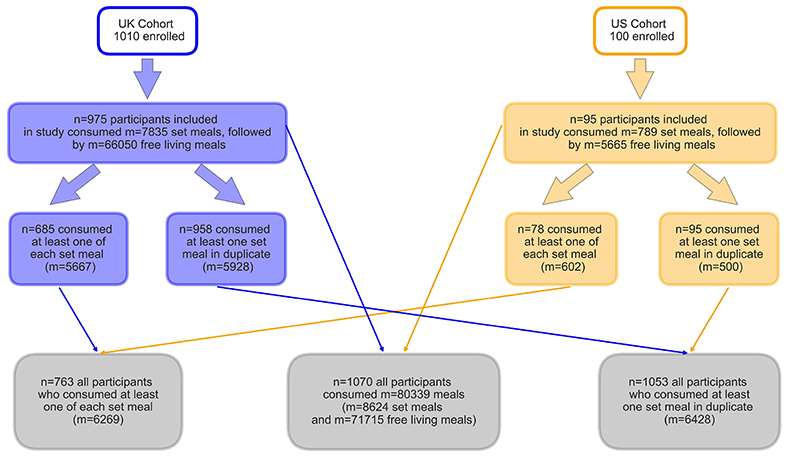
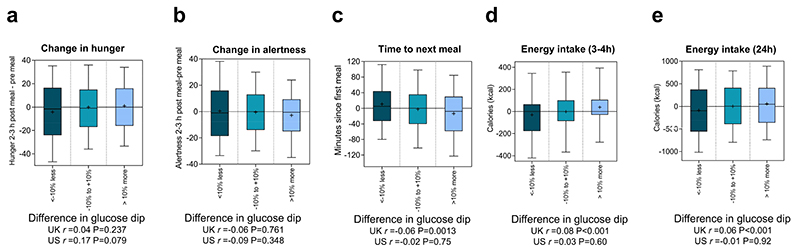
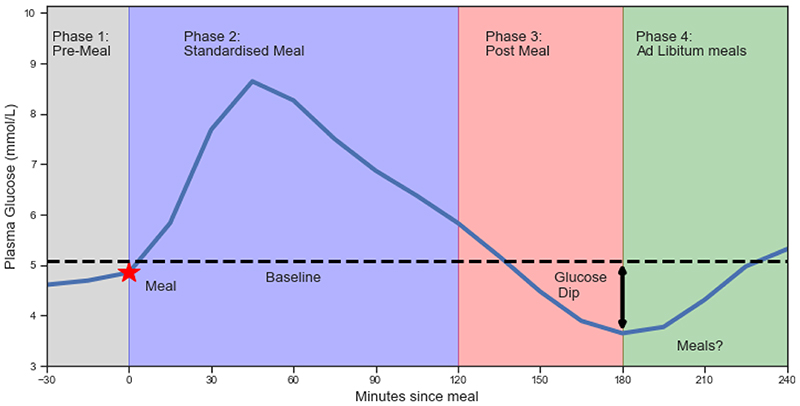
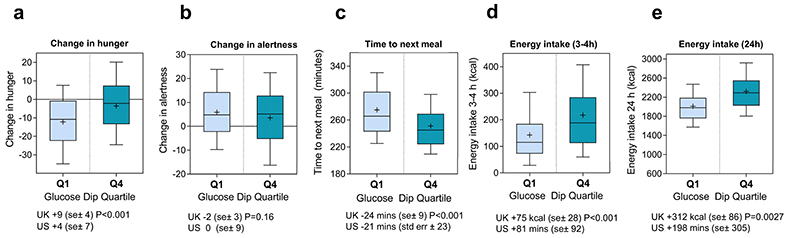
Understanding how to modulate appetite in humans is key to developing successful weight loss interventions. Here, we showed that postprandial glucose dips 2-3 h after a meal are a better predictor of postprandial self-reported hunger and subsequent energy intake than peak glucose at 0-2 h and glucose incremental area under the blood glucose curve at 0-2 h. We explore the links among postprandial glucose, appetite and subsequent energy intake in 1,070 participants from a UK exploratory and US validation cohort, who consumed 8,624 standardized meals followed by 71,715 ad libitum meals, using continuous glucose monitors to record postprandial glycaemia. For participants eating each of the standardized meals, the average postprandial glucose dip at 2-3 h relative to baseline level predicted an increase in hunger at 2-3 h (r = 0.16, P < 0.001), shorter time until next meal (r = -0.14, P < 0.001), greater energy intake at 3-4 h (r = 0.19, P < 0.001) and greater energy intake at 24 h (r = 0.27, P < 0.001). Results were directionally consistent in the US validation cohort. These data provide a quantitative assessment of the relevance of postprandial glycaemia in appetite and energy intake modulation.
了解如何调节人类的食欲是开发成功的减肥干预措施的关键。在这里,我们表明,餐后 2-3 小时的餐后葡萄糖下降是餐后自我报告饥饿感和随后能量摄入的更好预测指标,优于 0-2 小时的峰值葡萄糖和 0-2 小时的血糖曲线下葡萄糖增量面积。我们使用连续血糖监测仪记录餐后血糖,在来自英国探索性和美国验证队列的 1070 名参与者中探索了餐后葡萄糖、食欲和随后能量摄入之间的联系,这些参与者摄入了 8624 份标准化餐,随后摄入了 71715 份随意餐。对于摄入每份标准化餐的参与者,与基线水平相比,餐后 2-3 小时的平均餐后葡萄糖下降预测 2-3 小时的饥饿感增加(r=0.16,P<0.001),下一餐的时间间隔缩短(r=-0.14,P<0.001),3-4 小时的能量摄入增加(r=0.19,P<0.001)和 24 小时的能量摄入增加(r=0.27,P<0.001)。在美国验证队列中的结果方向一致。这些数据提供了对餐后血糖在食欲和能量摄入调节中的相关性的定量评估。