
通过金属有机化学气相沉积法合成的具有n型氮化镓纳米棒-石墨烯混合结构的紫外光电导器件。
Ultraviolet photoconductive devices with an n-GaN nanorod-graphene hybrid structure synthesized by metal-organic chemical vapor deposition.
作者信息
Kang San, Mandal Arjun, Chu Jae Hwan, Park Ji-Hyeon, Kwon Soon-Yong, Lee Cheul-Ro
机构信息
Semiconductor Materials Process Laboratory, School of Advanced Materials Engineering, Engineering College, Research Center for Advanced Materials Development (RCAMD), Chonbuk National University, Baekje-daero 567, Jeonju 561-756, Republic of Korea.
School of Materials Science and Engineering, Low Dimensional Carbon Materials Center, Ulsan National Institute of Science and Technology (UNIST), UNIST-gil 50, Ulsan 689-798, Republic of Korea.
出版信息
Sci Rep. 2015 Jun 1;5:10808. doi: 10.1038/srep10808.
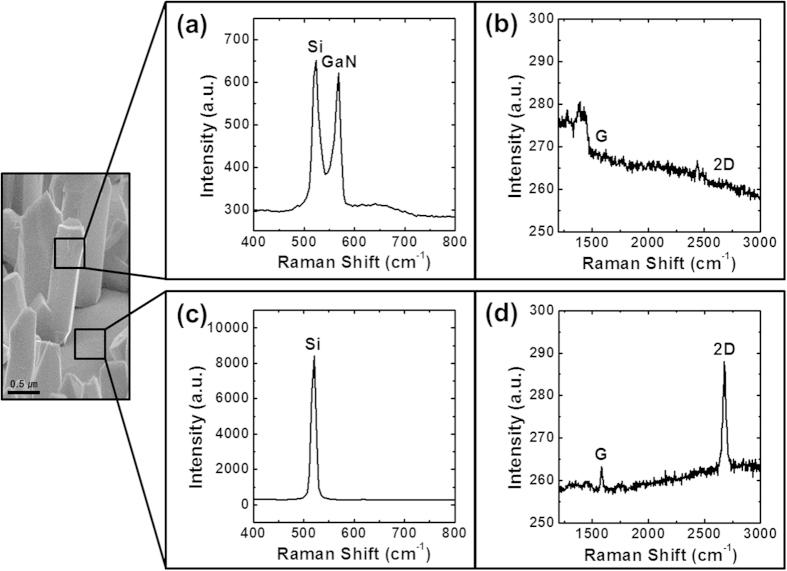
The superior photoconductive behavior of a simple, cost-effective n-GaN nanorod (NR)-graphene hybrid device structure is demonstrated for the first time. The proposed hybrid structure was synthesized on a Si (111) substrate using the high-quality graphene transfer method and the relatively low-temperature metal-organic chemical vapor deposition (MOCVD) process with a high V/III ratio to protect the graphene layer from thermal damage during the growth of n-GaN nanorods. Defect-free n-GaN NRs were grown on a highly ordered graphene monolayer on Si without forming any metal-catalyst or droplet seeds. The prominent existence of the undamaged monolayer graphene even after the growth of highly dense n-GaN NRs, as determined using Raman spectroscopy and high-resolution transmission electron microscopy (HR-TEM), facilitated the excellent transport of the generated charge carriers through the photoconductive channel. The highly matched n-GaN NR-graphene hybrid structure exhibited enhancement in the photocurrent along with increased sensitivity and photoresponsivity, which were attributed to the extremely low carrier trap density in the photoconductive channel.
首次展示了一种简单、经济高效的n型氮化镓纳米棒(NR)-石墨烯混合器件结构卓越的光电导性能。采用高质量石墨烯转移方法以及具有高V/III比的相对低温金属有机化学气相沉积(MOCVD)工艺,在硅(111)衬底上合成了所提出的混合结构,以保护石墨烯层在n型氮化镓纳米棒生长过程中免受热损伤。在硅上高度有序的石墨烯单层上生长出无缺陷的n型氮化镓纳米棒,且未形成任何金属催化剂或液滴晶种。如通过拉曼光谱和高分辨率透射电子显微镜(HR-TEM)所确定的,即使在生长高度密集的n型氮化镓纳米棒之后,未受损的单层石墨烯仍显著存在,这促进了所产生的电荷载流子通过光电导通道的优异传输。高度匹配的n型氮化镓纳米棒-石墨烯混合结构表现出光电流增强,同时灵敏度和光响应性提高,这归因于光电导通道中极低的载流子陷阱密度。



 Zotero 插件