Lee Myung-Hee, Lee Young-Chul, Kim Sung-Soo, Hong Hee-Do, Kim Kyung-Tack
Ginseng Research Center, Division of Industrial Research, Korea Food Research Institute, Gyeonggi, Korea.
J Ginseng Res. 2015 Apr;39(2):178-82. doi: 10.1016/j.jgr.2014.10.007. Epub 2014 Nov 24.
Fermentation technology is widely used to alter the effective components of ginseng. This study was carried out to analyze the characteristics and antioxidant activity of ginseng seeds fermented by Bacillus, Lactobacillus, and Pediococcus strains.
For ginseng seed fermentation, 1% of each strain was inoculated on sterilized ginseng seeds and then incubated at 30°C for 24 h in an incubator.
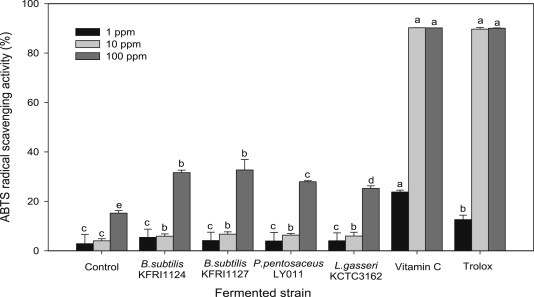
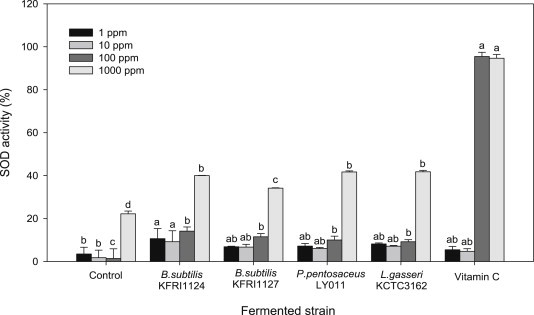
The total sugar content, acidic polysaccharides, and phenolic compounds, including p-coumaric acid, were higher in extracts of fermented ginseng seeds compared to a nonfermented control, and highest in extracts fermented with B. subtilis KFRI 1127. Fermentation led to higher antioxidant activity. The 2,2'-azine-bis-(3-ethylbenzothiazoline-6-sulfonic acid (ABTS) radical scavenging activity was higher in ginseng seeds fermented by Bacillus subtilis than by Lactobacillus and Pediococcus, but Superoxide dismutase (SOD) enzyme activity was higher in ginseng seeds fermented by Lactobacillus and Pediococcus.
Antioxidant activities measured by ABTS and SOD were higher in fermented ginseng seeds compared to nonfermented ginseng seeds. These results may contribute to improving the antioxidant activity and quality of ginseng subjected to fermentation treatments.
发酵技术被广泛用于改变人参的有效成分。本研究旨在分析经芽孢杆菌、乳酸菌和片球菌菌株发酵的人参种子的特性及抗氧化活性。
进行人参种子发酵时,将每种菌株的1%接种于灭菌后的人参种子上,然后在培养箱中于30°C孵育24小时。
与未发酵的对照相比,发酵人参种子提取物中的总糖含量、酸性多糖和酚类化合物(包括对香豆酸)更高,其中以枯草芽孢杆菌KFRI 1127发酵的提取物中含量最高。发酵导致更高的抗氧化活性。枯草芽孢杆菌发酵的人参种子的2,2'-联氮-双-(3-乙基苯并噻唑啉-6-磺酸)(ABTS)自由基清除活性高于乳酸菌和片球菌发酵的人参种子,但超氧化物歧化酶(SOD)酶活性在乳酸菌和片球菌发酵的人参种子中更高。
与未发酵的人参种子相比,发酵人参种子中通过ABTS和SOD测定的抗氧化活性更高。这些结果可能有助于提高经发酵处理的人参的抗氧化活性和品质。