Shield Kevin D, Rehm Jürgen
Centre for Addiction and Mental Health (CAMH), Toronto, Canada.
Institute of Medical Science, University of Toronto, Toronto, Canada.
BMC Res Notes. 2015 Jun 9;8:231. doi: 10.1186/s13104-015-1207-8.
Achieving health equity is a priority of the World Health Organization; however, there is a scant amount of literature on this topic. As the underlying influences that determine health loss caused by risk factors are age-dependent, the aim of this paper is to examine how the risk factor rankings for health loss differ by age.
Rankings were based on data obtained from the 2010 Global Burden of Disease study. Health loss (as measured by Disability Adjusted Life Years lost) by risk factor was estimated using Population-Attributable Fractions, years of life lost due to premature mortality, and years lived with disability, which were calculated for 187 countries, 20 age groups and both sexes. Uncertainties of the risk factor rankings were estimated using 1,000 simulations taken from posterior distributions
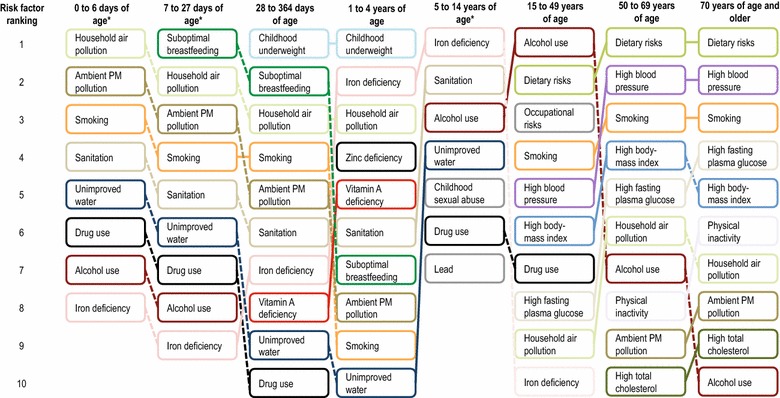
The top risk factors by age were: household air pollution for neonates 0-6 days of age [95% uncertainty interval (UI): 1 to 1]; suboptimal breast feeding for children 7-27 days of age (95% UI: 1-1); childhood underweight for children 28 days to less than 1 year of age and 1-4 years of age (95% UI: 1-2 and 1-1, respectively); iron deficiency for children and youth 5-14 years of age (95% UI: 1-1); alcohol use for people 15-49 years of age (95% UI: 1-2); and dietary risks for people 50 years of age and older (95% UI: 1-1). Rankings of risk factors varied by sex among the older age groups. Alcohol and smoking were the most important risk factors among men 15 years of age and older, and high body mass and intimate partner violence were some of the most important risk factors among women 15 years of age and older.
Our analyses confirm that the relative importance of risk factors is age-dependent. Therefore, preventing harms caused by various modifiable risk factors using interventions that target people of different ages should be a priority, especially since easily implemented and cost-effective public health interventions exist.
实现健康公平是世界卫生组织的一项优先任务;然而,关于这一主题的文献数量稀少。由于决定风险因素导致健康损失的潜在影响因素具有年龄依赖性,本文旨在研究健康损失的风险因素排名如何因年龄而异。
排名基于从2010年全球疾病负担研究中获得的数据。通过人群归因分数、过早死亡导致的寿命损失年数以及残疾生存年数来估计各风险因素导致的健康损失(以伤残调整生命年损失衡量),这些数据是针对187个国家、20个年龄组以及男女两性计算得出的。风险因素排名的不确定性通过从后验分布中抽取的1000次模拟来估计。
不同年龄的首要风险因素分别为:0 - 6天新生儿的家庭空气污染[95%不确定区间(UI):1至1];7 - 27天儿童的母乳喂养不足(95% UI:1 - 1);28天至不满1岁以及1 - 4岁儿童的儿童期体重不足(95% UI:分别为1 - 2和1 - 1);5 - 14岁儿童及青少年的缺铁(95% UI:1 - 1);15 - 49岁人群的饮酒(95% UI:1 - 2);以及50岁及以上人群的饮食风险(95% UI:1 - 1)。在年龄较大的年龄组中,风险因素排名因性别而异。酒精和吸烟是15岁及以上男性最重要的风险因素,而高体重和亲密伴侣暴力是15岁及以上女性最重要的一些风险因素。
我们的分析证实,风险因素的相对重要性具有年龄依赖性。因此,使用针对不同年龄人群的干预措施预防各种可改变风险因素造成的危害应成为优先事项,特别是因为存在易于实施且具有成本效益的公共卫生干预措施。