Suzuki Junko, Nishio Yohei, Kameo Yuki, Terada Yutaka, Kuwata Ryusei, Shimoda Hiroshi, Suzuki Kazuo, Maeda Ken
Laboratory of Veterinary Microbiology, Joint Faculty of Veterinary Medicine, Yamaguchi University, 1677-1 Yoshida, Yamaguchi 753-8515, Japan.
J Vet Med Sci. 2015 Nov;77(11):1457-63. doi: 10.1292/jvms.15-0237. Epub 2015 Jun 13.
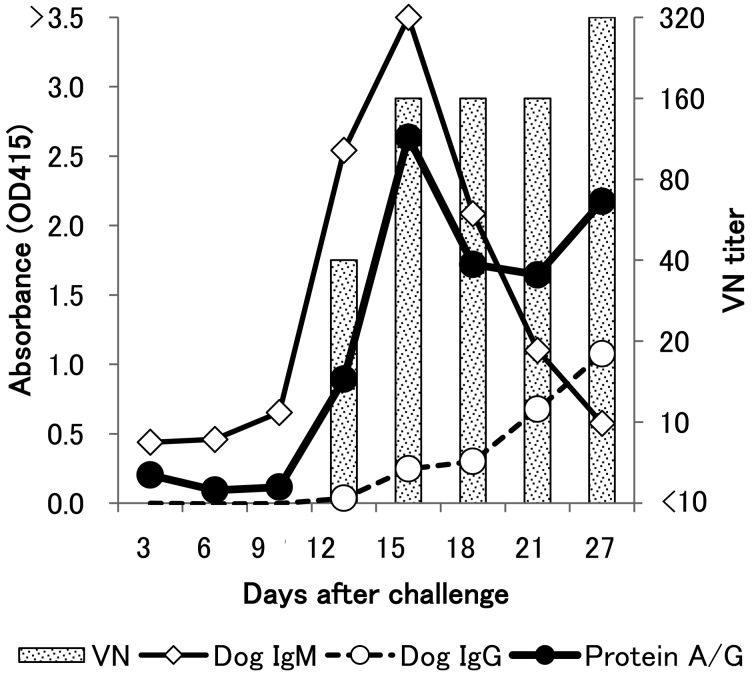
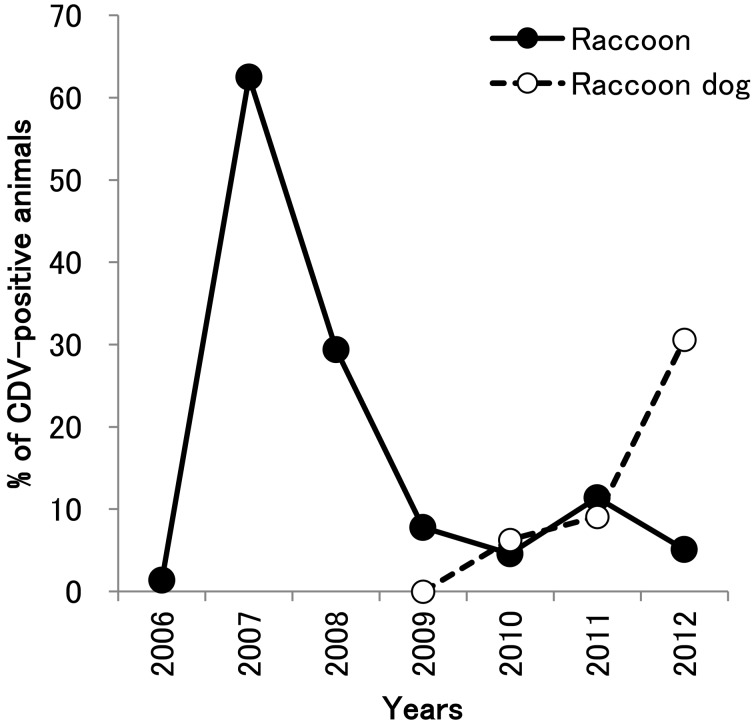
In 2007-2008, a canine distemper virus (CDV) epidemic occurred among wild animals in Wakayama Prefecture, Japan, and many mammals, including the wild boar and deer, were infected. In this study, CDV prevalence among wild animals was surveyed before and after the epidemic. At first, an enzyme-linked immunosorbent assay (ELISA) with horseradish peroxidase-conjugated protein A/G was established to detect CDV antibodies in many mammalian species. This established ELISA was available for testing dogs, raccoons and raccoon dogs as well as virus-neutralization test. Next, a serological survey of wild mammalians was conducted, and it was indicated that many wild mammalians, particularly raccoons, were infected with CDV during the epidemic, but few were infected before and after the epidemic. On the other hand, many raccoon dogs died during the epidemic, but CDV remained prevalent in the remaining population, and a small epidemic occurred in raccoon dogs in 2012-2013. These results indicated that the epidemic of 2007-2008 may have been intensified by transmission to raccoons.
2007年至2008年期间,日本和歌山县的野生动物中爆发了犬瘟热病毒(CDV)疫情,包括野猪和鹿在内的许多哺乳动物都受到了感染。在本研究中,对疫情前后野生动物中的CDV流行情况进行了调查。首先,建立了一种使用辣根过氧化物酶偶联蛋白A/G的酶联免疫吸附测定(ELISA)方法,以检测多种哺乳动物物种中的CDV抗体。这种建立好的ELISA方法可用于检测狗、浣熊和貉,也可用于病毒中和试验。接下来,对野生哺乳动物进行了血清学调查,结果表明,许多野生哺乳动物,特别是浣熊,在疫情期间感染了CDV,但在疫情前后感染的很少。另一方面,许多貉在疫情期间死亡,但CDV在剩余种群中仍然流行,并且在2012年至2013年期间,貉中发生了小规模疫情。这些结果表明,2007年至2008年的疫情可能因病毒传播至浣熊而加剧。