Azpurua Jorge, Eaton Benjamin A
Department of Physiology, University of Texas Health Science Center at San Antonio San Antonio, TX, USA.
Front Cell Neurosci. 2015 May 27;9:208. doi: 10.3389/fncel.2015.00208. eCollection 2015.
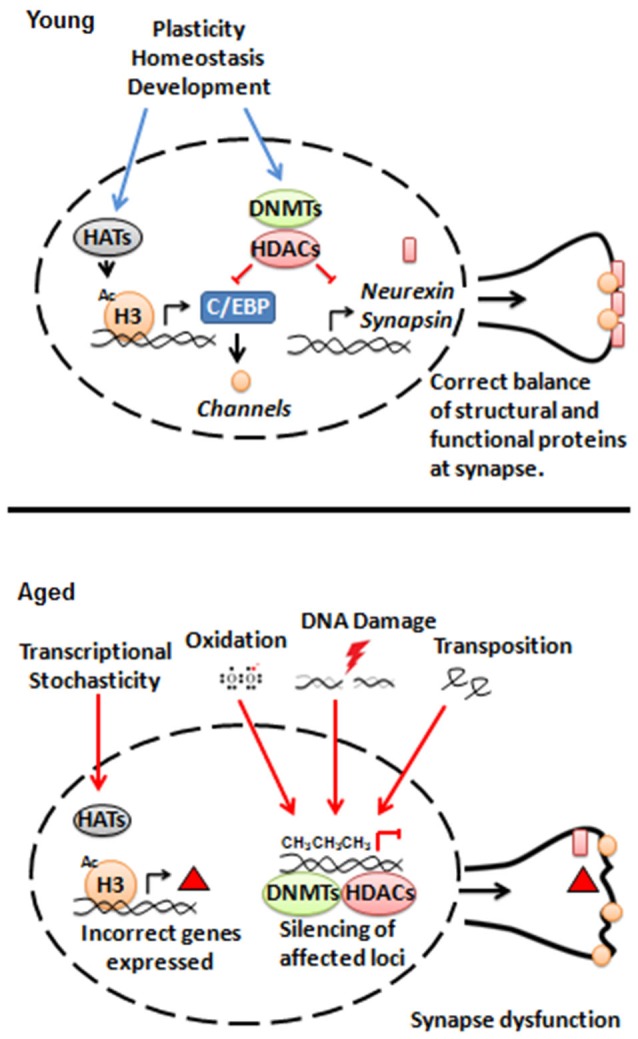
Two of the most salient phenotypes of aging are cognitive decline and loss of motor function, both of which are controlled by the nervous system. Cognition and muscle contraction require that neuronal synapses develop and maintain proper structure and function. We review the literature on how normal physiological aging disrupts central and peripheral synapse function including the degradation of structure and/or control of neurotransmission. Here we also attempt to connect the work done on the epigenetics of aging to the growing literature of how epigenetic mechanisms control synapse structure and function. Lastly, we address possible roles of epigenetic mechanisms to explain why the basal rates of age-related dysfunction vary so widely across individuals.
衰老最显著的两种表型是认知能力下降和运动功能丧失,这两者均由神经系统控制。认知和肌肉收缩要求神经元突触发育并维持适当的结构和功能。我们综述了关于正常生理衰老如何破坏中枢和外周突触功能的文献,包括结构退化和/或神经传递控制。在此,我们还试图将衰老表观遗传学方面的研究工作与关于表观遗传机制如何控制突触结构和功能的不断增加的文献联系起来。最后,我们探讨表观遗传机制可能发挥的作用,以解释为何与年龄相关的功能障碍基础发生率在个体间差异如此之大。