Yue Yaojing, Guo Tingting, Liu Jianbin, Guo Jian, Yuan Chao, Feng Ruilin, Niu Chune, Sun Xiaoping, Yang Bohui
Lanzhou Institute of Husbandry and Pharmaceutical Sciences, Chinese Academy of Agricultural Sciences, Jiangouyan Street, Lanzhou, China.
PLoS One. 2015 Jun 15;10(6):e0129249. doi: 10.1371/journal.pone.0129249. eCollection 2015.
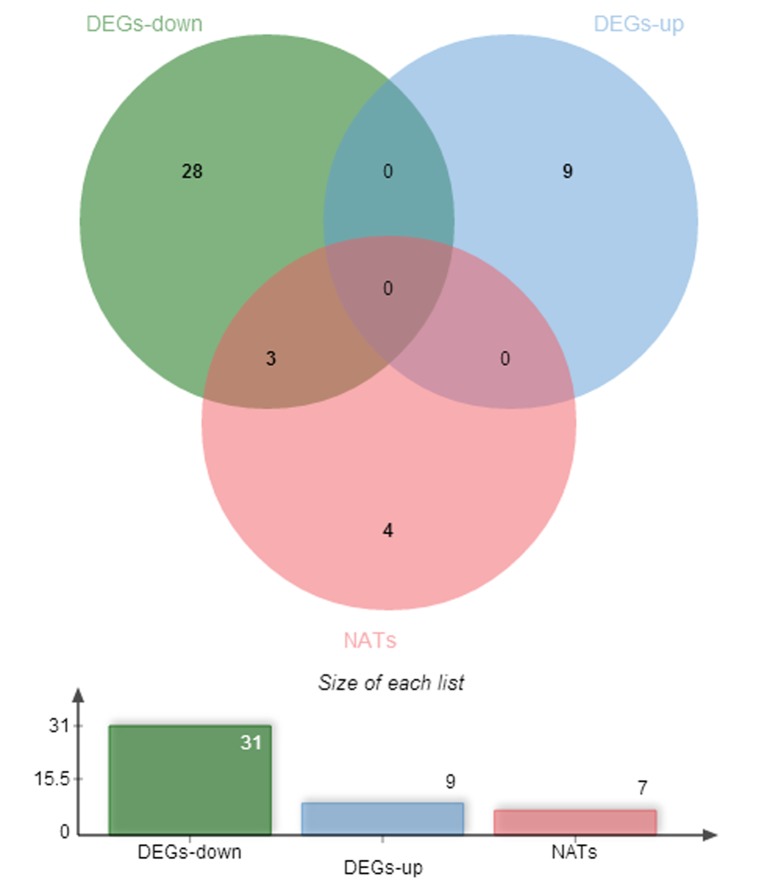
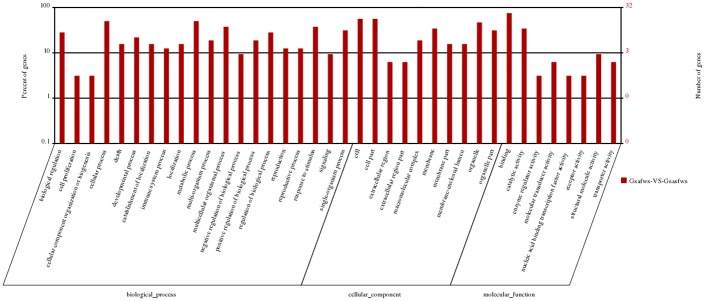
Wool fiber diameter (WFD) is the most important economic trait of wool. However, the genes specifically controlling WFD remain elusive. In this study, the expression profiles of skin from two groups of Gansu Alpine merino sheep with different WFD (a super-fine wool group [FD = 18.0 ± 0.5 μm, n=3] and a fine wool group [FD=23.0 ± 0.5 μm, n=3]) were analyzed using next-generation sequencing-based digital gene expression profiling. A total of 40 significant differentially expressed genes (DEGs) were detected, including 9 up-regulated genes and 31 down-regulated genes. Further expression profile analysis of natural antisense transcripts (NATs) showed that more than 30% of the genes presented in sheep skin expression profiles had NATs. A total of 7 NATs with significant differential expression were detected, and all were down-regulated. Among of 40 DEGs, 3 DEGs (AQP8, Bos d2, and SPRR) had significant NATs which were all significantly down-regulated in the super-fine wool group. In total of DEGs and NATs were summarized as 3 main GO categories and 38 subcategories. Among the molecular functions, cellular components and biological processes categories, binding, cell part and metabolic process were the most dominant subcategories, respectively. However, no significant enrichment of GO terms was found (corrected P-value >0.05). The pathways that were significantly enriched with significant DEGs and NATs were mainly the lipoic acid metabolism, bile secretion, salivary secretion and ribosome and phenylalanine metabolism pathways (P < 0.05). The results indicated that expression of NATs and gene transcripts were correlated, suggesting a role in gene regulation. The discovery of these DEGs and NATs could facilitate enhanced selection for super-fine wool sheep through gene-assisted selection or targeted gene manipulation in the future.
羊毛纤维直径(WFD)是羊毛最重要的经济性状。然而,具体控制WFD的基因仍不清楚。在本研究中,使用基于下一代测序的数字基因表达谱分析了两组不同WFD的甘肃高山细毛羊皮肤的表达谱(超细毛组[FD = 18.0±0.5μm,n = 3]和细毛组[FD = 23.0±0.5μm,n = 3])。共检测到40个显著差异表达基因(DEG),包括9个上调基因和31个下调基因。对天然反义转录本(NAT)的进一步表达谱分析表明,绵羊皮肤表达谱中超过30%的基因有NAT。共检测到7个具有显著差异表达的NAT,且均为下调。在40个DEG中,3个DEG(AQP8、Bos d2和SPRR)有显著的NAT,在超细毛组中均显著下调。DEG和NAT总共被归纳为3个主要的GO类别和38个子类别。在分子功能、细胞成分和生物学过程类别中,结合、细胞部分和代谢过程分别是最主要的子类别。然而,未发现GO术语有显著富集(校正P值>0.05)。显著DEG和NAT显著富集的途径主要是硫辛酸代谢、胆汁分泌、唾液分泌以及核糖体和苯丙氨酸代谢途径(P < 0.05)。结果表明NAT和基因转录本的表达相关,提示其在基因调控中起作用。这些DEG和NAT的发现可能有助于未来通过基因辅助选择或靶向基因操作加强对超细毛羊的选育。