Sokol Elena, Ulven Trond, Færgeman Nils J, Ejsing Christer S
Department of Biochemistry and Molecular Biology, VILLUM Center for Bioanalytical Sciences, University of Southern Denmark Odense, Denmark.
Department of Department of Physics Chemistry and Pharmacy, University of Southern Denmark Odense, Denmark.
Eur J Lipid Sci Technol. 2015 Jun;117(6):751-759. doi: 10.1002/ejlt.201400575. Epub 2015 Feb 24.
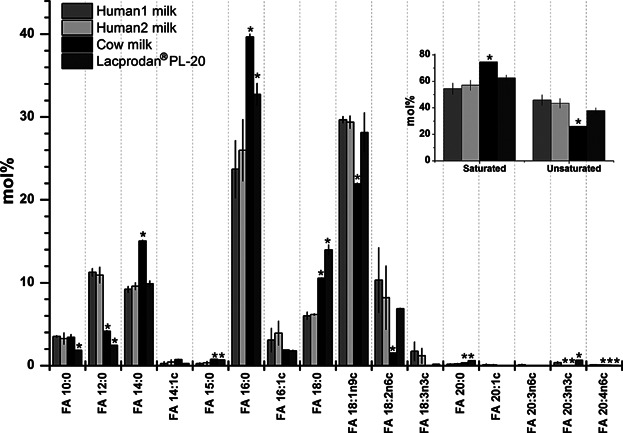
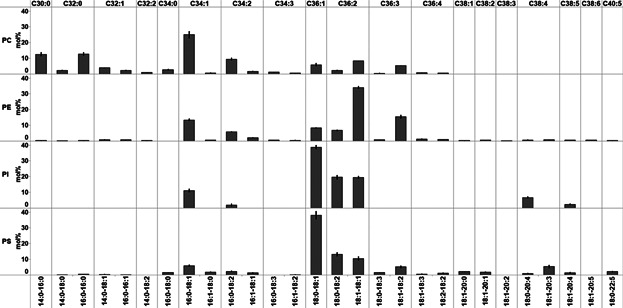
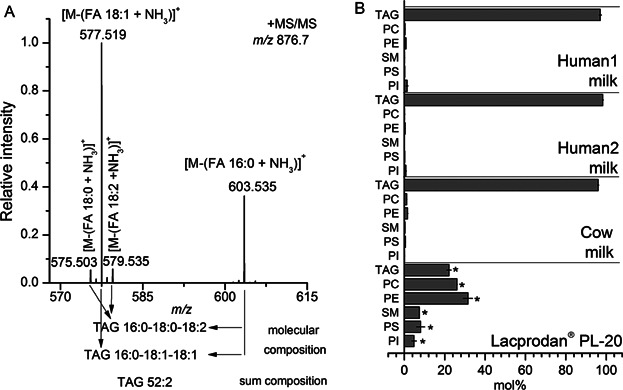
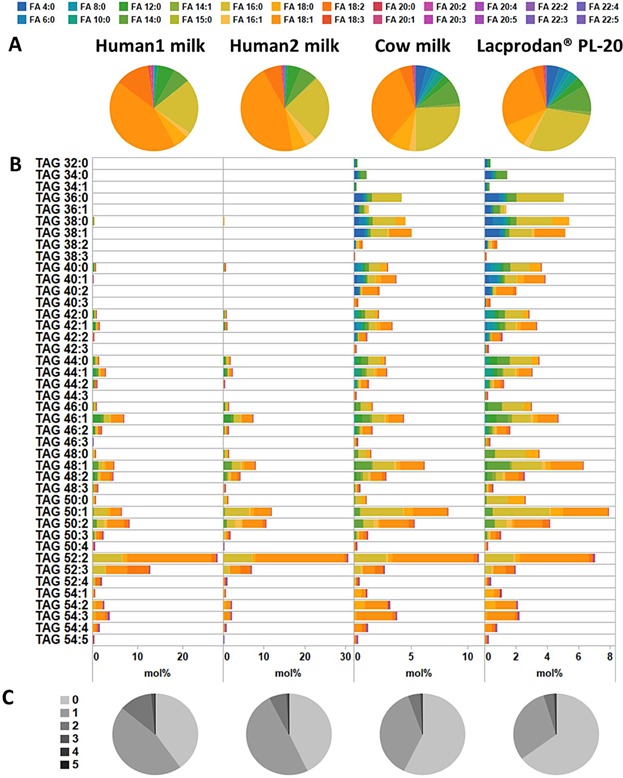
Here we present a workflow for in-depth analysis of milk lipids that combines gas chromatography (GC) for fatty acid (FA) profiling and a shotgun lipidomics routine termed MS/MS for structural characterization of molecular lipid species. To evaluate the performance of the workflow we performed a comparative lipid analysis of human milk, cow milk, and Lacprodan® PL-20, a phospholipid-enriched milk protein concentrate for infant formula. The GC analysis showed that human milk and Lacprodan have a similar FA profile with higher levels of unsaturated FAs as compared to cow milk. In-depth lipidomic analysis by MS/MS revealed that each type of milk sample comprised distinct composition of molecular lipid species. Lipid class composition showed that the human and cow milk contain a higher proportion of triacylglycerols (TAGs) as compared to Lacprodan. Notably, the MS/MS analysis demonstrated that the similar FA profile of human milk and Lacprodan determined by GC analysis is attributed to the composition of individual TAG species in human milk and glycerophospholipid species in Lacprodan. Moreover, the analysis of TAG molecules in Lacprodan and cow milk showed a high proportion of short-chain FAs that could not be monitored by GC analysis. The results presented here show that complementary GC and MS/MS analysis is a powerful approach for characterization of molecular lipid species in milk and milk products.
: Milk lipid analysis is routinely performed using gas chromatography. This method reports the total fatty acid composition of all milk lipids, but provides no structural or quantitative information about individual lipid molecules in milk or milk products. Here we present a workflow that integrates gas chromatography for fatty acid profiling and a shotgun lipidomics routine termed MS/MS for structural analysis and quantification of molecular lipid species. We demonstrate the efficacy of this complementary workflow by a comparative analysis of molecular lipid species in human milk, cow milk, and a milk-based supplement used for infant formula.
在此,我们展示了一种用于深入分析乳脂的工作流程,该流程结合了用于脂肪酸(FA)谱分析的气相色谱法(GC)和一种用于分子脂质种类结构表征的鸟枪法脂质组学方法,即串联质谱(MS/MS)。为了评估该工作流程的性能,我们对人乳、牛乳和Lacprodan® PL - 20(一种用于婴儿配方奶粉的富含磷脂的乳蛋白浓缩物)进行了脂质比较分析。GC分析表明,与人乳和Lacprodan相比,牛乳中不饱和脂肪酸含量较高,且人乳和Lacprodan具有相似的脂肪酸谱。通过MS/MS进行的深入脂质组学分析表明,每种类型的乳样都包含不同的分子脂质种类组成。脂质类别组成显示,与人乳和牛乳相比,Lacprodan中三酰甘油(TAGs)的比例更高。值得注意的是,MS/MS分析表明,GC分析确定的人乳和Lacprodan相似的脂肪酸谱归因于人乳中单个TAG种类的组成和Lacprodan中甘油磷脂种类的组成。此外,对Lacprodan和牛乳中TAG分子的分析表明,存在高比例的短链脂肪酸,而GC分析无法监测到这些短链脂肪酸。此处呈现的结果表明,互补的GC和MS/MS分析是表征乳及乳制品中分子脂质种类的有力方法。
乳脂分析通常使用气相色谱法进行。该方法报告了所有乳脂的总脂肪酸组成,但未提供有关乳或乳制品中单个脂质分子的结构或定量信息。在此,我们展示了一种工作流程,该流程整合了用于脂肪酸谱分析的气相色谱法和一种用于分子脂质种类结构分析与定量的鸟枪法脂质组学方法,即串联质谱(MS/MS)。我们通过对人乳、牛乳和一种用于婴儿配方奶粉的乳基补充剂中的分子脂质种类进行比较分析,证明了这种互补工作流程的有效性。