Loeb Gerald E, Tsianos George A
Department of Biomedical Engineering, University of Southern California Los Angeles, CA, USA.
L-3 Applied Technologies Inc., HEM Division San Diego, CA, USA.
Front Comput Neurosci. 2015 Jun 4;9:70. doi: 10.3389/fncom.2015.00070. eCollection 2015.
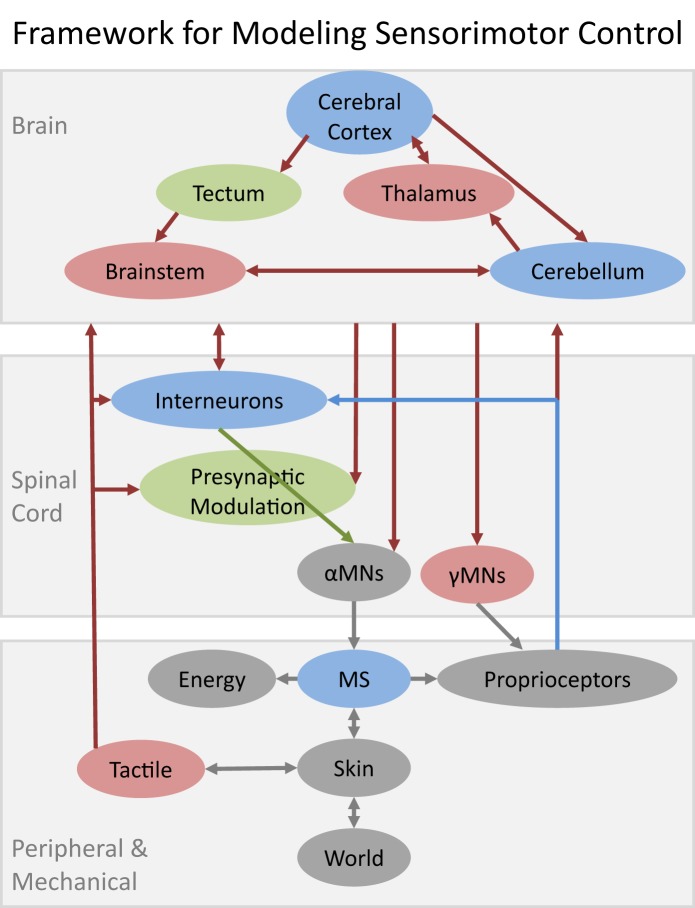
Experimental descriptions of the anatomy and physiology of individual components of sensorimotor systems have revealed substantial complexity, making it difficult to intuit how complete systems might work. This has led to increasing efforts to develop and employ mathematical models to study the emergent properties of such systems. Conversely, the development of such models tends to reveal shortcomings in the experimental database upon which models must be constructed and validated. In both cases models are most useful when they point up discrepancies between what we think we know and possibilities that we may have overlooked. This overview considers those components of complete sensorimotor systems that currently appear to be potentially important but poorly understood. These are generally omitted completely from modeled systems or buried in implicit assumptions that underlie the design of the model.
对感觉运动系统各个组成部分的解剖学和生理学进行的实验描述显示出极大的复杂性,这使得很难直观地理解完整的系统是如何运作的。这导致人们越来越努力地开发和运用数学模型来研究此类系统的涌现特性。相反,此类模型的开发往往会揭示构建和验证模型所依据的实验数据库中的不足之处。在这两种情况下,当模型指出我们自认为已知的内容与可能被忽视的可能性之间的差异时,模型最为有用。本综述考虑了完整感觉运动系统中目前看似潜在重要但却了解不足的那些组成部分。这些部分通常在建模系统中被完全忽略,或者被隐藏在模型设计所依据的隐含假设中。