Oliveira Arcolino Fanny, Tort Piella Agnès, Papadimitriou Elli, Bussolati Benedetta, Antonie Daniel J, Murray Patricia, van den Heuvel Lamberthus, Levtchenko Elena
Department of Development and Regeneration, Catholic University Leuven, Herestraat 49, 3000 Leuven, Belgium.
Institute of Translational Medicine, University of Liverpool, Crown Street, Liverpool L69 3BX, UK.
Stem Cells Int. 2015;2015:362562. doi: 10.1155/2015/362562. Epub 2015 May 18.
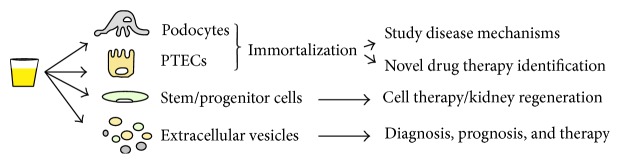
Urine represents an unlimited source of patient-specific kidney cells that can be harvested noninvasively. Urine derived podocytes and proximal tubule cells have been used to study disease mechanisms and to screen for novel drug therapies in a variety of human kidney disorders. The urinary kidney stem/progenitor cells and extracellular vesicles, instead, might be promising for therapeutic treatments of kidney injury. The greatest advantages of urine as a source of viable cells are the easy collection and less complicated ethical issues. However, extensive characterization and in vivo studies still have to be performed before the clinical use of urine-derived kidney progenitors.
尿液是患者特异性肾细胞的无限来源,可通过非侵入性方式获取。源自尿液的足细胞和近端肾小管细胞已被用于研究疾病机制,并在多种人类肾脏疾病中筛选新型药物疗法。相反,尿源性肾干/祖细胞和细胞外囊泡可能对肾损伤的治疗具有前景。尿液作为活细胞来源的最大优点是采集容易且伦理问题不那么复杂。然而,在尿源性肾祖细胞临床应用之前,仍需进行广泛的特性鉴定和体内研究。