Yang Ting-Ting, Lo Chen-Peng, Tsai Pei-Shan, Wu Shih-Ying, Wang Tzu-Feng, Chen Yun-Wen, Jiang-Shieh Ya-Fen, Kuo Yu-Min
School of Chinese Medicine for Post-Baccalaureate, I-Shou University, Kaohsiung, Taiwan.
Institute of Basic Medical Sciences, National Cheng Kung University, Tainan, Taiwan.
PLoS One. 2015 Jul 6;10(7):e0132152. doi: 10.1371/journal.pone.0132152. eCollection 2015.
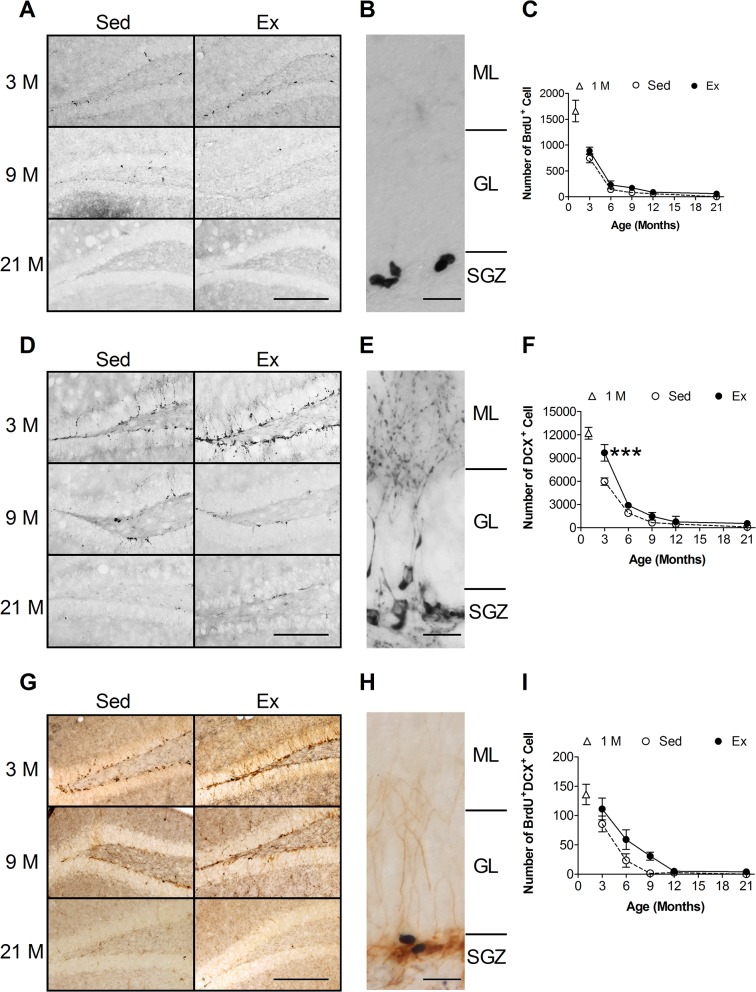
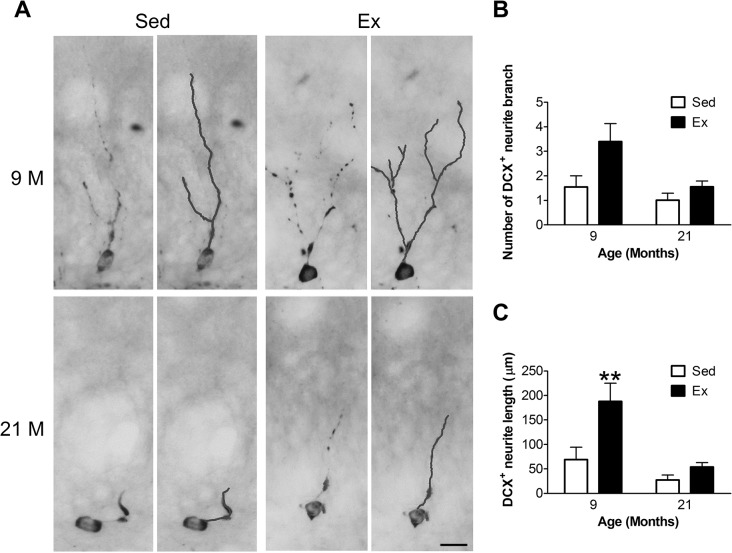
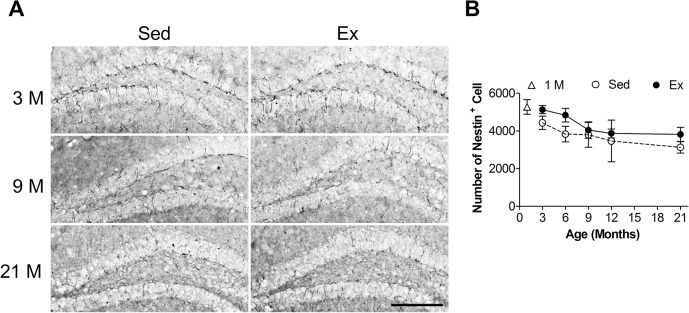
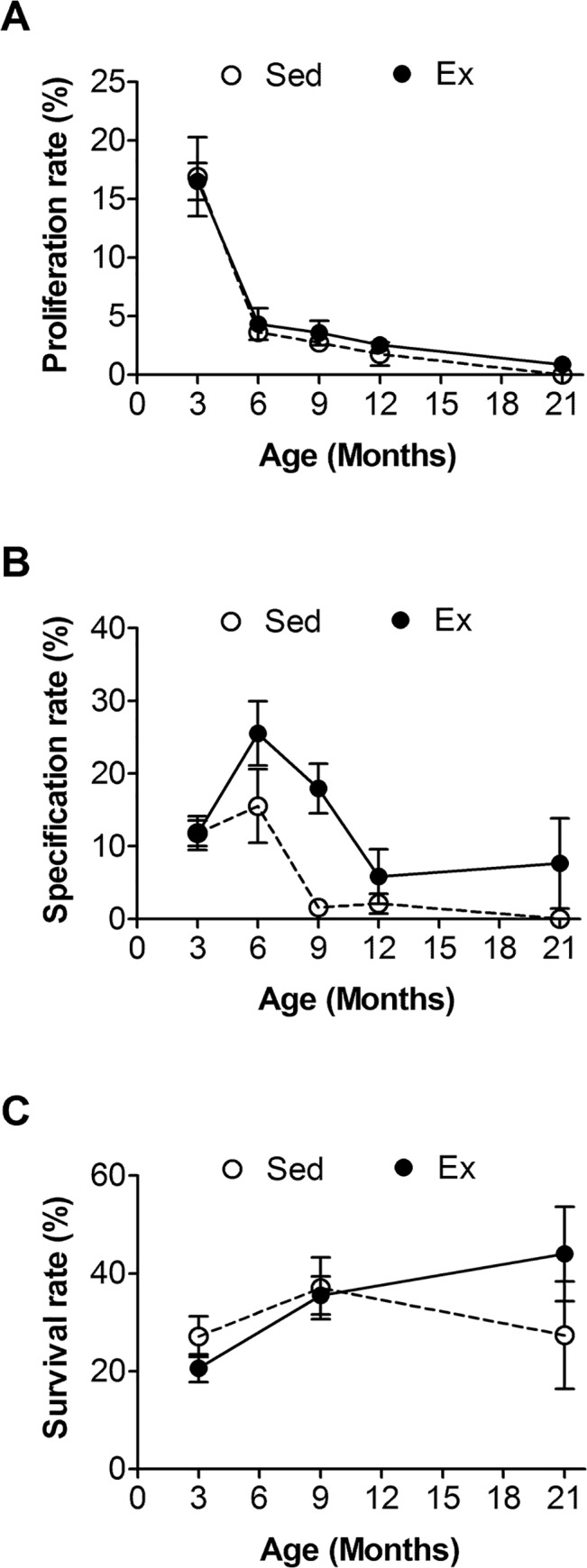
The rate of neurogenesis is determined by 1) the number of neural stem/progenitor cells (NSCs), 2) proliferation of NSCs, 3) neuron lineage specification, and 4) survival rate of the newborn neurons. Aging lowers the rate of hippocampal neurogenesis, while exercise (Ex) increases this rate. However, it remains unclear which of the determinants are affected by aging and Ex. We characterized the four determinants in different age groups (3, 6, 9, 12, 21 months) of mice that either received one month of Ex training or remained sedentary. Bromodeoxyuridine (BrdU) was injected two hours before sacrificing the mice to label the proliferating cells. The results showed that the number of newborn neurons massively decreased (>95%) by the time the mice reached nine months of age. The number of NSC was mildly reduced during aging, while Ex delayed such decline. The proliferation rates were greatly decreased by the time the mice were 9-month-old and Ex could not improve the rates. The rates of neuron specification were decreased during aging, while Ex increased the rates. The survival rate was not affected by age or Ex. Aging greatly reduced newborn neuron maturation, while Ex potently enhanced it. In conclusion, age-associated decline of hippocampal neurogenesis is mainly caused by reduction of NSC proliferation. Although Ex increases the NSC number and neuron specification rates, it doesn't restore the massive decline of NSC proliferation rate. Hence, the effect of Ex on the rate of hippocampal neurogenesis during aging is limited, but Ex does enhance the maturation of newborn neurons.
1)神经干细胞/祖细胞(NSCs)的数量;2)NSCs的增殖;3)神经元谱系特化;4)新生神经元的存活率。衰老会降低海马体神经发生的速率,而运动(Ex)则会提高这一速率。然而,目前尚不清楚衰老和运动分别影响了哪些决定因素。我们对接受了一个月运动训练或保持久坐的不同年龄组(3、6、9、12、21个月)的小鼠的这四个决定因素进行了表征。在处死小鼠前两小时注射溴脱氧尿苷(BrdU)以标记增殖细胞。结果显示,到小鼠9个月大时,新生神经元的数量大幅减少(>95%)。衰老过程中NSC的数量略有减少,而运动则延缓了这种减少。到小鼠9个月大时,增殖率大幅下降,运动无法提高该速率。衰老过程中神经元特化率下降,而运动则提高了该速率。存活率不受年龄或运动的影响。衰老极大地降低了新生神经元的成熟度,而运动则有力地增强了这一过程。总之,与年龄相关的海马体神经发生减少主要是由NSC增殖减少引起的。尽管运动增加了NSC数量和神经元特化率,但它并不能恢复NSC增殖率的大幅下降。因此,运动对衰老过程中海马体神经发生速率的影响是有限的,但运动确实增强了新生神经元的成熟度。