Tajaddod Mansoureh, Jantsch Michael F, Licht Konstantin
Department of Chromosome Biology, Max F. Perutz Laboratories, University of Vienna, Dr. Bohr Gasse 9/5, A-1030, Vienna, Austria.
Department of Cell Biology, Center of Cell Biology and Anatomy, Medical University of Vienna, Schwarzspanierstrasse 17, A-1090, Vienna, Austria.
Chromosoma. 2016 Mar;125(1):51-63. doi: 10.1007/s00412-015-0526-9. Epub 2015 Jul 7.
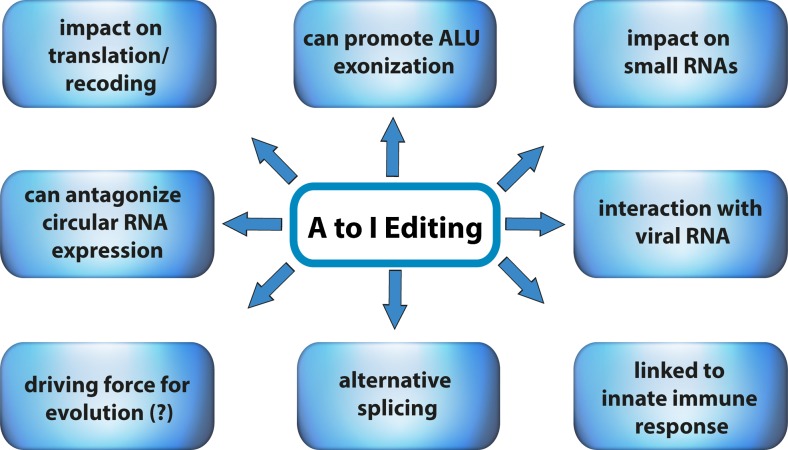
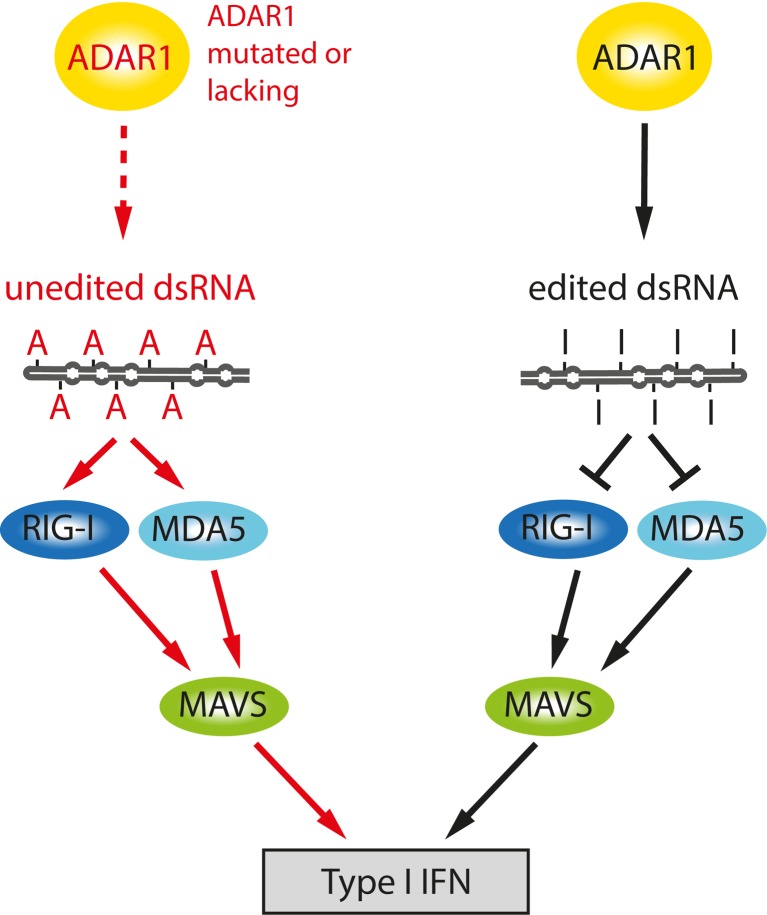
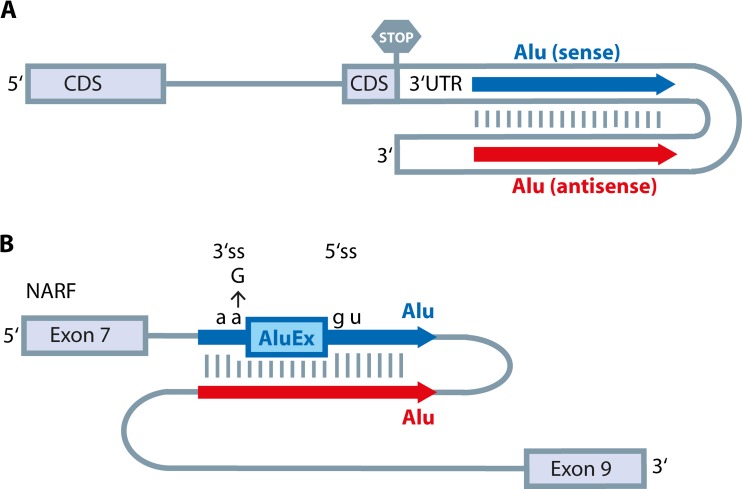
Adenosine to inosine editing (A to I editing) is a cotranscriptional process that contributes to transcriptome complexity by deamination of adenosines to inosines. Initially, the impact of A to I editing has been described for coding targets in the nervous system. Here, A to I editing leads to recoding and changes of single amino acids since inosine is normally interpreted as guanosine by cellular machines. However, more recently, new roles for A to I editing have emerged: Editing was shown to influence splicing and is found massively in Alu elements. Moreover, A to I editing is required to modulate innate immunity. We summarize the multiple ways in which A to I editing generates transcriptome variability and highlight recent findings in the field.
腺苷到肌苷的编辑(A到I编辑)是一个共转录过程,通过将腺苷脱氨基为肌苷来增加转录组的复杂性。最初,A到I编辑的影响已在神经系统的编码靶点中得到描述。在这里,A到I编辑导致单个氨基酸的重新编码和改变,因为肌苷通常被细胞机制解读为鸟苷。然而,最近,A到I编辑出现了新的作用:编辑被证明会影响剪接,并且在Alu元件中大量存在。此外,A到I编辑是调节先天免疫所必需的。我们总结了A到I编辑产生转录组变异性的多种方式,并强调了该领域的最新发现。