Hu Shi-Bin, Xiang Jian-Feng, Li Xiang, Xu Yefen, Xue Wei, Huang Min, Wong Catharine C, Sagum Cari A, Bedford Mark T, Yang Li, Cheng Donghang, Chen Ling-Ling
State Key Laboratory of Molecular Biology, Institute of Biochemistry and Cell Biology, Shanghai Institutes for Biological Sciences, Chinese Academy of Sciences, Shanghai 200031, China;
Key Laboratory of Computational Biology, Chinese Academy of Sciences (CAS)-German Max Planck Society (MPG) Partner Institute for Computational Biology, Shanghai Institutes for Biological Sciences, Chinese Academy of Sciences, Shanghai 200031, China;
Genes Dev. 2015 Mar 15;29(6):630-45. doi: 10.1101/gad.257048.114.
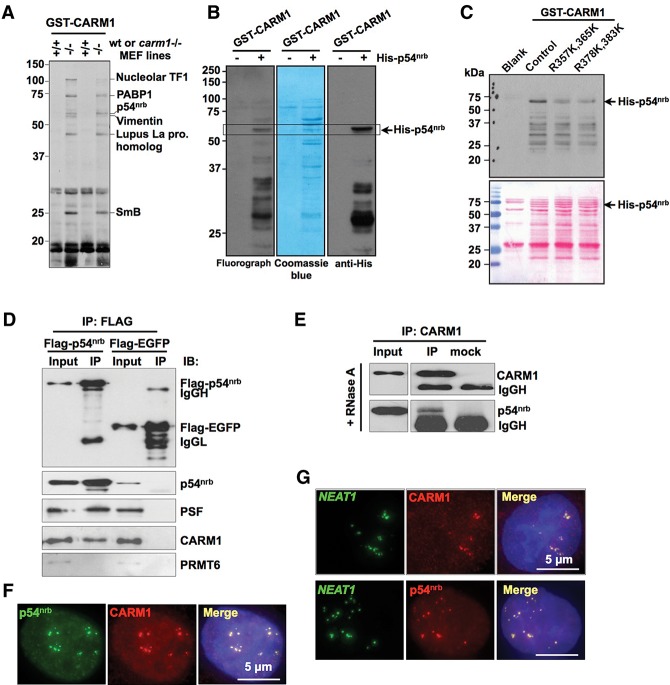
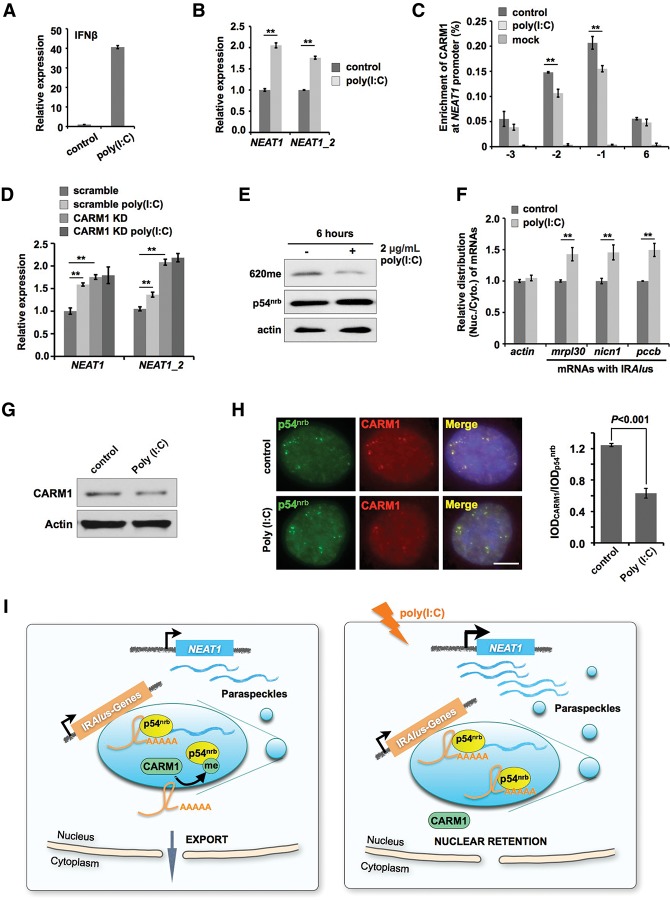
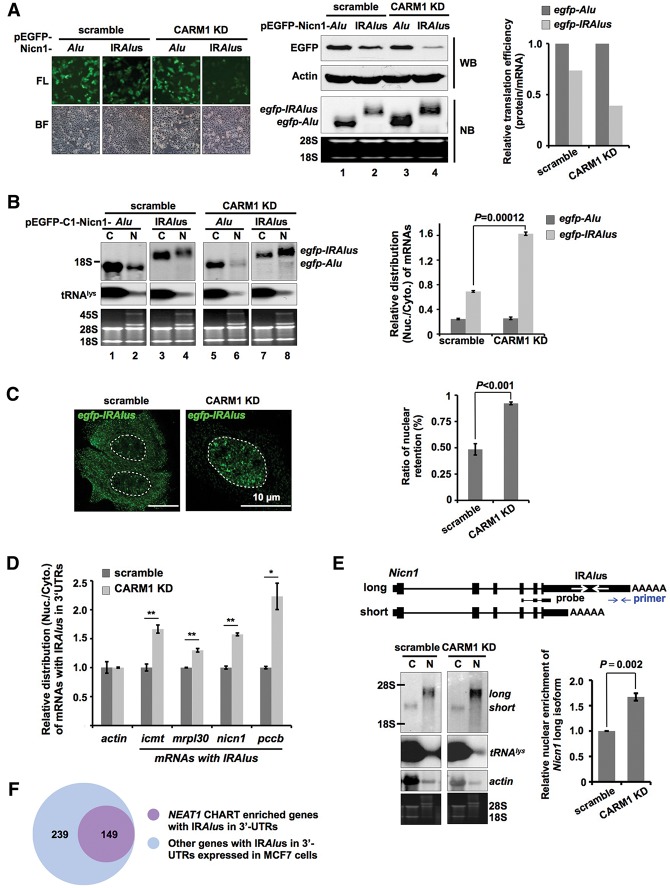
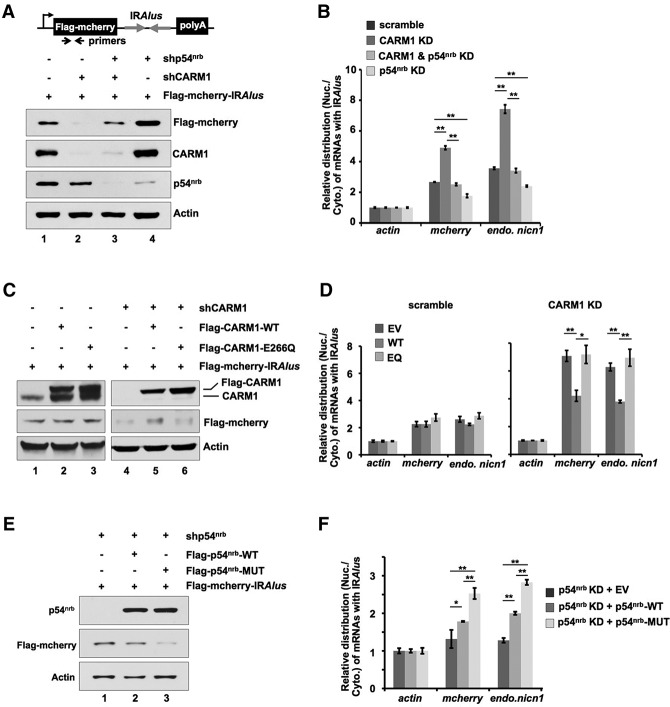
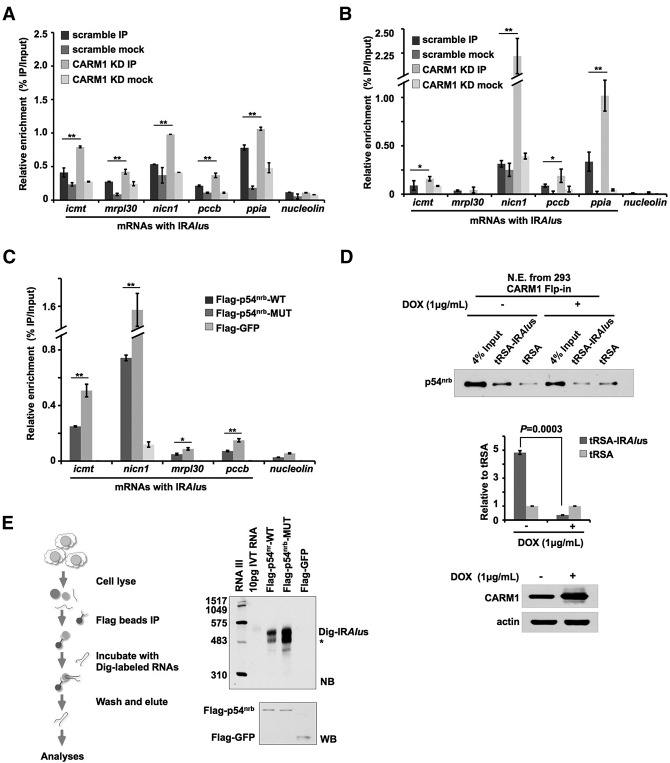
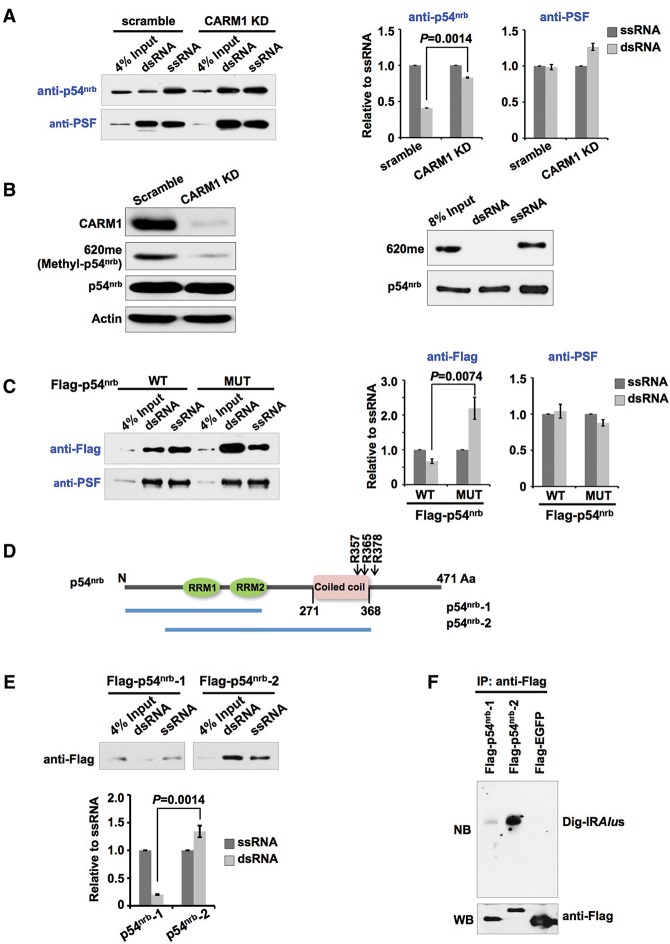
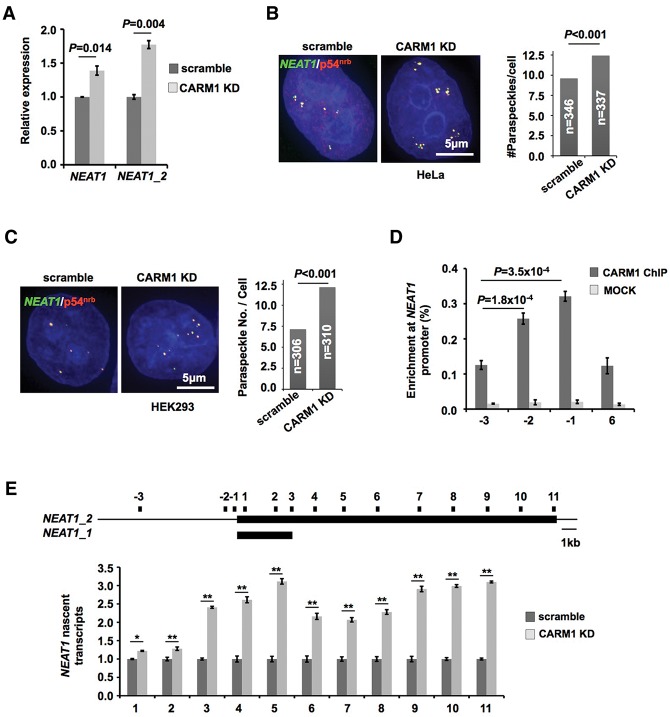
In many cells, mRNAs containing inverted repeated Alu elements (IRAlus) in their 3' untranslated regions (UTRs) are inefficiently exported to the cytoplasm. Such nuclear retention correlates with paraspeckle-associated protein complexes containing p54(nrb). However, nuclear retention of mRNAs containing IRAlus is variable, and how regulation of retention and export is achieved is poorly understood. Here we show one mechanism of such regulation via the arginine methyltransferase CARM1 (coactivator-associated arginine methyltransferase 1). We demonstrate that disruption of CARM1 enhances the nuclear retention of mRNAs containing IRAlus. CARM1 regulates this nuclear retention pathway at two levels: CARM1 methylates the coiled-coil domain of p54(nrb), resulting in reduced binding of p54(nrb) to mRNAs containing IRAlus, and also acts as a transcription regulator to suppress NEAT1 transcription, leading to reduced paraspeckle formation. These actions of CARM1 work together synergistically to regulate the export of transcripts containing IRAlus from paraspeckles under certain cellular stresses, such as poly(I:C) treatment. This work demonstrates how a post-translational modification of an RNA-binding protein affects protein-RNA interaction and also uncovers a mechanism of transcriptional regulation of the long noncoding RNA NEAT1.
在许多细胞中,3'非翻译区(UTR)含有反向重复Alu元件(IRAlus)的mRNA被低效转运至细胞质。这种核内滞留与包含p54(nrb)的副斑点相关蛋白复合物有关。然而,含有IRAlus的mRNA的核内滞留情况存在差异,且对滞留和转运的调控机制仍知之甚少。在此,我们展示了一种通过精氨酸甲基转移酶CARM1(共激活因子相关精氨酸甲基转移酶1)进行这种调控的机制。我们证明,CARM1的破坏会增强含有IRAlus的mRNA的核内滞留。CARM1在两个层面上调控这种核内滞留途径:CARM1使p54(nrb)的卷曲螺旋结构域甲基化,导致p54(nrb)与含有IRAlus的mRNA的结合减少,并且还作为转录调节因子抑制NEAT1转录,从而导致副斑点形成减少。在某些细胞应激条件下,如聚肌胞苷酸(poly(I:C))处理时,CARM1的这些作用协同发挥,共同调节含有IRAlus的转录本从副斑点的转运。这项研究展示了RNA结合蛋白的翻译后修饰如何影响蛋白质-RNA相互作用,同时也揭示了长链非编码RNA NEAT1的转录调控机制。